

How can we help?
Let's Talk
How can we help?
Let's Talk
Choosing an enterprise data governance provider is about more than finding a company that can create policies or recommend a governance framework.
For organizations with complex data environments, governance affects data ownership, quality, access, metadata, lineage, accountability, analytics, and AI initiatives. The right provider needs to understand how these areas connect to the way your organization actually works.
A provider may have a strong methodology but limited implementation experience. Another may offer sophisticated governance technology without helping business teams establish clear ownership and accountability.
So, how should you choose the right data governance provider?
The best approach is to evaluate the provider’s experience, methodology, implementation capabilities, technical understanding, and ability to create a governance model that your organization can maintain over time.
Start With the Governance Problem
Before comparing providers, be clear about why your organization needs data governance.
You may be dealing with inconsistent data definitions, unclear ownership, poor data quality, access-control challenges, limited metadata, or difficulty tracing data across systems.
These problems are connected, but they may require different priorities.
A good provider should begin by understanding your current situation rather than immediately recommending a standard framework.
Ask how they would assess your governance maturity, identify gaps, and determine which areas should be addressed first.
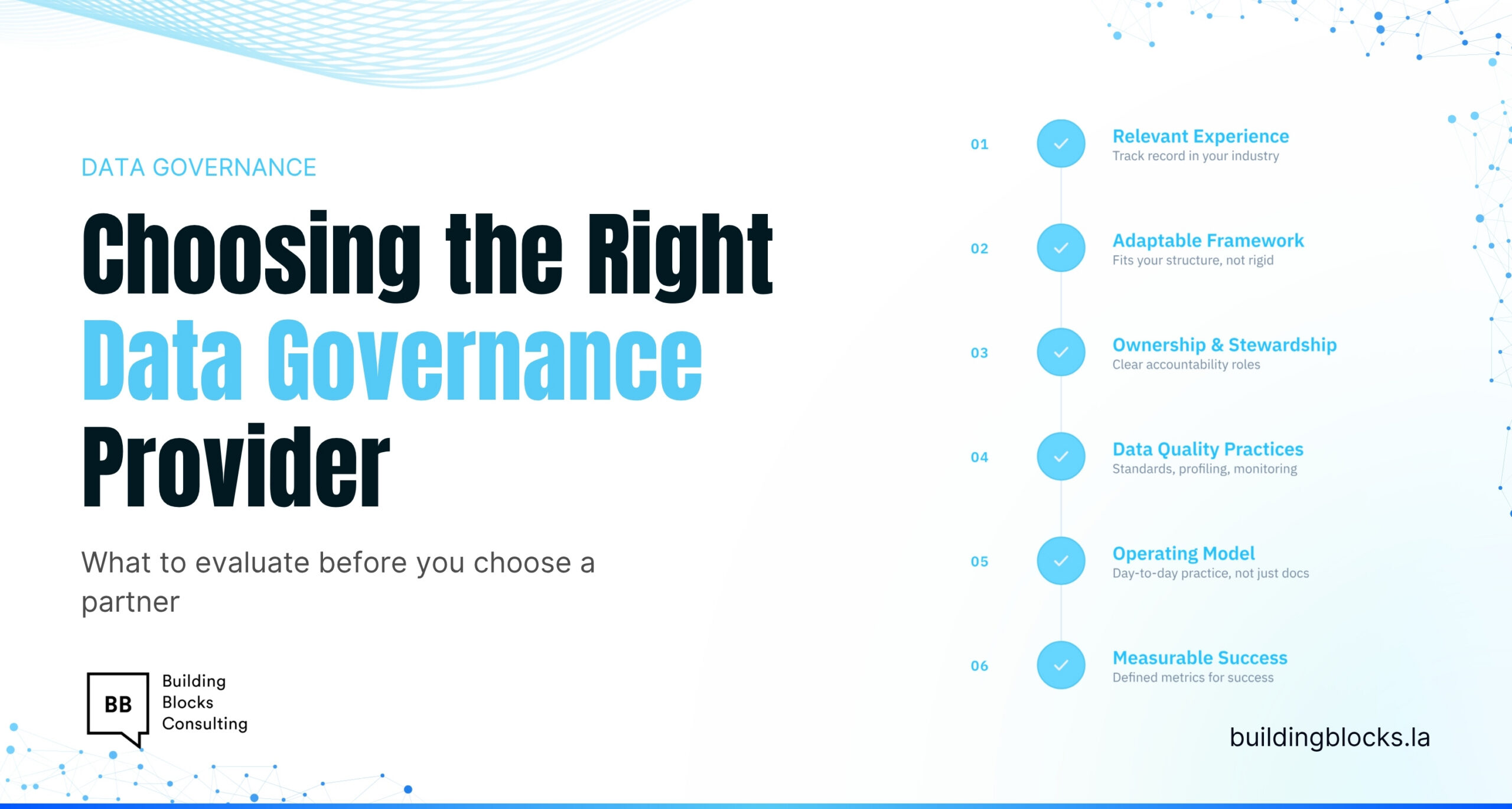
Look for Relevant Enterprise Experience
Enterprise data governance can involve multiple departments, business units, applications, data domains, and technology environments.
The provider should understand how governance responsibilities work across both business and technical teams.
Rather than simply asking whether a provider has worked on data governance before, look for evidence that it has addressed challenges similar to yours.
Relevant experience may include:
- Complex or distributed data environments
- Multiple business units
- Regulated or sensitive data
- Data quality initiatives
- Enterprise metadata and lineage
- Governance operating models
The goal is to find experience that matches your organization’s complexity, not simply a long list of previous projects.
Evaluate the Governance Framework
A capable provider should have a clear approach to developing a data governance framework.
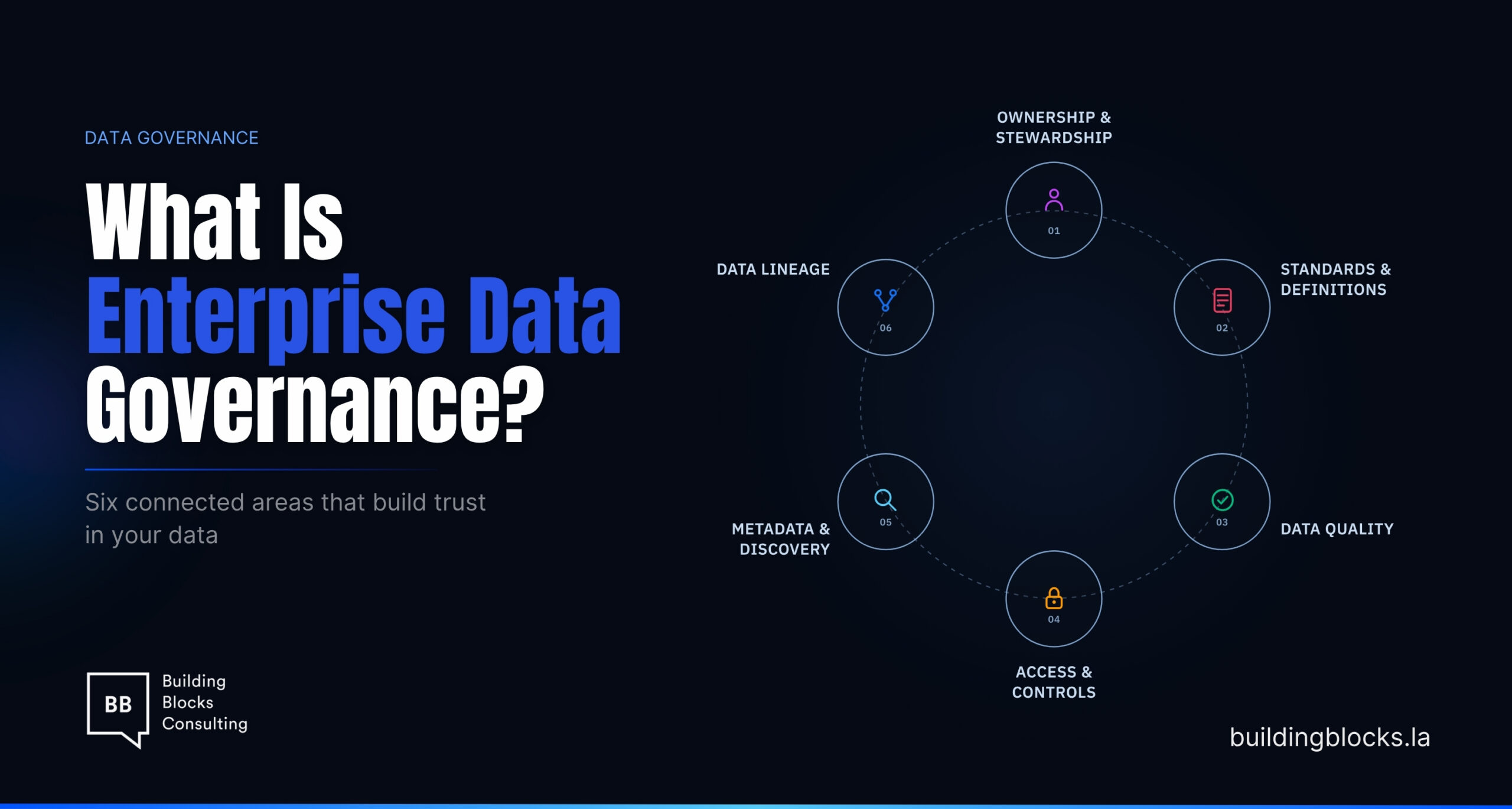
This may include ownership, stewardship, policies, standards, decision-making, data quality, access, metadata, lineage, and escalation processes.
However, the framework should be adaptable.
A governance model for a global financial organization may look very different from one designed for a growing technology company. The provider should be able to explain what its framework includes and how it adapts to your organization’s industry, structure, data environment, and governance maturity.
Examine Ownership and Stewardship Capabilities
Clear accountability is one of the foundations of effective governance.
A provider should be able to help establish who owns important data and who is responsible for its day-to-day stewardship.
This means going beyond assigning titles.
Data owners and stewards need to understand what decisions they are responsible for, how data-quality issues are handled, how definitions are maintained, and how governance decisions are escalated.
If a provider cannot explain how these responsibilities will work in practice, the resulting governance framework may remain largely theoretical.
Assess Data Quality Capabilities
Data governance and data quality are closely connected.
A provider should understand how to establish quality expectations for critical data, define responsibilities, and create processes for identifying and resolving issues.
Ask how the provider approaches critical data elements, quality standards, monitoring, issue management, and ownership.
Technology can help identify data-quality problems, but it does not determine who is responsible for fixing them.
That is where governance becomes important.
Consider Access, Metadata, and Lineage
Modern organizations need governance across more than databases.
Important data may exist in cloud platforms, data warehouses, business applications, analytics environments, APIs, and other systems.
A provider should understand how data access governance, metadata, and lineage fit into the broader governance model.
For example, your organization should be able to answer questions such as:
Who owns this dataset?
Who is allowed to access it?
What does this data actually mean?
Where did it come from?
Which systems or reports depend on it?
How does the data move through the organization?
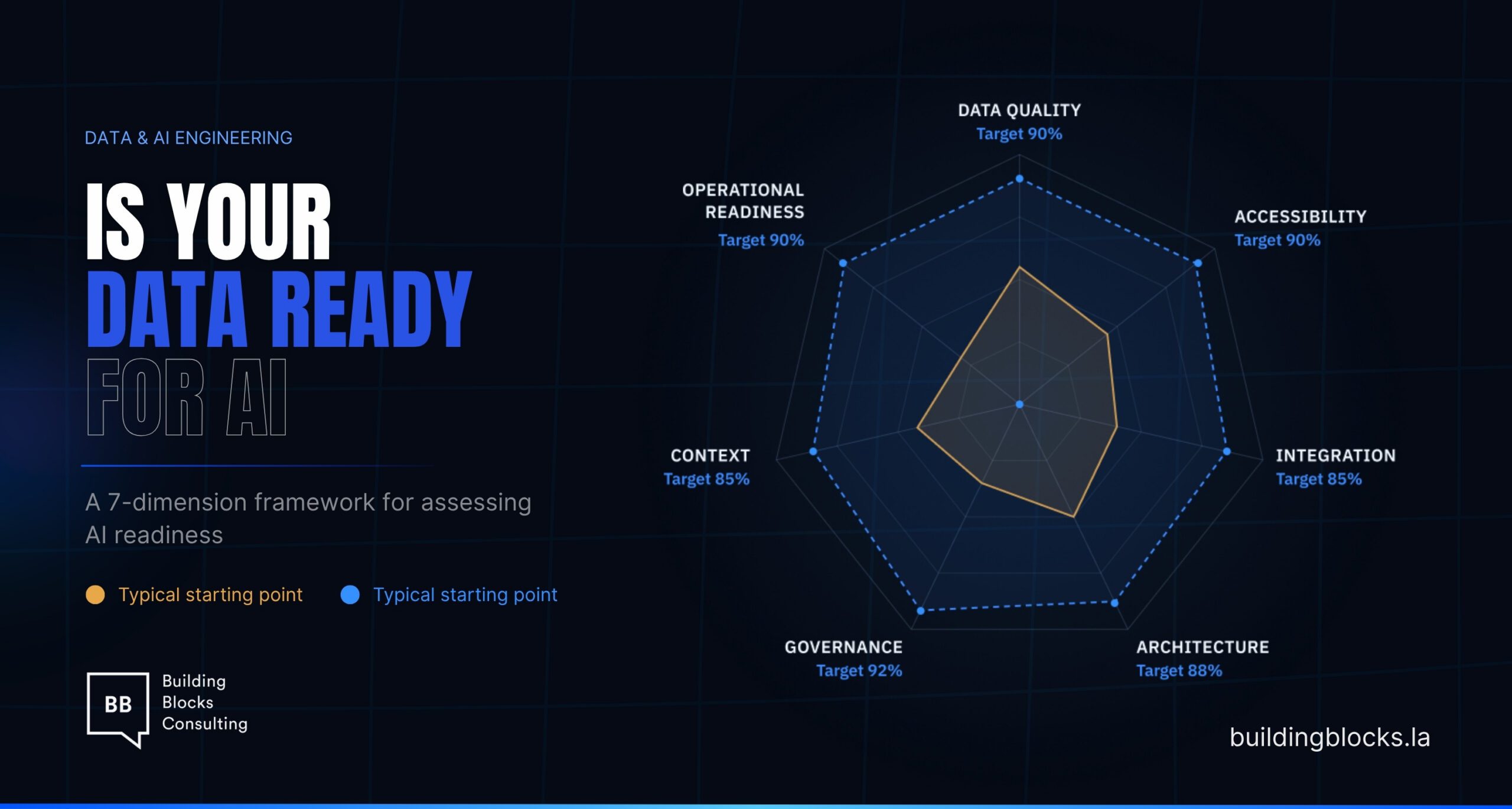
These capabilities become particularly valuable as organizations expand analytics and AI initiatives.
Look for an Operating Model, Not Just Documentation
A governance framework explains how governance should work.
An operating model explains how people will actually operate it.
This can include governance roles, decision-making responsibilities, escalation processes, stewardship activities, review procedures, and ongoing maintenance.
Ask the provider what happens after the initial framework is created. Who maintains the framework?
Who makes governance decisions? How are new data assets brought under governance? How are disagreements resolved?
The answers can reveal whether the provider is focused on sustainable governance rather than simply delivering documentation.
Evaluate Implementation Experience
Governance changes how people and teams work, so implementation experience matters.
A provider should be able to explain how it moves from assessment and strategy into practical implementation.
Depending on the organization’s needs, this could involve assessing the current environment, prioritizing critical data, defining ownership, establishing policies, implementing governance processes, and measuring progress.
The exact approach should be tailored to the organization’s maturity and priorities.
Don't Choose Based on Technology Alone
Data catalogs, lineage platforms, quality tools, and access-management technologies can all support governance.
But technology cannot decide who owns a customer data domain or what a particular business term should mean.
Those are organizational decisions.
Technology should support the governance model rather than define it.
Before selecting a provider or governance platform, make sure the organization understands what problems it needs to solve and what capabilities are actually required.
Ask How Success Will Be Measured
A provider should be able to explain how governance success will be evaluated.
Useful measures might include clearer ownership of critical data, improved quality of important datasets, better visibility into lineage, stronger access accountability, or greater consistency in business definitions.
The important thing is to connect governance activities to meaningful business and operational improvements.
Consider the People Behind the Provider
The consulting team matters just as much as the methodology.
Data governance sits between business and technology, so the provider needs to communicate effectively with business leaders, data teams, security teams, and technical stakeholders.
During the evaluation process, pay attention to whether the team asks thoughtful questions about your organization or immediately presents a predefined solution.
A strong provider should be able to understand both the business problem and the technical environment.
Questions to Ask a Data Governance Provider
Before selecting a provider, consider asking:
- How do you assess governance maturity?
- How do you define data ownership and stewardship?
- How do you approach data quality?
- How do you handle metadata and data lineage?
- How do you address sensitive data and access governance?
- How do you move from a framework into implementation?
- How do you adapt governance to different industries and organizational structures?
- How do you support governance for analytics and AI?
- What happens after the initial governance program is implemented?
The answers can help you distinguish between a provider that offers a generic framework and one that can build a practical governance model around your organization.
Choosing the Right Data Governance Provider
There is no single best enterprise data governance provider for every organization.
The right choice depends on your data environment, business priorities, governance maturity, industry requirements, technology landscape, and the level of implementation support you need.
Look for a provider that can connect data ownership, stewardship, quality, access, metadata, lineage, policies, and accountability into a governance approach that your organization can actually operate.
The objective is not to create the most complicated governance framework.
It is to create a practical system that helps your organization manage and use data with greater clarity and accountability.
How BuildingBlocks Can Help
BuildingBlocks Consulting provides Data Governance Services to help organizations assess governance maturity, establish ownership and stewardship, improve data quality practices, define standards, strengthen access governance, and operationalize governance across their data environment.
The approach can be adapted to an organization’s existing data environment, business priorities, technology landscape, and governance maturity.
For organizations evaluating their governance capabilities, the first step is often understanding the current environment and identifying the areas where stronger governance can provide the greatest value.
Make Data Governance Practical
Choosing a data governance provider is ultimately about finding a partner that can turn governance principles into practical processes.
The strongest provider is not necessarily the one with the most tools or the most complicated framework. It is the one that understands your environment, identifies the governance issues that matter most, establishes clear accountability, and helps your teams make governance part of everyday operations.
For organizations preparing for larger data, analytics, or AI initiatives, that practical foundation can make governance more useful, sustainable, and easier to scale.




By Chris Clifford
Chris Clifford was born and raised in San Diego, CA and studied at Loyola Marymount University with a major in Entrepreneurship, International Business and Business Law. Chris founded his first venture-backed technology startup over a decade ago and has gone on to co-found, advise and angel invest in a number of venture-backed software businesses. Chris is the CSO of Building Blocks where he works with clients across various sectors to develop and refine digital and technology strategy.