


How can we help?
Let's Talk
How can we help?
Let's Talk
Choosing the right managed data and AI services provider requires more than comparing service lists and pricing. The right partner should have the technical expertise, operational processes, security practices, and support model needed to keep your data and AI environment reliable as it evolves.
A good provider should be able to work with your existing systems, respond to operational issues, support integrations, and help improve performance over time.
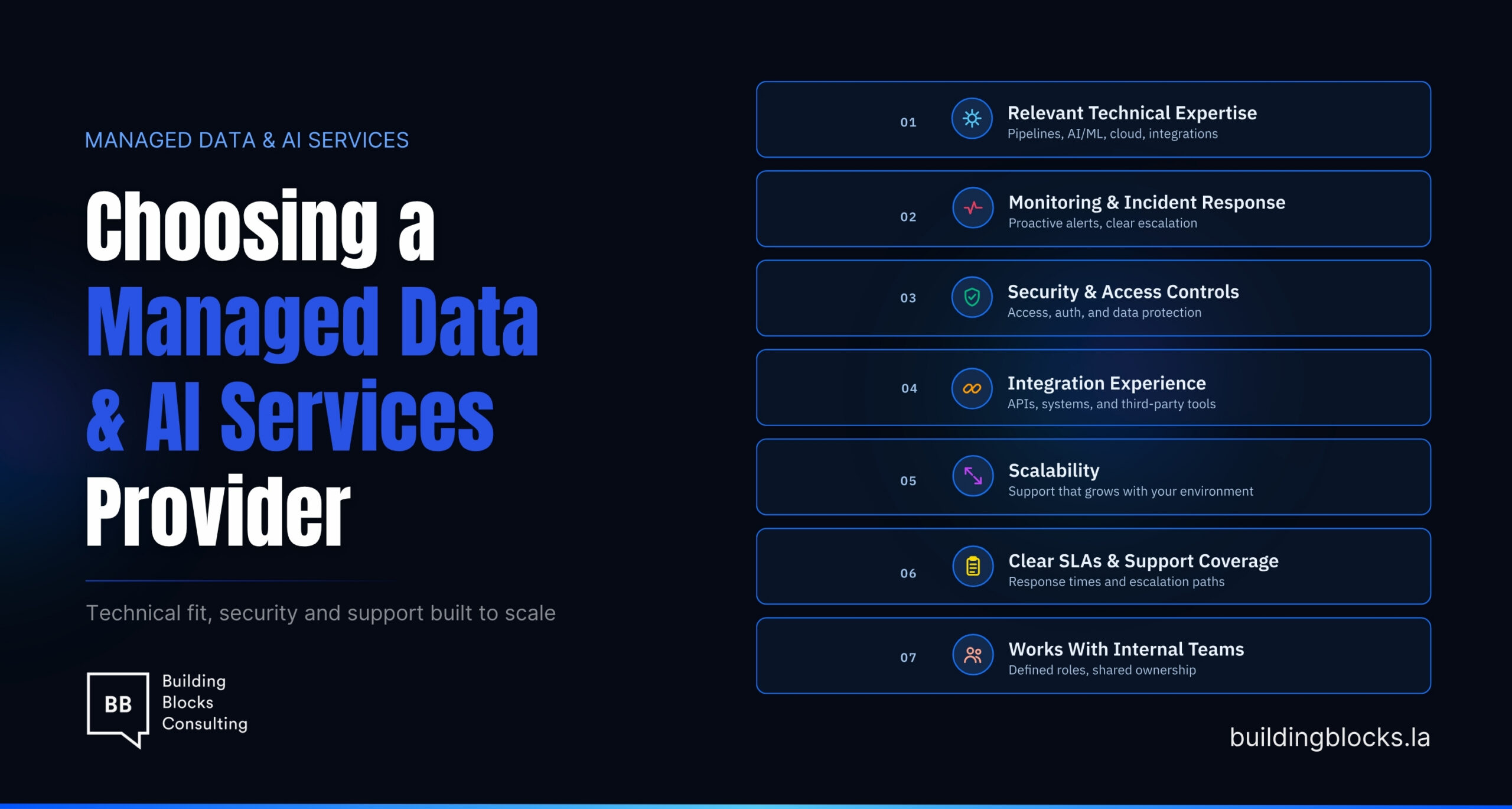
What Should You Look for in a Managed Data & AI Services Provider?
1. Relevant Technical Expertise
Start by evaluating whether the provider has experience with the technologies and systems your organization relies on.
This may include:
- Data pipelines and data platforms
- Databases and data warehouses
- AI and machine learning applications
- Generative AI systems
- APIs and integrations
- Cloud infrastructure
- Analytics environments
The provider should understand not only how to monitor these systems but also how to troubleshoot and improve them when issues arise.
2. Strong Monitoring and Incident Response
Effective managed support depends on proactive monitoring.
Ask how the provider identifies:
- Pipeline failures and delays
- Integration problems
- Application performance issues
- Infrastructure problems
- AI system or model performance changes
Also evaluate how incidents are investigated, escalated, and resolved. A provider should have a clear process for responding to critical issues rather than relying on ad hoc troubleshooting.
3. Security and Access Controls
Managed providers may need access to production systems, data platforms, APIs, or sensitive information.
Before selecting a provider, understand how it manages:
- User and privileged access
- Authentication and credentials
- Data protection
- Logging and monitoring
- Access reviews
- Security incidents
The provider should clearly define what access it needs and the security responsibilities shared between the provider and your organization.
4. Integration and Existing-System Experience
Data and AI environments often depend on multiple systems working together. A provider should be comfortable supporting APIs, data integrations, enterprise applications, cloud platforms, and third-party services.
Ask about experience with environments similar to yours and how the provider handles issues that cross multiple systems.
5. Scalability
Your operational requirements may change as data volumes, AI usage, applications, and infrastructure grow.
Choose a provider that can adapt its support as your environment changes, including:
- Increased data volumes
- Additional applications
- New integrations
- Growing infrastructure requirements
- Changing monitoring needs
Scalability should be part of the provider’s operating model, not something considered only after the environment has grown.
6. Clear SLAs and Support Coverage
Service-level agreements should establish clear expectations for operational support.
Review:
- Support hours
- Incident priorities
- Response times
- Escalation procedures
- Systems covered
- Reporting requirements
- After-hours support, if needed
The appropriate SLA depends on how critical your data and AI systems are to business operations.
7. Ability to Work With Internal Teams
A managed services provider does not necessarily need to replace your internal engineering team.
The provider should be able to work alongside internal teams with clearly defined responsibilities. Internal engineers can focus on development and strategic initiatives while the provider supports agreed operational responsibilities.
Ask how communication, handoffs, escalation, and ownership will work before the engagement begins.
Questions to Ask Before Choosing a Provider
Before selecting a managed data and AI services provider, ask:
- What data and AI environments do you support?
- What monitoring capabilities do you provide?
- How do you handle production incidents?
- What are your response times and support hours?
- How do you manage security and system access?
- Can you support our existing integrations and infrastructure?
- How do you work with internal engineering teams?
- How does your support model scale as our environment grows?
- What is included in the service agreement and SLA?
The answers should help you determine whether the provider is equipped to support your specific environment rather than simply offering a broad list of capabilities.
How to Choose the Right Provider
The right managed data and AI services provider should fit your technical environment, operational requirements, security expectations, and future needs.
Rather than choosing based only on price or the number of services offered, evaluate the provider’s technical expertise, monitoring capabilities, incident response, security practices, integration experience, scalability, SLAs, and collaboration model.
A provider that understands your environment and can support it consistently is more valuable than one that simply offers the broadest service catalog.




By Chris Clifford
Chris Clifford was born and raised in San Diego, CA and studied at Loyola Marymount University with a major in Entrepreneurship, International Business and Business Law. Chris founded his first venture-backed technology startup over a decade ago and has gone on to co-found, advise and angel invest in a number of venture-backed software businesses. Chris is the CSO of Building Blocks where he works with clients across various sectors to develop and refine digital and technology strategy.