


How can we help?
Let's Talk
How can we help?
Let's Talk
As organizations collect more data across applications, departments, cloud platforms, analytics environments, and AI systems, managing that data becomes increasingly difficult.
Different teams may use different definitions for the same information. Employees may be unsure who owns a particular dataset. Important data may exist in several systems with conflicting values. Sensitive information may not have clearly defined access responsibilities.
These problems are not solved simply by adding another database or data platform.
They require a clear approach to how data is owned, defined, managed, accessed, protected, and used across the organization.
That is the role of enterprise data governance.
What Is Enterprise Data Governance?
Enterprise data governance is the system of policies, responsibilities, standards, processes, and decision-making practices an organization uses to manage its data consistently across the business.
It establishes expectations for how important organizational data should be created, maintained, accessed, understood, and used.
For example, enterprise data governance can help answer questions such as:
Who owns customer data?
Who is responsible for its quality?
What does “active customer” actually mean?
Who can access sensitive customer information?
Where does a particular data element come from?
Which system should be considered the authoritative source?
Who decides when a data definition or standard needs to change?
Without governance, these decisions may be made inconsistently by different teams.
With governance, organizations can establish clearer accountability and more consistent ways of managing important data.
Why Does Enterprise Data Governance Matter?
Data has become part of everyday business operations.
It supports financial reporting, customer experiences, operational processes, analytics, regulatory activities, and increasingly, AI applications.
When data cannot be trusted or its meaning is unclear, the impact can extend well beyond the data team.
A finance team may report one number while another department uses a different version. An analytics team may build dashboards using inconsistent definitions. Employees may struggle to find the information they need. AI applications may rely on incomplete or poorly governed data.
Enterprise data governance helps establish the structures needed to reduce these problems.
The objective is not to control every piece of data in the organization.
The objective is to create clear accountability and consistent practices for the data that matters most.
What Does Enterprise Data Governance Cover?
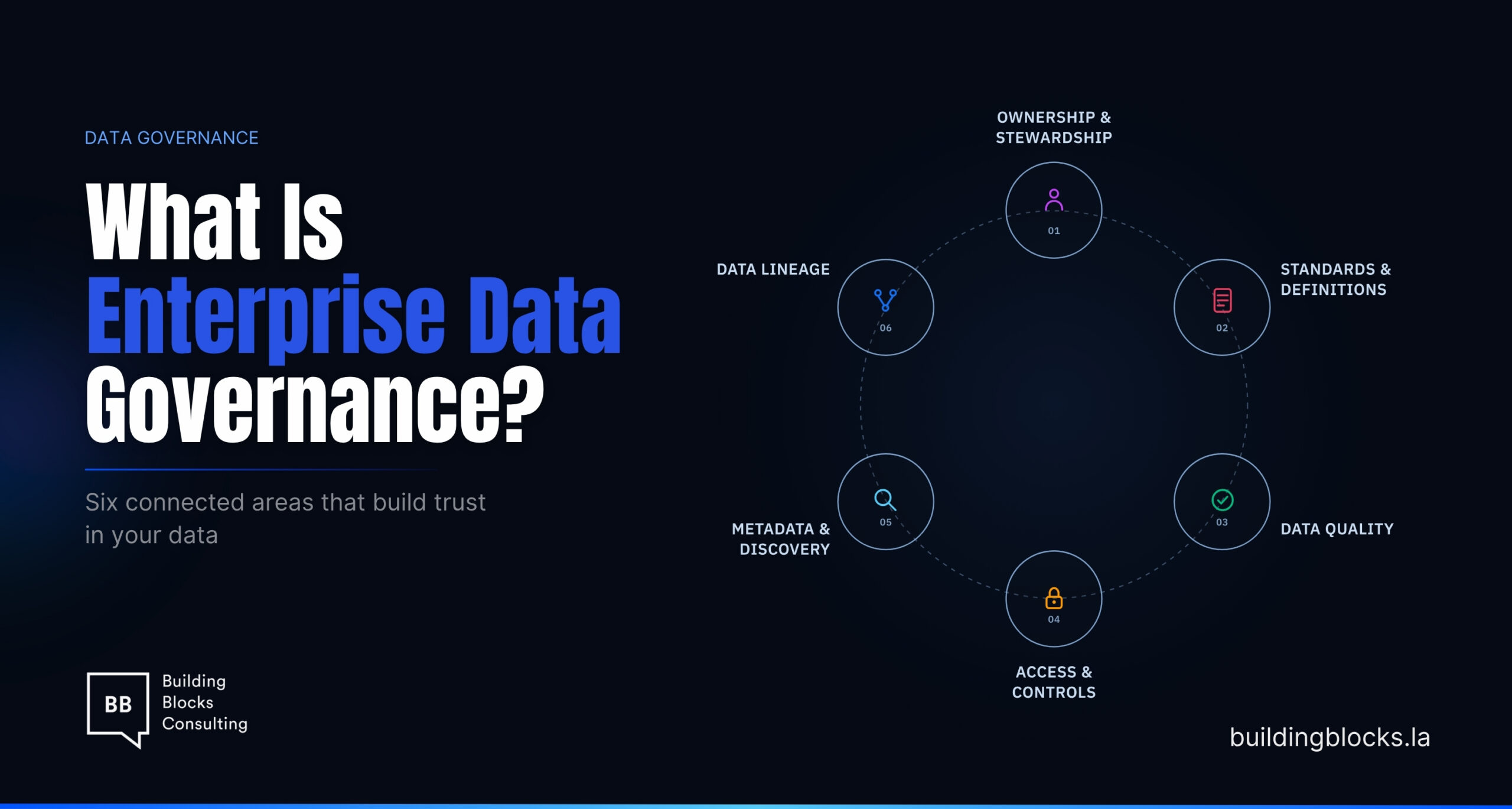
Enterprise data governance typically covers several connected areas.
Data Ownership and Stewardship
Organizations need to know who is accountable for important data.
A data owner may be responsible for decisions about a particular data domain, while data stewards may help maintain definitions, standards, quality practices, and day-to-day governance activities.
The exact roles vary between organizations, but the principle is straightforward:
Important data should have clear responsibility attached to it.
Without ownership, data-quality problems can become everyone’s problem and therefore no one’s responsibility.
Data Standards and Definitions
Different teams can use the same term to mean different things.
Consider the term “customer.”
Does it mean anyone who has purchased something? Anyone with an active account? Anyone who has purchased within the last year?
Enterprise data governance can establish common definitions for important business concepts.
These definitions help teams work from a shared understanding when developing reports, applications, analytics, and AI systems.
Data Quality
Data governance also establishes responsibility for data quality.
Quality can involve factors such as accuracy, completeness, consistency, timeliness, and validity.
Not every dataset needs the same level of quality.
A governance program should identify which data is critical to important business processes and establish appropriate expectations for that information.
This makes data quality a business responsibility rather than simply a technical cleanup exercise.
Data Access and Controls
Organizations need to determine who should be able to access different types of information and under what conditions.
This becomes especially important when data contains sensitive customer, financial, employee, or proprietary information.
Governance can establish policies and responsibilities around access while working alongside the organization’s technical security controls.
The goal is to make access decisions intentional and accountable rather than allowing data access to develop without clear ownership.
Metadata and Data Discovery
Data becomes difficult to use when people cannot easily understand what it represents or where it came from.
Metadata provides information about data, such as its meaning, source, ownership, format, and other relevant characteristics.
Good metadata can make it easier for teams to discover and understand available information.
For example, an analyst looking for revenue data should be able to determine which dataset represents the approved business definition rather than choosing between several similarly named sources.
Data Lineage
Data lineage helps organizations understand how information moves through their environment.
It can show where data originated, how it was transformed, and where it is ultimately used.
This can become particularly valuable when investigating data-quality problems or understanding dependencies between systems.
If a number in an executive report changes unexpectedly, lineage can help teams trace the information back through the systems and transformations that produced it.
Enterprise Data Governance Is More Than a Policy Document
One common misunderstanding is that data governance means creating a collection of policies and storing them somewhere for employees to read.
Policies are important, but governance needs to operate within everyday business and technical processes.
If an organization defines a data-quality standard but has no process for measuring quality or addressing problems, the standard has limited practical value.
Similarly, assigning a data owner is not enough if that person has no clear responsibilities or decision-making authority.
Effective governance connects policies with people, processes, and technology.
How Enterprise Data Governance Works Across Departments
Enterprise governance becomes particularly important because data crosses organizational boundaries.
Marketing may create customer information. Sales may update it. Finance may use it for revenue analysis. Customer service may depend on it for support. Product teams may use it to understand customer behavior.
Each department may have a different perspective on the same data.
Enterprise governance creates a mechanism for resolving these differences and establishing shared standards where necessary.
This does not mean every department has to work in exactly the same way.
Instead, governance provides a framework for deciding where consistency is important and who has authority to make those decisions.
Data Governance and AI
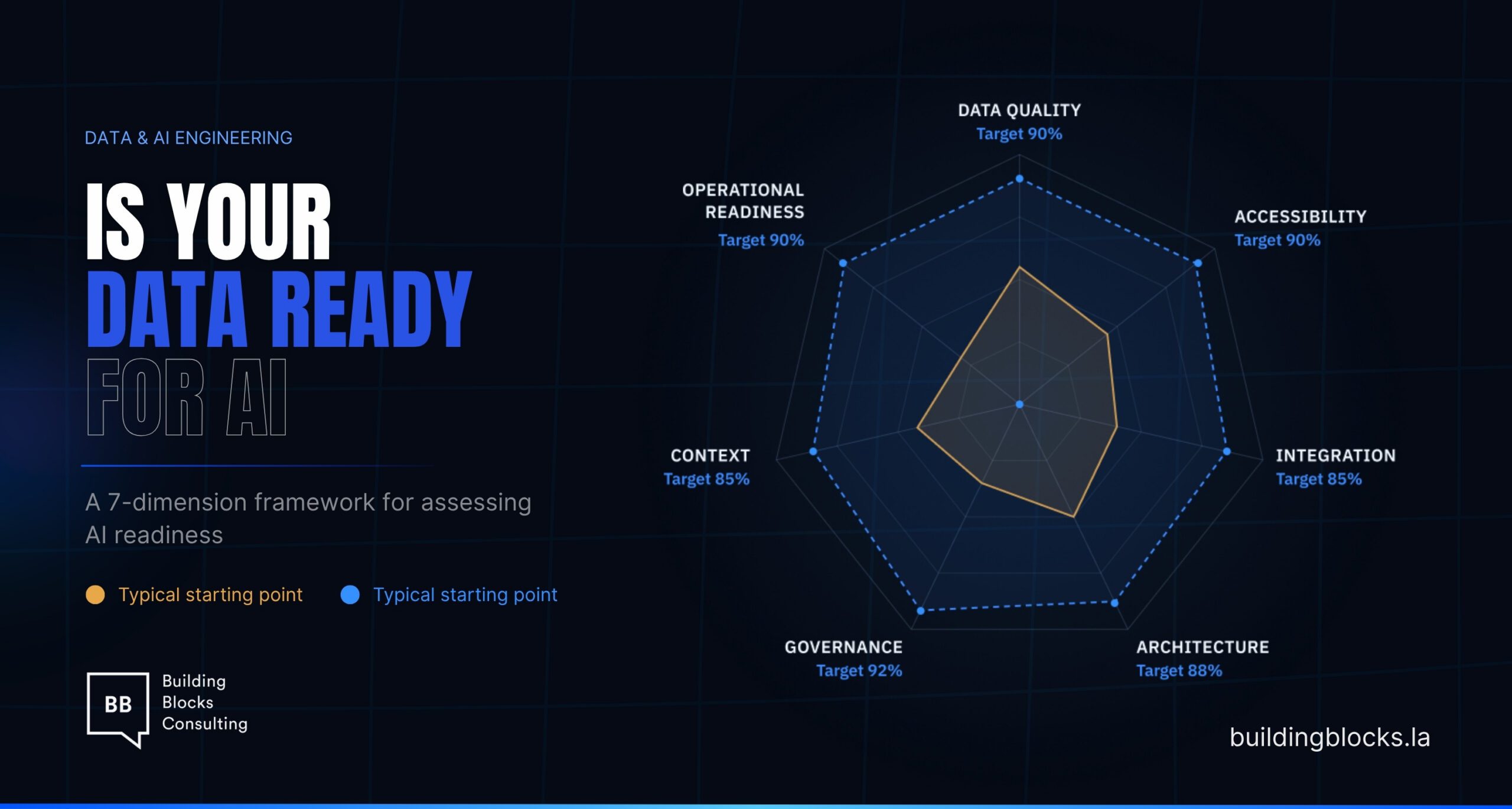
The importance of governance increases as organizations use data to support AI.
AI systems may rely on customer information, internal documents, operational records, product data, or other organizational datasets.
If the underlying data has unclear ownership, inconsistent definitions, inappropriate access, or weak quality controls, those problems can affect the AI system as well.
For example, an AI application retrieving information from internal documents needs to know which information it is allowed to access and whether the information it retrieves is current and appropriate.
This is one reason AI data governance is increasingly becoming part of broader enterprise governance programs.
AI does not eliminate the need for data governance. In many cases, it makes that need more visible.
What Are the Benefits of Enterprise Data Governance?
The value of governance is not limited to compliance.
A well-designed governance approach can help an organization establish greater confidence in important data and make it easier for teams to use that information consistently.
Potential benefits include:
- Clearer data ownership and accountability
- More consistent business definitions
- Better visibility into important data
- Improved data-quality management
- More controlled access to sensitive information
- Better understanding of data movement and dependencies
- Stronger foundations for analytics and AI
- More consistent decision-making across departments
The specific benefits depend on the organization’s data environment and business priorities.
Governance should therefore be connected to real business problems rather than implemented as an isolated administrative program.
What Happens Without Enterprise Data Governance?
Organizations can operate without a formal governance framework, particularly when they are small and their data environment is relatively simple.
As the organization grows, however, informal approaches can become harder to maintain.
Data may become distributed across more systems. Teams may create their own definitions and processes. New applications may introduce additional sources of information. Cloud platforms and AI systems may create new data flows.
Over time, this can lead to questions that become increasingly difficult to answer:
Where did this data come from?
Which version should we trust?
Who owns it?
Who can access it?
What does this field mean?
What happens when the data is incorrect?
The cost is not always visible as a single line item. It can appear as duplicated work, conflicting reports, slower decision-making, security risks, and difficulty implementing new data and AI initiatives.
Does Every Piece of Enterprise Data Need the Same Governance?
No.
Trying to apply the same level of governance to every data asset can create unnecessary complexity.
A better approach is often to identify the data that is most important to business operations, reporting, regulatory requirements, customer experiences, analytics, and AI initiatives.
Those critical data assets can receive greater attention around ownership, quality, access, definitions, metadata, and lineage.
This allows organizations to build governance around business priorities instead of attempting to govern everything equally.
How Do Organizations Build Enterprise Data Governance?
There is no universal governance framework that works for every organization.
A practical approach typically begins by understanding the existing data environment and identifying the areas where unclear ownership, poor quality, inconsistent definitions, access issues, or limited visibility are creating problems.
The organization can then prioritize important data domains, establish responsibilities, define standards, and introduce governance processes into everyday operations.
Over time, governance can expand as the organization’s data environment and business requirements evolve.
The important point is to treat governance as an operating capability rather than a one-time project.
Enterprise Data Governance and Compliance
Governance can also support an organization’s ability to manage regulatory and compliance responsibilities.
Data classification, access responsibilities, ownership, retention practices, documentation, and lineage can help organizations understand how important information is handled.
However, data governance should not be treated as a guarantee of compliance.
Specific compliance requirements depend on the organization’s industry, location, data types, and applicable regulations.
Governance provides structures and accountability that can support those requirements, while legal and compliance teams determine the obligations that apply to the organization.
How BuildingBlocks Approaches Data Governance
BuildingBlocks Consulting helps organizations establish practical Data Governance Services around ownership, stewardship, data standards, quality, access, metadata, lineage, and governance processes.
The approach begins by understanding the organization’s existing data environment, governance maturity, business priorities, and requirements.
Rather than creating governance structures that exist only as documentation, the objective is to establish responsibilities and practices that can operate within the organization’s actual business and technology environment.
This can also provide a stronger foundation for analytics, data initiatives, and AI adoption.
Building a Data Foundation the Organization Can Trust
Enterprise data governance is ultimately about creating clarity around an organization’s data.
People should know what important data means, who is responsible for it, how it should be managed, who can access it, and where it moves through the organization.
As data environments become more complex and organizations increasingly depend on analytics and AI, that clarity becomes more valuable.
Effective governance does not require controlling every dataset or creating unnecessary bureaucracy. It requires identifying what matters, assigning appropriate accountability, establishing practical standards, and making governance part of everyday data operations.
That creates a stronger foundation for organizations that want to use their data with greater confidence and build on it for analytics, AI, and future business initiatives.





By Chris Clifford
Chris Clifford was born and raised in San Diego, CA and studied at Loyola Marymount University with a major in Entrepreneurship, International Business and Business Law. Chris founded his first venture-backed technology startup over a decade ago and has gone on to co-found, advise and angel invest in a number of venture-backed software businesses. Chris is the CSO of Building Blocks where he works with clients across various sectors to develop and refine digital and technology strategy.