


How can we help?
Let's Talk
How can we help?
Let's Talk
Not every organization needs a completely customized AI training program.
For some businesses, a standard AI course can provide employees with a useful introduction to AI concepts, generative AI tools, prompting, responsible AI use, and practical applications. But as AI adoption becomes more closely connected to specific roles, workflows, technologies, and business objectives, generic training may no longer be enough.
So when does a business actually need custom AI training?
The answer depends on how your organization uses AI, who needs to be trained, and what you want the training to accomplish.
What Is Custom AI Training?
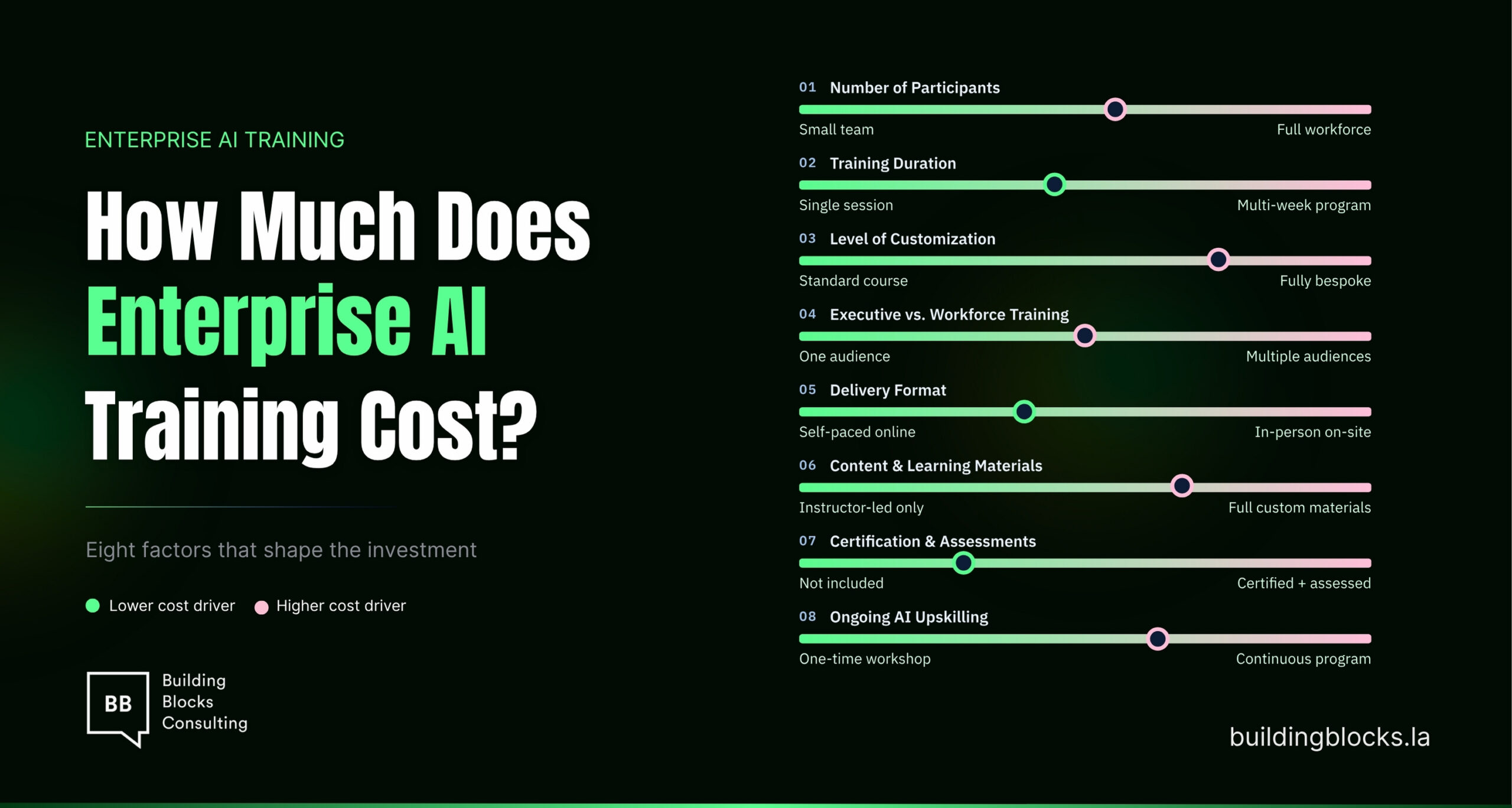
Custom AI training is a training program adapted to an organization’s specific needs rather than delivered as a completely standardized course.
Customization can involve changing the content, examples, exercises, use cases, delivery format, or level of instruction.
For example, an executive program might focus on AI opportunities, risks, governance, and decision-making, while a marketing team may need practical training around content creation, research, and campaign workflows.
The goal isn’t customization for its own sake. The goal is to make training more relevant and useful.
When Is Standard AI Training Enough?
A standard AI training program may be sufficient when employees have similar requirements and relatively limited AI experience.
It can be a good starting point when your organization primarily wants to:
- Build basic AI literacy
- Introduce employees to generative AI
- Explain AI capabilities and limitations
- Teach general prompting techniques
- Establish awareness of responsible AI use
- Give employees a common foundation before deeper training
For organizations at the beginning of their AI adoption journey, standardized training can create a shared baseline without requiring a highly specialized program.
Customization becomes more valuable when the organization needs training to go beyond general awareness.
1. Different Roles Need Different AI Skills
One of the strongest reasons to customize training is that employees use AI differently.
An executive may need to understand how AI affects business strategy, risk, workforce planning, and investment decisions.
A sales team may need training around research, customer communication, and workflow assistance.
A technical team may require more advanced knowledge of AI applications, automation, integrations, or evaluation.
Trying to give every employee exactly the same training can result in some people receiving information that is either too basic or not relevant to their responsibilities.
Role-based customization allows training to focus on the skills employees are most likely to use.
2. Your Industry Has Specific Requirements
Industry context can also justify customized training.
Organizations operating in regulated or highly sensitive environments may need training that addresses their particular requirements around data, privacy, security, human oversight, or responsible AI use.
For example, an organization handling sensitive customer information may need practical guidance on what information employees should and should not provide to AI systems.
In this situation, generic AI ethics training may be less useful than AI ethics training modules tailored for business leaders and employees within the organization’s actual operating environment.
3. Employees Have Different Levels of AI Knowledge
Another reason to customize training is uneven AI experience.
Some employees may have never used generative AI. Others may already use AI tools every day and want to improve their workflows.
Putting both groups through the same introductory course can limit the value for everyone.
A customized program can be structured around different skill levels, such as:
- AI fundamentals for beginners
- Practical AI skills for regular users
- Advanced AI enablement for teams with deeper requirements
This creates a more appropriate learning path without assuming that everyone starts from the same place.
4. You Want Training Connected to Real Workflows
Training becomes more valuable when employees can immediately apply what they learn.
Instead of teaching AI concepts in isolation, a customized program can use examples based on actual business activities.
For example, training might show employees how AI can help with:
- Summarizing internal information
- Organizing research
- Drafting and improving documents
- Generating ideas
- Analyzing information
- Structuring reports
- Supporting repetitive knowledge-work tasks
The examples can then be adapted to the workflows of specific departments.
This makes the training less theoretical and more actionable.
5. Your Leadership Team Has Different Needs
Executives don’t necessarily need the same AI training as employees.
Business leaders may need to understand what AI can realistically do, where it can create business opportunities, what risks need attention, and what organizational capabilities are required for adoption.
They may also need to evaluate AI initiatives without becoming deeply involved in technical implementation.
For organizations looking for AI training services tailored for enterprise executives, customization can make the program much more relevant to strategic decision-making.
6. Your Organization Has Specific AI Use Cases
Customization becomes particularly valuable when your organization has already identified specific generative AI use cases.
Suppose a company wants employees to use AI for internal research, customer communications, document analysis, or knowledge management.
A generic course can explain how AI works, but a tailored program can demonstrate how employees should approach those specific activities.
Training can include relevant examples, exercises, workflows, and evaluation practices.
This helps employees move from learning about AI to applying it responsibly.
7. You Need Training That Reflects Your Technology Environment
Your technology environment can also influence the type of training employees need.
Organizations may use different AI platforms, enterprise software, internal knowledge systems, security controls, or approved AI tools.
Training should not encourage employees to use tools or workflows that conflict with organizational policies or technology requirements.
Customized programs can account for the tools employees are actually expected to use and the boundaries within which they should operate.
When Customization May Not Be Necessary
Customization isn’t always the right answer.
A standard course may be a better option when:
- The organization is only beginning to explore AI.
- Employees need basic AI literacy.
- Training needs are broadly similar across teams.
- There are no specific AI use cases yet.
- The organization wants to establish a common baseline first.
In these situations, starting with standard training can be more efficient. The organization can then identify skill gaps and introduce specialized training later.
How to Decide If You Need a Customized Program
Before investing in a customized program, ask a few practical questions:
Who needs training?
Are you training executives, managers, employees, technical teams, or multiple groups?
What do they already know?
Do employees need basic AI literacy, practical skills, or advanced enablement?
What do you want them to do differently?
Training should connect to specific behaviors, workflows, or business objectives.
Are there industry or organizational requirements?
Consider privacy, security, compliance, responsible AI, and internal policies.
Do you have specific AI use cases?
If your organization already has defined use cases, training can be built around them.
Do different teams need different skills?
If the answer is yes, role-based customization may provide more value than one standardized course.
If your answers point toward different requirements across roles, workflows, and skill levels, customized AI training for enterprises may be worth considering.
What Should a Customized AI Training Program Include?
A customized program doesn’t necessarily mean creating every piece of content from scratch.
Customization can happen at different levels.
It may involve adapting:
- Learning objectives
- Examples and case studies
- Exercises
- AI tools and workflows
- Role-specific use cases
- Leadership content
- Responsible AI guidance
- Skill levels
- Delivery format
- Assessment methods
The right level of customization depends on the organization’s needs.
For some businesses, adapting examples and exercises may be enough. Others may benefit from a more comprehensive program designed around specific departments, workflows, and AI adoption goals.
The Goal Is Useful AI Capability
The purpose of custom AI training isn’t simply to create a more personalized course.
It is to help people develop AI skills that are relevant to the work they actually perform.
For an organization considering custom AI training services, the key question is therefore not “Can the training be customized?”
It is:
Will customization help our people use AI more effectively, responsibly, and confidently in the context of their actual work?
If the answer is yes, a tailored program can provide considerably more value than a generic course.
If your organization is still establishing basic AI literacy, however, a standard foundation may be the better place to start.
How BuildingBlocks Can Help
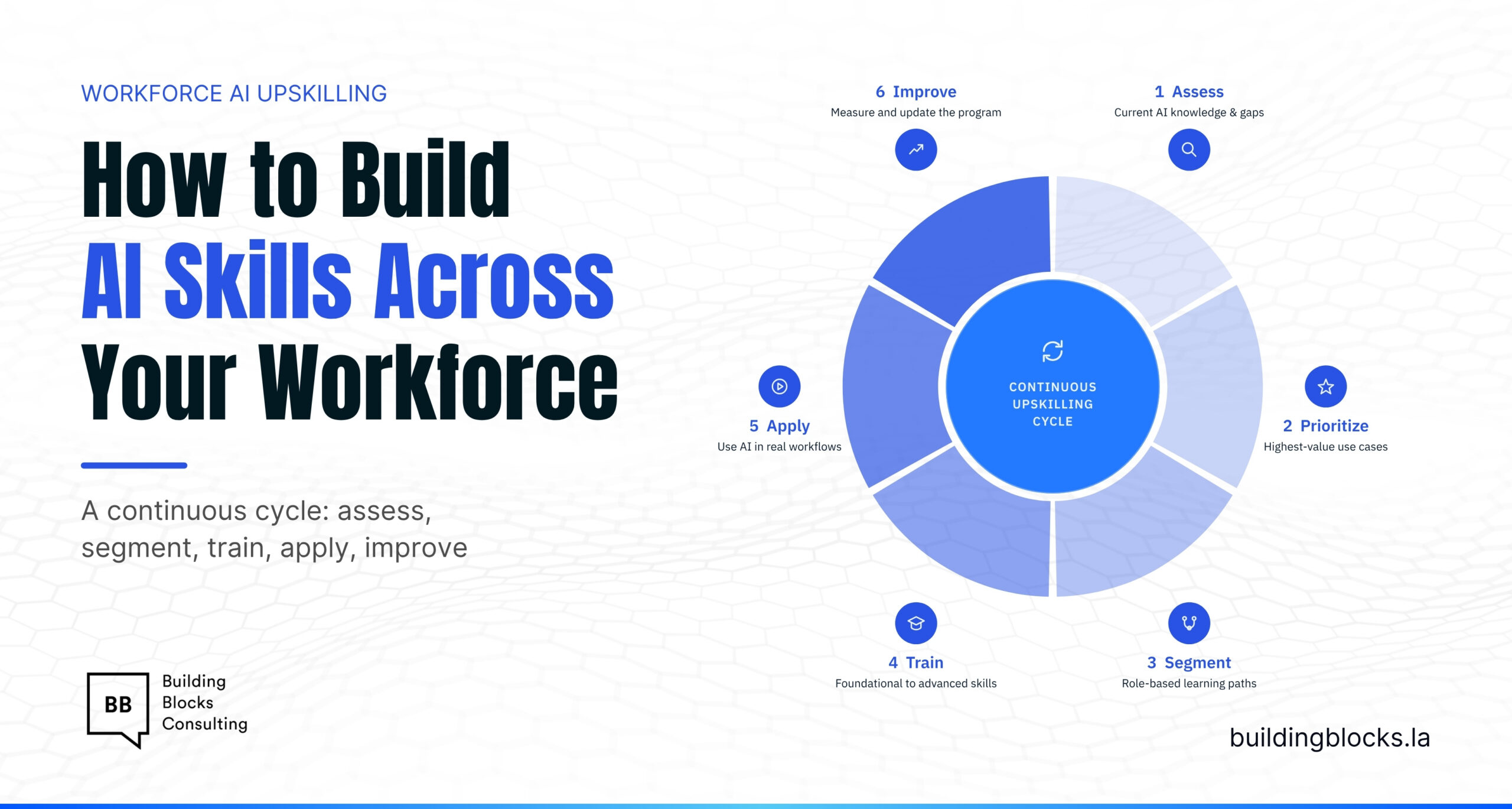
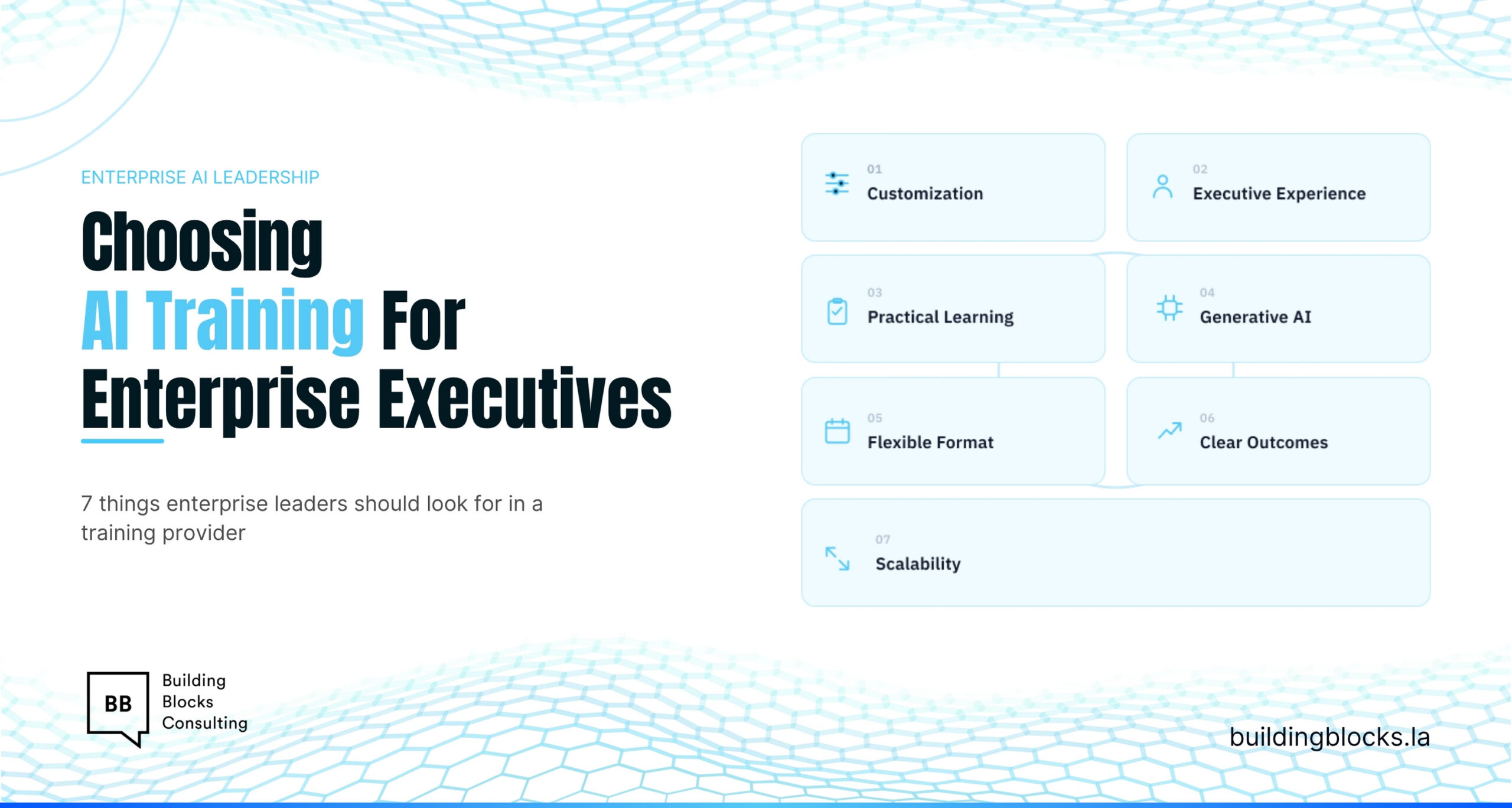
BuildingBlocks Consulting provides AI Training for Enterprises designed around different employee roles, departments, levels of AI experience, business workflows, and organizational requirements.
Training can cover AI fundamentals, generative AI, practical AI tools and prompting, output evaluation, AI-assisted workflows, and responsible AI use.
For organizations with more specific requirements, the training approach can be adapted to leadership needs, industry context, job functions, existing AI knowledge, and practical business use cases.
If you’re unsure whether your organization needs a standard course or a customized program, the right starting point is to assess your workforce, existing AI capabilities, and intended use cases before deciding on the training approach.



By Chris Clifford
Chris Clifford was born and raised in San Diego, CA and studied at Loyola Marymount University with a major in Entrepreneurship, International Business and Business Law. Chris founded his first venture-backed technology startup over a decade ago and has gone on to co-found, advise and angel invest in a number of venture-backed software businesses. Chris is the CSO of Building Blocks where he works with clients across various sectors to develop and refine digital and technology strategy.