

How can we help?
Let's Talk
How can we help?
Let's Talk
Artificial intelligence is becoming a leadership issue, not just a technology issue. Executives are increasingly expected to understand where AI can create business value, what risks it introduces, and how their organizations should prepare their workforce for its use.
But choosing the right AI training provider can be difficult. Executive teams do not necessarily need another generic AI course. They need training that connects AI concepts with business strategy, decision-making, organizational priorities, and real-world use cases.
So, how should an enterprise evaluate AI training services for its executives?
The right program should match the organization’s goals, leadership responsibilities, existing AI knowledge, industry requirements, and expected outcomes.
What Is Executive AI Training?
Executive AI training is designed to help business leaders understand and make informed decisions about artificial intelligence without requiring them to become AI engineers.
A strong executive program may cover areas such as:
- AI and generative AI fundamentals
- Business applications of AI
- AI opportunities and use-case identification
- AI risks and responsible use
- AI governance and decision-making
- Workforce implications of AI
- Evaluating AI investments
- Understanding AI implementation requirements
- Practical applications of AI in leadership workflows
The emphasis should be on helping executives understand what AI means for the business and what decisions they need to make, rather than simply teaching technical concepts.
Why Generic AI Courses May Not Be Enough for Executives
Many online AI courses are designed for broad audiences. They can be useful for building basic awareness, but enterprise executives often have different learning requirements.
A CTO may need to understand AI architecture, technology dependencies, security, and implementation considerations.
An HR or L&D leader may be more concerned with workforce readiness, AI skills, employee adoption, and responsible use.
A CEO or COO may want to understand business opportunities, operational impact, investment decisions, and organizational risk.
This is why customization matters.
The best AI training services for enterprise executives should be relevant to the decisions leaders actually make.
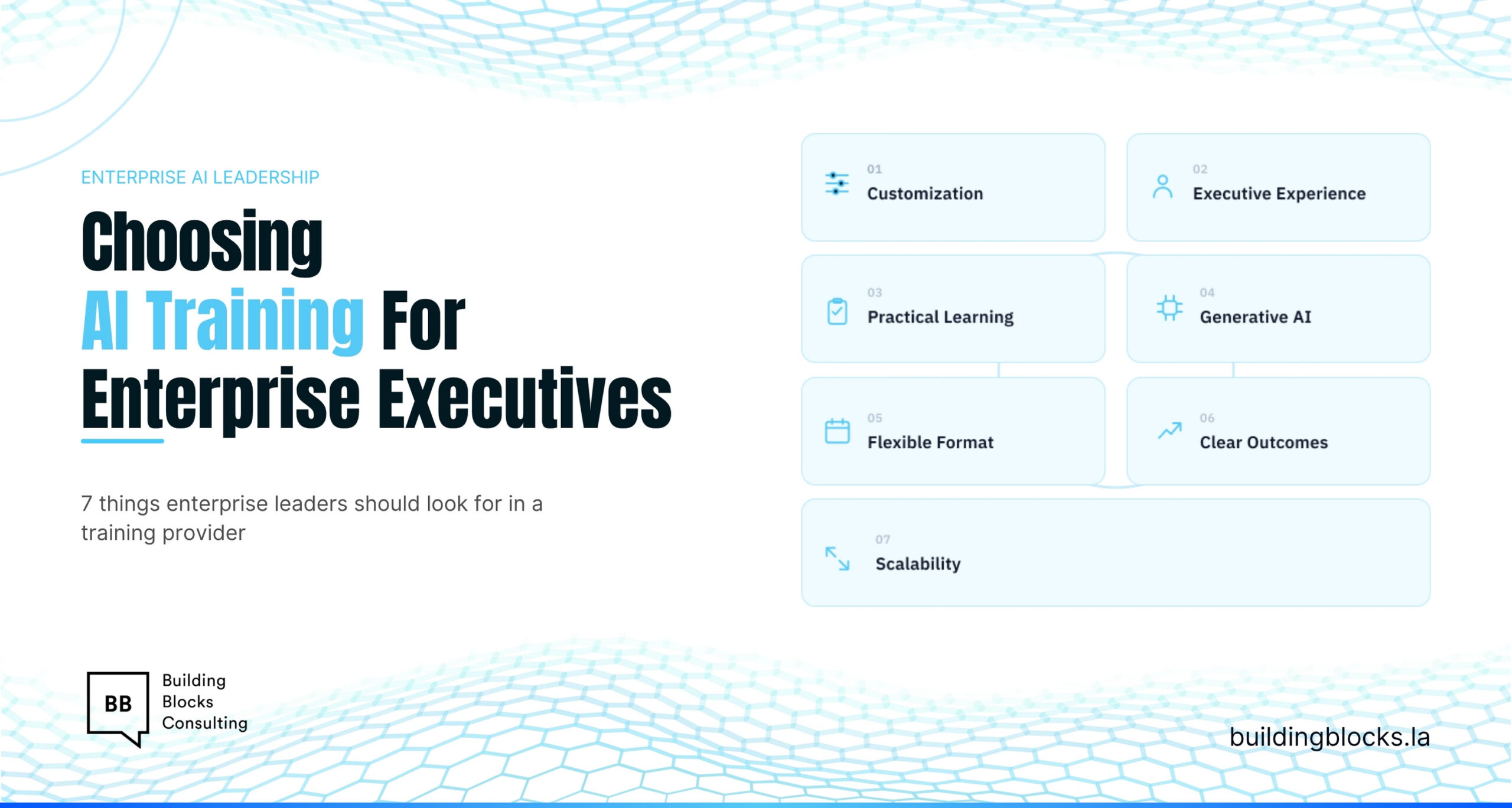
7 Things to Look for in an Executive AI Training Provider
1. Training That Is Customized to Your Organization
Customization is one of the most important factors to evaluate.
Ask whether the provider can adapt the training around your:
- Industry
- Business objectives
- Leadership roles
- Existing AI knowledge
- Technology environment
- Business processes
- AI use cases
- Workforce priorities
A customized program can make training more relevant than a standard course built for a general audience.
For example, a manufacturing company may need to explore AI for operations, forecasting, quality control, and supply chains, while a professional services organization may focus more on knowledge work, productivity, client delivery, and document workflows.
2. Experience Working With Business Leaders
Executive training requires a different approach from technical training.
Look for trainers who can explain complex AI concepts in terms of business decisions, opportunities, risks, and practical applications.
Executives should be able to leave a session understanding not only how AI works, but also:
- Where AI could create value
- Where it may introduce risk
- Which use cases deserve further investigation
- What capabilities the organization needs
- What questions to ask technical teams and vendors
3. Practical Learning Instead of AI Theory Alone
AI training becomes more valuable when participants can connect concepts to actual business situations.
Ask whether the program includes practical exercises, demonstrations, workshops, or business-specific scenarios.
For executive teams, practical learning could involve evaluating potential AI use cases, reviewing AI-generated outputs, discussing implementation scenarios, or identifying opportunities within existing workflows.
The goal is to turn AI awareness into better decision-making.
4. Coverage of Generative AI
Generative AI has become an important part of enterprise AI education.
Executive training should help leaders understand technologies such as large language models and generative AI applications while also addressing their limitations.
Relevant topics may include:
- Generative AI capabilities
- Prompting and AI-assisted workflows
- Enterprise use cases
- Data and privacy considerations
- AI accuracy and hallucinations
- Human oversight
- Responsible AI use
- Security considerations
- Organizational policies
Executives do not need to become prompt engineers, but they should understand enough to make informed decisions about how generative AI can be used across the organization.
5. A Format That Works for Executives
Even a strong training program will have limited impact if the format does not fit the leadership team’s schedule and working style.
Enterprise providers may offer options such as:
- Executive workshops
- Live virtual sessions
- In-person training
- Short intensive programs
- Multi-session learning programs
- Leadership briefings
- Hands-on workshops
Consider the number of participants, executive availability, geographic distribution, and whether the program needs to accommodate different leadership groups.
6. Clear Learning Outcomes
Before selecting a provider, ask what participants should be able to do after completing the program.
For example, an executive AI program might aim to help leaders:
- Identify relevant AI opportunities
- Evaluate AI initiatives
- Understand AI risks
- Ask better questions of technology teams
- Recognize workforce implications
- Understand responsible AI principles
- Make more informed AI investment decisions
Clear outcomes make it easier to determine whether the training delivered meaningful value.
7. Ability to Scale Beyond the Executive Team
Executive education can be the starting point for broader organizational AI capability.
If the organization expects to expand AI training to employees, managers, or specific departments, it can be useful to work with a provider capable of supporting different learning requirements.
Leadership training might focus on AI strategy and decision-making, while employee training could focus more heavily on practical AI skills and role-specific workflows.
This creates a more consistent approach to AI upskilling across the organization.
Executive AI Training vs. Employee AI Training
These two types of training should not necessarily have the same objectives.
Executive training generally focuses on:
- Business impact
- AI opportunities
- Risk and governance
- Investment decisions
- Organizational readiness
- Leadership responsibilities
Employee training is more likely to focus on:
- Practical AI tools
- Role-specific workflows
- Productivity
- Generative AI skills
- Safe and responsible usage
- Hands-on application
For larger organizations, separating these learning objectives can make an AI training program more effective.
Questions to Ask an AI Training Provider
Before choosing an executive AI training partner, enterprise leaders should ask:
Can the program be customized?
Find out whether the provider can adapt content to your industry, leadership roles, technology environment, and business objectives.
Who delivers the training?
Understand the trainers’ experience with AI, business, enterprise environments, and executive audiences.
Is the training practical?
Ask whether participants will work through real scenarios, use cases, demonstrations, or exercises.
How is success measured?
The provider should be able to explain how learning outcomes and program effectiveness will be evaluated.
Can the program scale?
If executive training is successful, determine whether the provider can support AI upskilling across additional teams and employee groups.
What happens after training?
For some organizations, a one-time workshop may be sufficient. Others may need ongoing learning, additional workshops, or role-specific training.
How Much Customization Does an Enterprise Need?
Not every organization needs a completely bespoke AI training program.
A standard executive course may be appropriate when leaders primarily need foundational AI literacy.
Customization becomes more valuable when the organization has:
- Specific industry requirements
- Existing AI initiatives
- Defined business use cases
- Different leadership skill levels
- Specific technology environments
- Responsible AI or governance requirements
- Workforce transformation goals
The right level of customization depends on what the organization wants the training to accomplish.
How to Evaluate the Value of Executive AI Training
The value of executive AI training should not be measured only by course completion or participant satisfaction.
Organizations can also consider whether training helps leaders:
- Identify practical AI opportunities
- Improve AI-related decision-making
- Understand implementation requirements
- Recognize potential risks
- Align leadership around AI priorities
- Support workforce AI initiatives
- Ask more informed questions about AI investments
The most useful outcome is often greater organizational clarity around how AI should be understood, evaluated, and used.
When Should an Enterprise Work With a Specialized AI Training Provider?
A specialized provider can be particularly useful when an organization needs training that goes beyond general AI awareness.
This may include executive workshops, customized learning programs, generative AI education, role-specific training, or broader enterprise AI upskilling.
For organizations looking to build practical AI capability across leadership and teams, BuildingBlocks Consulting provides AI training for enterprises designed around business needs, leadership requirements, and practical AI skills.
You can learn more about the approach on the AI Training for Enterprises service page.
Final Takeaway
Choosing AI training services for enterprise executives is not simply about finding the course with the most AI topics.
The better question is whether the program can help your leadership team understand AI in the context of your business.
Look for a provider that combines relevant AI knowledge with executive-level communication, practical learning, customization, measurable outcomes, and an understanding of enterprise environments.
For organizations moving from general AI awareness toward practical capability, the right training program can help leadership teams make better-informed decisions and prepare the wider workforce for an AI-enabled future.




By Chris Clifford
Chris Clifford was born and raised in San Diego, CA and studied at Loyola Marymount University with a major in Entrepreneurship, International Business and Business Law. Chris founded his first venture-backed technology startup over a decade ago and has gone on to co-found, advise and angel invest in a number of venture-backed software businesses. Chris is the CSO of Building Blocks where he works with clients across various sectors to develop and refine digital and technology strategy.