

How can we help?
Let's Talk
How can we help?
Let's Talk
AI adoption is no longer limited to technology teams. Employees across marketing, finance, operations, sales, customer service, HR, and other functions are beginning to use AI to research information, analyze data, create content, automate repetitive work, and support everyday decisions.
For business leaders, the challenge is no longer simply deciding whether employees should learn AI. The bigger question is how to build the right AI skills across the workforce without giving everyone the same training.
A successful workforce AI upskilling program starts with understanding current capabilities, identifying the skills the business actually needs, and creating learning paths that employees can apply to their roles.
Why Workforce AI Skills Matter
Giving employees access to AI tools does not automatically create AI capability.
Employees need to understand what AI can do, where it can be useful, how to evaluate its output, and when human judgment is still required.
Without structured learning, organizations may face inconsistent AI usage. Some employees may become highly proficient while others avoid AI altogether. Teams may also use AI tools without understanding privacy, security, accuracy, or responsible-use considerations.
Workforce AI upskilling helps create a more consistent foundation.
The goal is not to make every employee an AI expert. It is to help employees develop the level of AI capability that is relevant to their responsibilities.
Start by Assessing Your Workforce's AI Readiness
Before creating a training program, organizations should understand where employees are today.
An AI readiness assessment can examine:
- Existing AI knowledge
- Current use of AI tools
- Employee confidence
- Role-specific skill gaps
- Existing AI workflows
- Department-level requirements
- Technical capabilities
- Responsible AI awareness
This assessment can reveal that different groups have very different learning needs.
For example, a technical team may already understand machine learning concepts while business teams may need foundational generative AI skills. Conversely, employees who regularly use AI tools may need more advanced training around evaluation, automation, and responsible use.
Identify the AI Skills Your Business Actually Needs
AI training should be connected to business requirements rather than simply following the latest AI trend.
Organizations can start by identifying where AI could realistically improve existing work.
Potential areas include:
- Research and information gathering
- Content creation
- Data analysis
- Document processing
- Customer support
- Internal knowledge management
- Reporting
- Workflow automation
- Software development
- Administrative tasks
Once these opportunities are identified, businesses can determine which AI skills employees need to use them effectively.
Don't Train Every Employee the Same Way
One of the most common mistakes in workforce AI training is creating one program for everyone.
Different roles require different levels of AI knowledge.
Executives and Senior Leaders
Leadership teams generally need AI literacy that supports decision-making, risk awareness, business opportunity identification, and organizational planning.
Managers
Managers need to understand how AI can affect team workflows, productivity, processes, and employee responsibilities.
They may also need to understand how to establish appropriate expectations for AI use within their teams.
Knowledge Workers
Employees working with documents, information, communication, research, analysis, or other knowledge-intensive tasks may benefit from practical generative AI skills.
Training can focus on prompting, reviewing AI outputs, research assistance, content workflows, and task automation.
Technical Teams
Engineering and technical employees may require deeper training related to AI development, APIs, data, model integration, security, evaluation, and deployment.
HR and Learning Teams
HR and L&D teams can benefit from understanding AI’s impact on workforce skills, employee training, responsible use, and ongoing AI capability development.
This role-based approach makes training more relevant and easier to apply.
Build Role-Specific AI Learning Paths
Once employee groups have been identified, organizations can create learning paths based on their responsibilities.
A basic learning path might progress from:
AI awareness → AI literacy → Practical application → Role-specific skills → Advanced capability
Not every employee needs to progress through every level.
For example, an employee may only need foundational generative AI skills for everyday productivity, while an automation specialist may require more advanced technical training.
The objective is to match learning depth with actual job requirements.
Include Generative AI Skills
Generative AI should be an important part of many modern workforce training programs, but employees should learn more than how to write prompts.
Useful generative AI skills can include:
- Writing effective prompts
- Providing useful context
- Evaluating AI-generated information
- Identifying inaccurate outputs
- Improving AI-assisted content
- Using AI for research and analysis
- Integrating AI into appropriate workflows
- Protecting confidential information
- Understanding responsible AI use
Employees should understand both the capabilities and limitations of the tools they use.
Train Employees Around Real Workflows
AI training is more likely to create value when employees can connect learning to work they already perform.
Instead of teaching AI tools in isolation, organizations can identify specific workflows where AI could help.
For example:
A marketing team might explore AI-assisted research and content workflows.
A customer service team might explore knowledge retrieval and response assistance.
An operations team might investigate document processing or repetitive administrative tasks.
A finance team might explore analysis and reporting support.
This approach helps employees understand not only what AI can do, but where it fits into their work.
Create an Ongoing AI Upskilling Program
AI skills should not be treated as a one-time training requirement.
AI tools and capabilities continue to change, and employees may discover new use cases after their initial training.
An ongoing program can include:
- Foundational AI training
- Role-specific workshops
- Advanced training
- Refresher sessions
- New tool education
- AI use-case workshops
- Leadership updates
- Responsible AI education
This allows organizations to build AI capability progressively rather than expecting employees to learn everything in a single course.
Measure AI Skills, Not Just Course Completion
Completion rates can tell an organization whether employees attended training, but they do not necessarily show whether employees developed useful AI capabilities.
Organizations can measure:
- Improvement in AI knowledge
- Employee confidence
- Practical AI usage
- Number of AI use cases identified
- Adoption of approved AI tools
- Workflow improvements
- Time saved on selected tasks
- Quality of AI-assisted work
- Responsible AI awareness
The right metrics depend on the organization’s objectives.
If the goal is productivity, organizations may measure time savings and workflow improvements.
If the goal is AI literacy, knowledge and confidence may be more appropriate measures.
Common Workforce AI Upskilling Mistakes
Training Everyone With the Same Curriculum
Different roles have different requirements. A single generic program may not provide enough practical value for every employee.
Focusing Only on AI Tools
Tools change quickly. Employees should also learn transferable concepts such as evaluating outputs, identifying appropriate use cases, protecting data, and applying human judgment.
Ignoring Existing Skill Levels
Some employees may be complete beginners while others already use AI regularly. Training should account for these differences.
Treating Training as a One-Time Event
AI capability needs to develop alongside the organization’s use of AI.
Measuring Only Attendance
A completed course does not necessarily mean that employees can apply AI effectively in their jobs.
How to Build a Workforce AI Upskilling Strategy
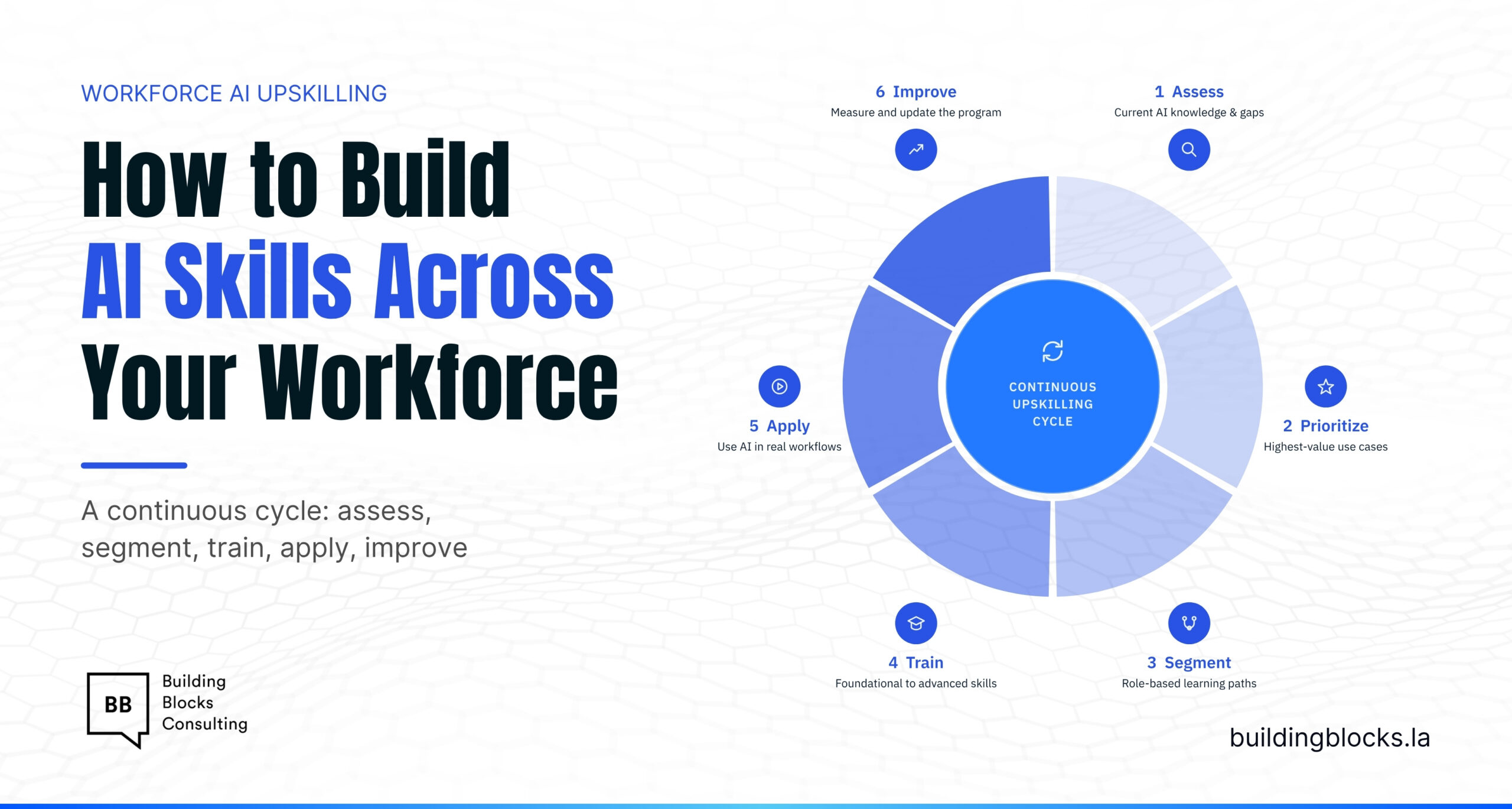
A practical approach can follow six stages:
1. Assess
Understand current AI knowledge, usage, and skill gaps.
2. Prioritize
Identify the employee groups and business areas where AI skills can create the greatest value.
3. Segment
Create learning paths based on roles, responsibilities, and existing capabilities.
4. Train
Provide foundational, practical, and role-specific AI education.
5. Apply
Give employees opportunities to use AI skills within appropriate business workflows.
6. Improve
Measure results, identify new skill gaps, and update the training program as business and AI requirements change.
This creates a continuous AI upskilling cycle rather than a one-time training initiative.
How Enterprise AI Training Supports Workforce Upskilling
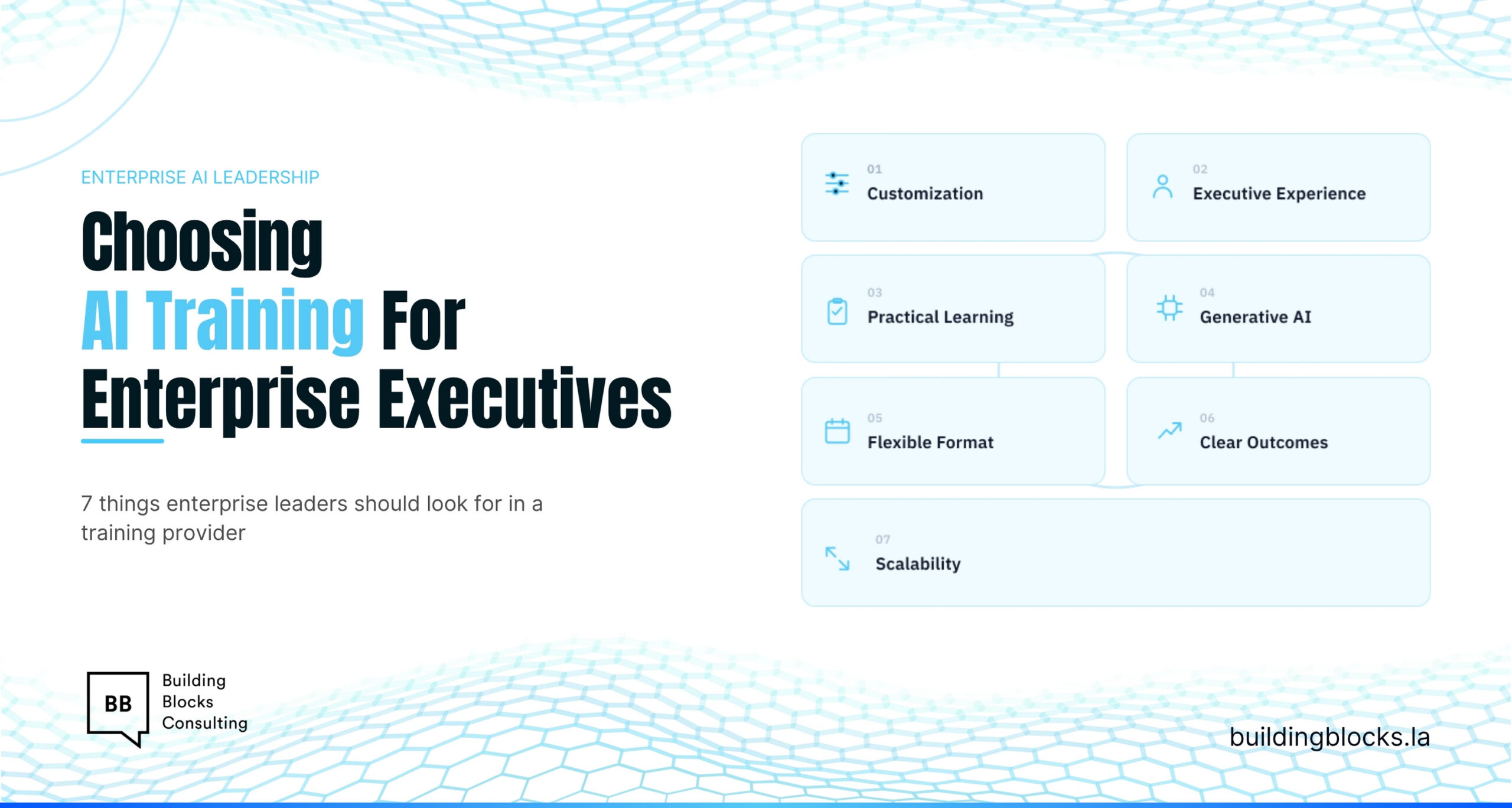
For organizations developing AI capability across multiple departments, structured enterprise training can provide a consistent foundation while allowing learning to be adapted for different audiences.
BuildingBlocks Consulting provides AI training for enterprises focused on practical AI skills, workforce enablement, generative AI education, and leadership AI understanding.
The appropriate training approach depends on the organization’s workforce, existing capabilities, business objectives, and AI use cases.
When Should a Business Start Workforce AI Upskilling?
Organizations do not need to wait until every AI initiative has been finalized.
Workforce training can begin when a business is:
- Introducing generative AI tools
- Developing an AI strategy
- Identifying AI use cases
- Experiencing inconsistent AI usage
- Preparing employees for changing workflows
- Expanding AI adoption
- Building internal AI capabilities
- Establishing responsible AI practices
Starting with a readiness assessment can help determine where training should begin and which employee groups should be prioritized.
Final Takeaway
Building AI skills across a workforce is not simply about giving employees access to AI tools or sending everyone through the same online course.
Organizations need to understand their current capabilities, identify relevant skill gaps, create role-specific learning paths, provide practical training, and continue developing those skills as AI evolves.
The most effective workforce AI upskilling programs connect learning to real business workflows.
When employees understand how to use AI appropriately within their roles—and understand its limitations—organizations are better positioned to turn AI adoption into practical, sustainable capability.




By Chris Clifford
Chris Clifford was born and raised in San Diego, CA and studied at Loyola Marymount University with a major in Entrepreneurship, International Business and Business Law. Chris founded his first venture-backed technology startup over a decade ago and has gone on to co-found, advise and angel invest in a number of venture-backed software businesses. Chris is the CSO of Building Blocks where he works with clients across various sectors to develop and refine digital and technology strategy.