


How can we help?
Let's Talk
How can we help?
Let's Talk
Data platforms and AI applications require ongoing attention after they are deployed. Pipelines can fail, integrations can change, infrastructure requirements can grow, and application performance can shift over time.
Managed Data & AI Services help organizations handle these operational demands through ongoing monitoring, maintenance, troubleshooting, and optimization.
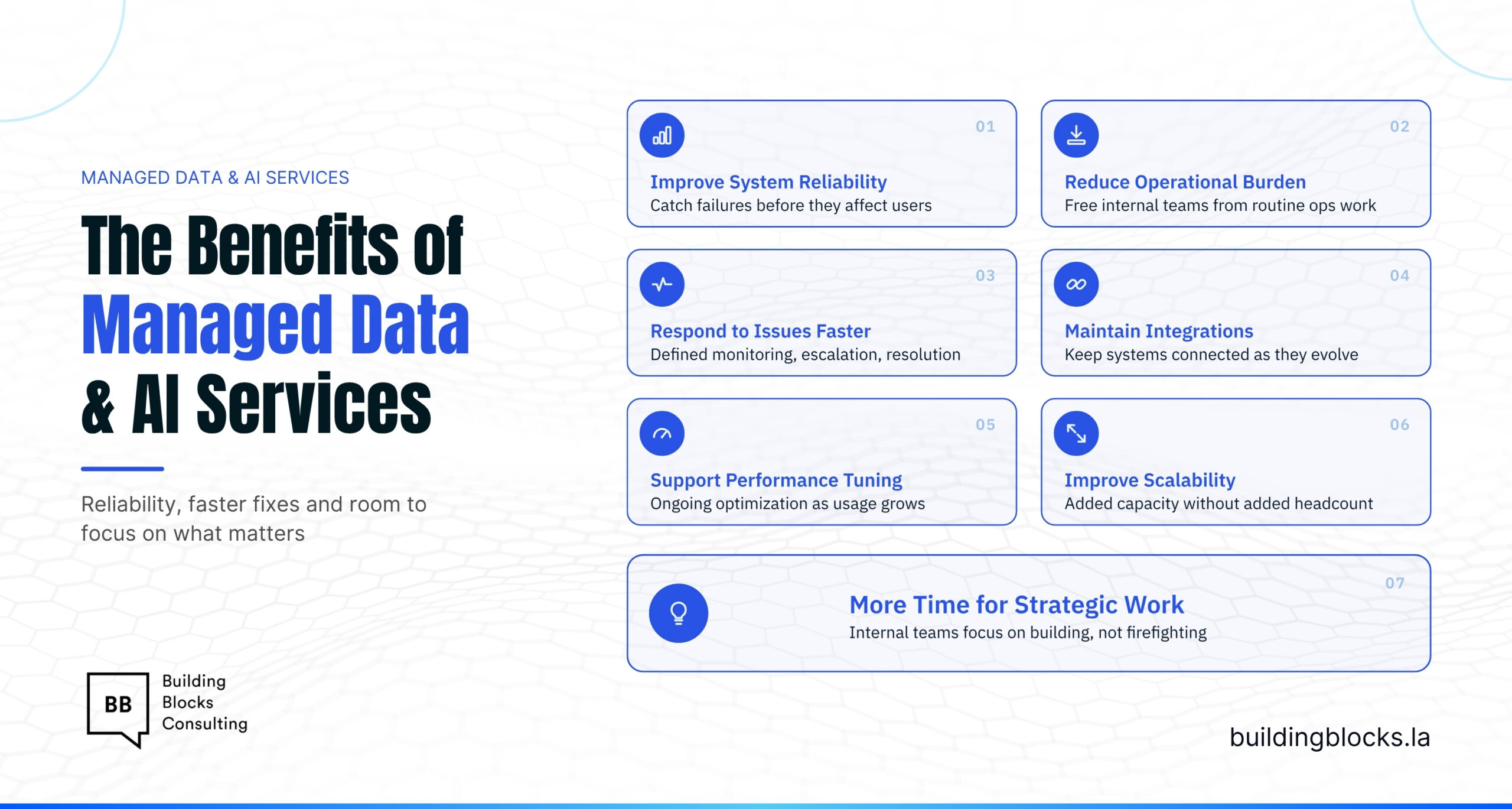
For businesses with growing data and AI environments, the main benefits include improved reliability, lower operational burden, faster issue resolution, and more capacity for internal teams to focus on higher-value work.
What Are the Benefits of Managed Data & AI Services?
1. Improve System Reliability
Continuous monitoring can help identify pipeline failures, application issues, integration problems, and other operational disruptions.
Instead of discovering problems after they affect users or business processes, organizations can establish processes for detecting and addressing issues more consistently.
2. Reduce the Operational Burden on Internal Teams
Managing production data and AI systems requires ongoing technical work.
Internal teams may spend significant time on:
- Monitoring systems
- Troubleshooting failures
- Maintaining integrations
- Managing infrastructure
- Responding to incidents
- Performing routine maintenance
Managed support can take responsibility for defined operational activities, allowing internal teams to spend more time on development, architecture, and strategic initiatives.
3. Respond to Issues More Effectively
Production problems require timely investigation and resolution.
A managed services approach provides defined processes for monitoring, incident response, troubleshooting, and escalation. This can help organizations respond more consistently when data pipelines, applications, APIs, or infrastructure experience problems.
4. Maintain Integrations as Systems Change
Data and AI environments rarely remain static.
APIs change, source systems are updated, applications evolve, and new platforms may be introduced. These changes can affect existing integrations and workflows.
Ongoing technical support helps organizations maintain connections between data platforms, AI applications, enterprise systems, APIs, and external services as the environment evolves.
5. Support Performance Optimization
Keeping systems operational is only part of ongoing management. Performance may also need to be reviewed and improved as usage, data volumes, models, and infrastructure requirements change.
Managed services can support activities such as performance analysis, configuration changes, optimization, and ongoing technical improvements.
6. Improve Operational Scalability
As organizations grow, data volumes and AI usage can increase faster than internal operational capacity.
Managed support can provide additional technical capacity without requiring an organization to immediately expand its internal team for every operational requirement.
This can be particularly useful when organizations have multiple data platforms, AI applications, integrations, or production environments to support.
7. Give Internal Teams More Time for Strategic Work
Internal engineering and data teams often need to balance operational responsibilities with strategic initiatives.
By shifting defined monitoring, maintenance, and support activities to a managed partner, internal teams can dedicate more time to:
- Building new data and AI capabilities
- Improving products and applications
- Developing new use cases
- Architecture and engineering improvements
- Business-focused innovation
The goal is not necessarily to replace internal expertise, but to use available technical resources more effectively.
When Do Managed Data & AI Services Make Sense?
Managed services can be valuable when an organization has production data or AI systems that require regular operational attention but does not want all monitoring, maintenance, and troubleshooting responsibilities handled internally.
They may be particularly useful when:
- Data and AI systems have become difficult to manage internally
- Production issues require frequent troubleshooting
- Internal teams have limited operational capacity
- Multiple systems and integrations need ongoing support
- Data or AI environments are growing quickly
- Organizations need consistent monitoring and maintenance
The right approach depends on the complexity and criticality of the environment.
Managed Services Are About Ongoing Improvement
Managed Data & AI Services are not limited to fixing problems after they occur.
Effective ongoing management combines monitoring, maintenance, troubleshooting, and optimization to help organizations keep their data and AI environments reliable as systems and business requirements evolve.
For businesses that have already invested in data and AI but need ongoing technical support, managed services can provide a practical way to maintain those systems while allowing internal teams to focus on higher-value priorities.




By Chris Clifford
Chris Clifford was born and raised in San Diego, CA and studied at Loyola Marymount University with a major in Entrepreneurship, International Business and Business Law. Chris founded his first venture-backed technology startup over a decade ago and has gone on to co-found, advise and angel invest in a number of venture-backed software businesses. Chris is the CSO of Building Blocks where he works with clients across various sectors to develop and refine digital and technology strategy.