


How can we help?
Let's Talk
How can we help?
Let's Talk
Before investing in an AI implementation, businesses need to answer an important question:
Is our data ready for AI?
Having large amounts of data does not automatically mean an organization has an AI-ready data foundation. Data may be fragmented across systems, inconsistent, difficult to access, poorly documented, or subject to governance restrictions.
Data readiness should therefore be assessed against the specific AI use case the organization wants to implement. The same dataset may be suitable for one application but inadequate for another.
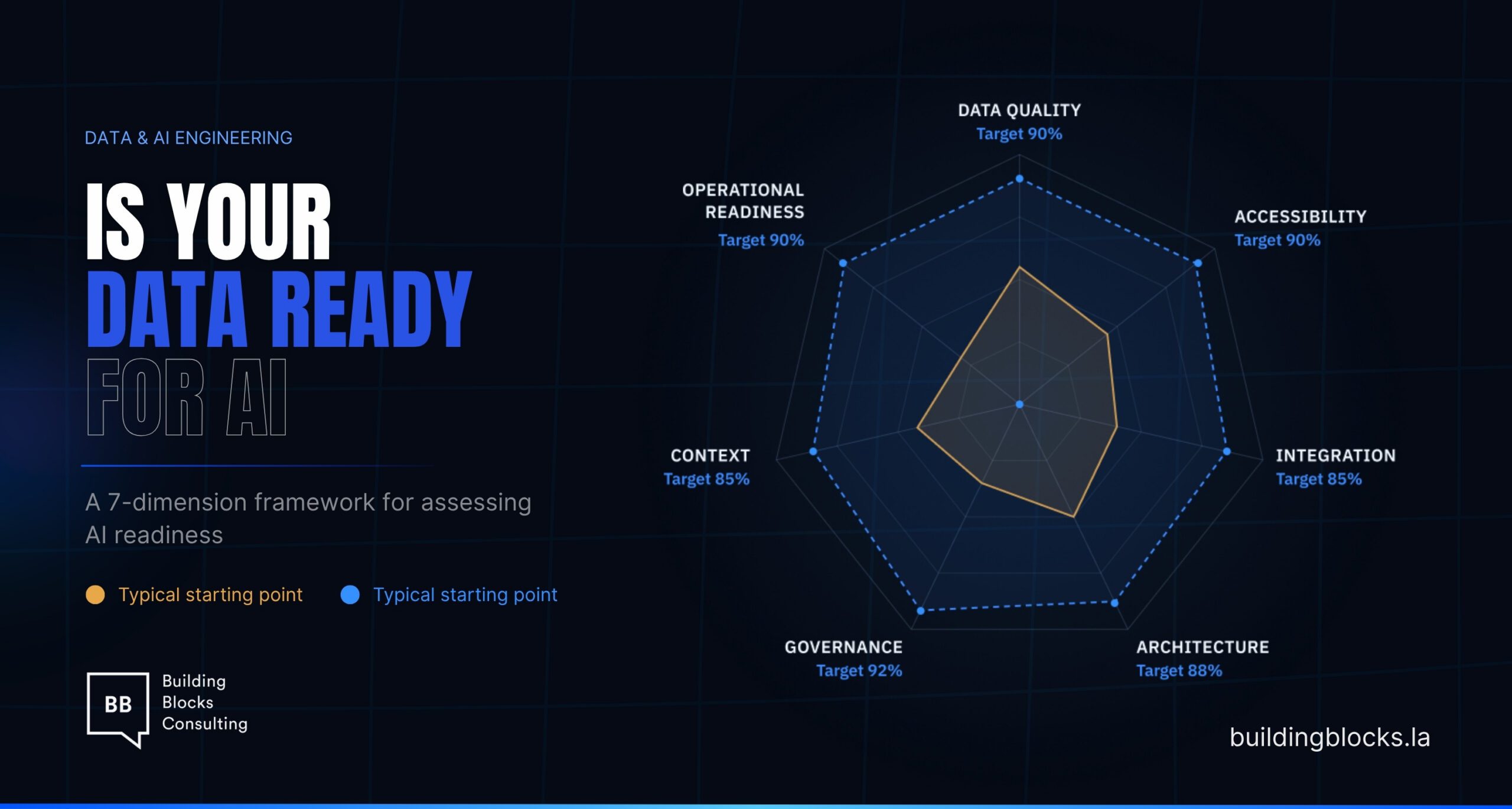
A practical assessment should examine data quality, accessibility, architecture, integration, governance, and the processes required to keep data reliable over time.
What Does Data Readiness for AI Mean?
Data readiness for AI means that the data required for a particular AI use case is sufficiently accurate, relevant, accessible, governed, and usable for the intended application.
There is no single checklist that makes every organization’s data “AI-ready.”
For example, an AI application that summarizes internal documents may have different data requirements from a machine learning system that predicts customer churn.
The first step is therefore to define the AI use case and then assess whether the available data can support it.
1. Identify the Data the AI Use Case Requires
Start by defining what information the proposed AI system actually needs.
Ask:
- What business problem will the AI system solve?
- What data sources will it need?
- Where does that data currently exist?
- How frequently does the data change?
- Who owns the data?
- Are there gaps in the available information?
For a customer-facing AI application, the required data might include customer records, product information, support documentation, and transaction history.
For an internal knowledge assistant, the requirements could include policies, procedures, documents, and other trusted organizational information.
This use-case-first approach prevents organizations from spending time preparing large amounts of data that the AI application may never need.
2. Evaluate Data Quality
Data quality is one of the most important parts of an AI readiness assessment.
Common areas to evaluate include:
- Accuracy
- Completeness
- Consistency
- Timeliness
- Validity
- Uniqueness
- Relevance
For example, if customer records contain duplicate accounts, inconsistent names, outdated contact information, or missing fields, those issues can affect downstream AI applications.
The required quality threshold depends on the use case. Data does not need to be perfect, but organizations need to understand its limitations and determine whether it is fit for the intended purpose. GOV.UK+1
3. Check Where the Data Lives
Enterprise data is rarely stored in one place.
It may be distributed across:
- Operational databases
- Data warehouses
- Cloud platforms
- SaaS applications
- Internal systems
- File repositories
- APIs
- Data lakes
- Customer-facing applications
Map the major sources involved in the AI use case and determine how easily they can be accessed.
A dataset that exists but cannot be reliably accessed by the application may be just as problematic as missing data.
4. Assess Data Integration
AI systems often need information from multiple sources.
For example, an AI application supporting customer service may need to combine customer information, product data, support tickets, documentation, and transaction records.
Ask whether these systems can exchange data reliably.
Look for issues such as:
- Incompatible data formats
- Duplicate records
- Missing integrations
- Manual data transfers
- Unreliable APIs
- Disconnected systems
- Different definitions for the same business information
Integration problems can become a major engineering requirement when moving an AI project toward production.
5. Review the Data Architecture
The underlying data architecture also matters.
Consider how data moves through the organization and where it is stored, transformed, processed, and consumed.
An assessment should examine whether the existing environment can support the expected AI workload without creating unnecessary complexity.
This doesn’t mean every organization needs to replace its existing data platform.
In many cases, targeted improvements to pipelines, integration, transformation, storage, or access patterns may be more appropriate than rebuilding the entire environment.
Modern enterprise AI architectures increasingly require data environments that support reliable access, contextual information, integration, and scalable AI workloads. Gartner+1
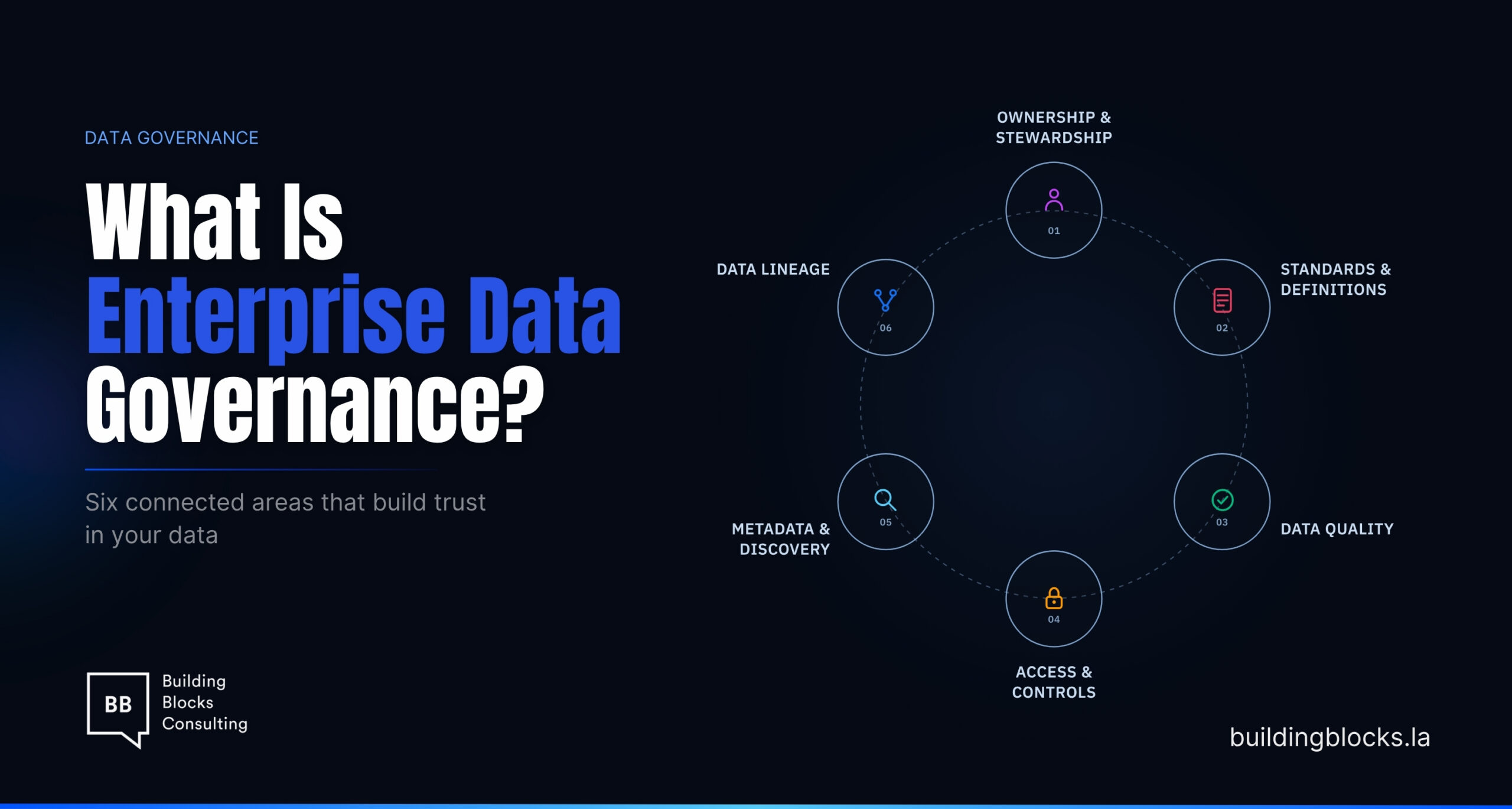
6. Check Data Governance and Ownership
Data readiness is not only a technical issue.
Organizations should know who owns important datasets, who can access them, how they can be used, and what controls apply to them.
Review:
- Data ownership
- Access permissions
- Sensitive information
- Retention requirements
- Data usage policies
- Metadata
- Data lineage
- Stewardship responsibilities
Governance becomes particularly important when AI applications use sensitive business or customer information.
A technically accessible dataset may still be unsuitable for a particular AI use case if the organization does not have the appropriate permissions or controls.
7. Evaluate Metadata and Context
AI systems need more than raw data.
They often need context to understand what the information represents.
Metadata can help explain where data came from, what fields mean, when information was created, and how it should be interpreted.
This becomes especially important for generative AI and retrieval-based systems that need to retrieve relevant business information.
If documents or datasets lack useful organization, descriptions, ownership, or other context, additional preparation may be necessary before they can reliably support an AI application.
8. Consider Data Freshness
Some AI use cases can work with relatively static information.
Others depend on current information.
For example, an AI assistant answering questions about company policies may work with documents updated periodically. A system supporting inventory, pricing, fraud detection, or operational decisions may require much more current information.
Ask:
- How frequently does the data change?
- How quickly does the AI system need updated information?
- Can updates flow automatically?
- Are stale records identified?
- Are pipelines monitored?
Data freshness requirements should be defined according to the actual business use case.
9. Assess Security and Privacy Requirements
Before connecting business data to an AI system, determine what information can be used and under what conditions.
Sensitive information may require additional controls around access, storage, processing, and transmission.
Review whether the proposed architecture can support appropriate security controls and whether existing policies address AI-related data use.
This is particularly important when AI applications interact with customer records, employee information, financial data, intellectual property, or other sensitive information.
10. Determine Whether the Data Can Support Production
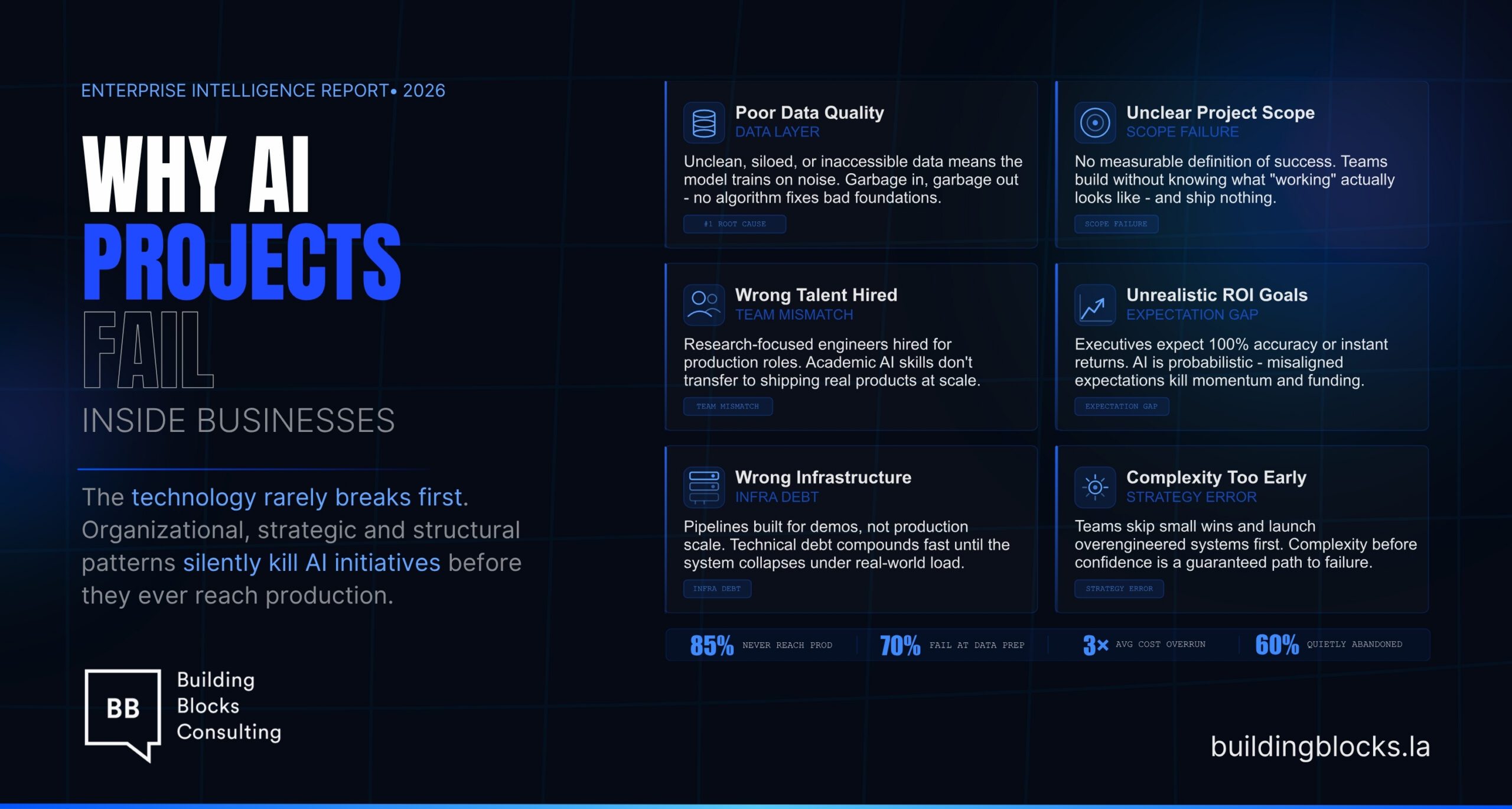
A dataset may be sufficient for a proof of concept but still be unsuitable for production.
Production AI requires more than a successful demonstration.
Consider whether the organization can maintain:
- Reliable data pipelines
- Consistent data quality
- Monitoring
- Access controls
- Error handling
- Data updates
- Operational ownership
- Integration with downstream systems
A readiness assessment should therefore look beyond whether an AI prototype can work and ask whether the supporting data environment can operate reliably over time.
A Simple Data Readiness Assessment
Organizations can use the following questions as a starting point.
Data quality
Is the data accurate, complete, consistent, relevant, and sufficiently current?
Data accessibility
Can the AI application access the required data reliably?
Data integration
Can information from different systems be connected without excessive manual work?
Data architecture
Can the existing architecture support the required AI workloads and data flows?
Data governance
Are ownership, permissions, security, lineage, and usage requirements clearly defined?
Data context
Does the data have enough metadata, structure, and business context to be interpreted correctly?
Operational readiness
Can the organization maintain data pipelines, monitor quality, and address issues once the AI system is in production?
If several of these areas have significant gaps, the organization may need data engineering or data platform work before implementing the planned AI system.
Does Data Need to Be Perfect Before AI Implementation?
No.
Waiting for every data problem to be solved before starting an AI initiative can create unnecessary delays.
The more useful question is whether the data is fit for the specific AI use case.
Some issues can be addressed during implementation. Others may represent fundamental blockers.
For example, a minor formatting inconsistency may be relatively easy to resolve. Missing source data, unclear ownership, inaccessible systems, or serious quality problems may require substantially more work.
The objective is to identify the gaps early and prioritize them according to their impact on the planned AI system.
What Happens After a Data Readiness Assessment?
The outcome should not simply be a list of data problems.
A useful assessment should help the organization determine:
- What is already ready
- What needs improvement
- Which gaps could block implementation
- Which issues can be addressed during development
- What engineering work should happen first
- What the target data architecture should look like
- What should be monitored after deployment
This creates a practical roadmap from the current data environment toward the requirements of the AI project.
When Data Engineering Support Is Needed
If the assessment identifies significant gaps, the next step may involve data engineering rather than immediately building the AI application.
Engineering work might include improving data pipelines, integrating systems, transforming data, developing data platforms, implementing monitoring, or creating the infrastructure required for AI applications.
This is where Data & AI Engineering Services can become relevant. The focus is not simply on preparing a dataset once, but on building the reliable data and technical foundation required to support AI in production.
How BuildingBlocks Can Help
BuildingBlocks Consulting provides Data & AI Engineering Services to help organizations design, build, integrate, and improve the technical systems that support AI initiatives.
This can include data pipelines, data integration, data transformation, data architecture, data platforms, AI applications, AI integrations, and production infrastructure.
For organizations assessing an AI initiative, the starting point is understanding the gap between the current data environment and what the intended use case requires.
That assessment can then determine what needs to be improved, integrated, or engineered before the AI system moves toward production.
Final Takeaway
AI readiness starts with understanding the data behind the use case.
Before selecting a model or building an AI application, organizations should determine whether the required data is available, reliable, accessible, integrated, governed, and operationally sustainable.
The goal isn’t to make every piece of enterprise data perfect.
The goal is to identify what the AI application actually needs, understand the gaps, and prioritize the engineering work required to create a reliable foundation.
For organizations moving from an AI concept or proof of concept toward a production system, a structured data readiness assessment can provide the technical clarity needed to decide what should happen next.





By Chris Clifford
Chris Clifford was born and raised in San Diego, CA and studied at Loyola Marymount University with a major in Entrepreneurship, International Business and Business Law. Chris founded his first venture-backed technology startup over a decade ago and has gone on to co-found, advise and angel invest in a number of venture-backed software businesses. Chris is the CSO of Building Blocks where he works with clients across various sectors to develop and refine digital and technology strategy.