

How can we help?
Let's Talk
How can we help?
Let's Talk
Integrating AI into a business is rarely as simple as connecting an AI model to an application.
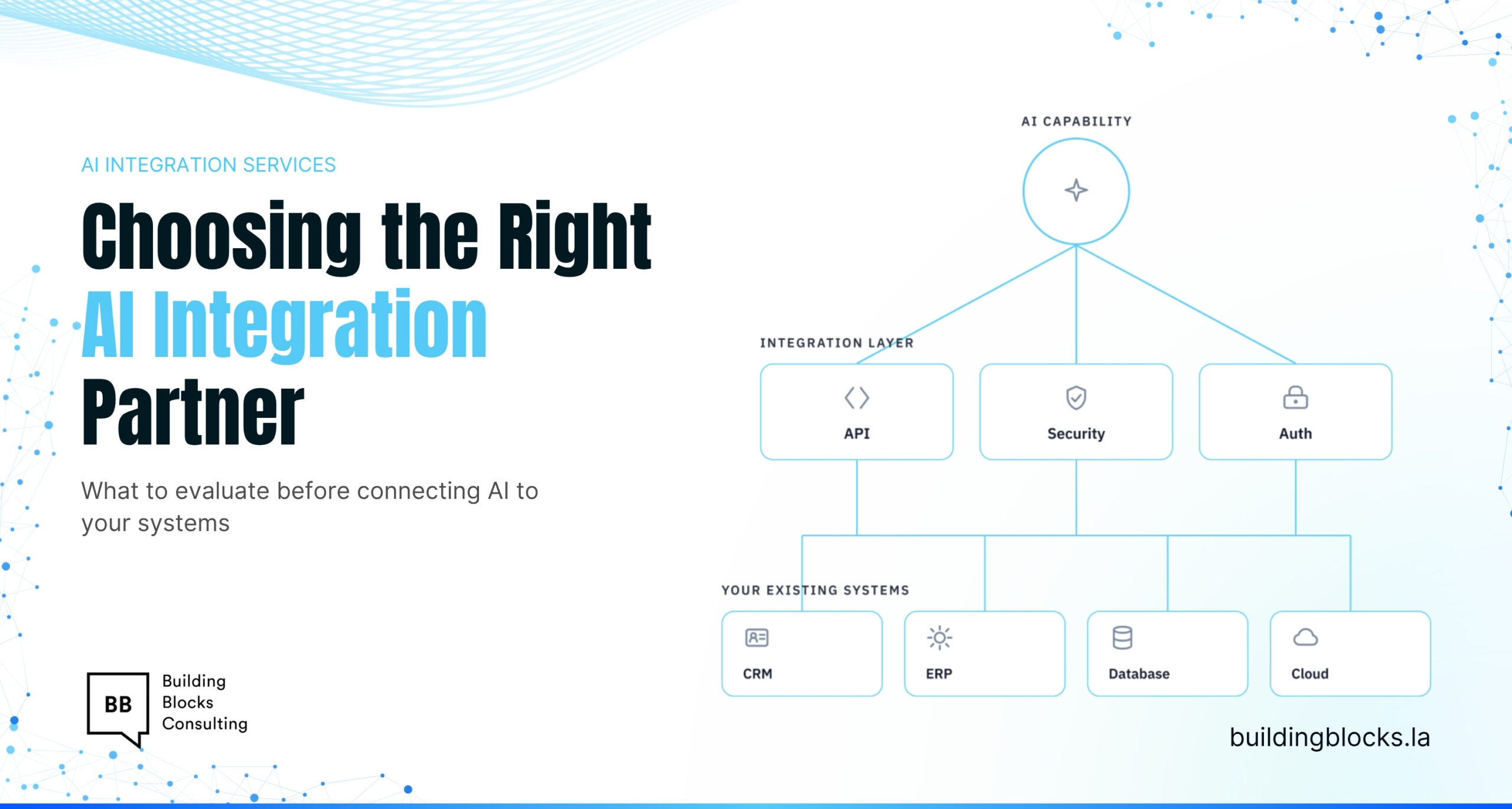
In a real enterprise environment, AI may need to work with existing applications, databases, APIs, cloud infrastructure, authentication systems, workflows, and business processes.
That makes the choice of an AI integration partner an important technical and business decision.
The right partner should be able to understand your existing environment, select appropriate AI technologies, build reliable integrations, address security requirements, and support the system after it reaches production.
So how should a business evaluate potential AI integration partners?
Start With the Integration Problem
Before comparing providers, define what you actually want to integrate.
For example, your organization may want to:
- Add an AI assistant to an existing application
- Connect generative AI to internal business data
- Integrate AI capabilities into a customer-facing product
- Connect an AI model with enterprise APIs
- Automate a workflow using AI
- Add machine learning capabilities to an existing system
- Build a retrieval-based AI application
- Connect AI tools with databases or cloud platforms
The partner you choose should have experience with the type of integration you need.
A company that primarily builds standalone AI prototypes may not have the same capabilities as a team experienced in integrating AI into complex enterprise environments.
1. Evaluate API and Integration Expertise
APIs are often central to AI integration.
An AI system may need to communicate with existing applications, databases, SaaS platforms, internal services, or third-party tools.
Ask potential partners how they approach API integration and whether they have experience working with the systems your organization already uses.
Look for experience with:
- REST APIs
- Authentication and authorization
- Webhooks
- Data exchange
- Third-party APIs
- Internal APIs
- Service-to-service communication
- Error handling
- Rate limits
- API monitoring
The goal isn’t simply to connect two systems. The integration needs to remain reliable when data changes, services become unavailable, traffic increases, or business requirements evolve.
2. Look at Existing-System Integration Experience
Enterprise AI rarely operates in isolation.
Your AI application may need information from an existing CRM, ERP, database, document repository, data warehouse, customer portal, or internal application.
Ask prospective partners to explain how they approach integration with existing systems.
A good partner should first understand the current architecture rather than immediately recommending a new technology stack.
They should be able to identify:
- Where data currently resides
- Which systems need to communicate
- What interfaces are available
- Where data transformation is required
- What systems should remain unchanged
- Where new AI capabilities should be introduced
This architectural understanding can prevent an AI project from creating unnecessary complexity.
3. Check Their AI Technology Experience
“AI integration” can mean many different things.
Depending on the project, the integration may involve large language models, machine learning models, retrieval systems, AI APIs, computer vision, speech technologies, or other AI capabilities.
Ask the potential partner what types of AI systems they have actually built and integrated.
For generative AI projects, for example, relevant experience may include model APIs, retrieval-augmented systems, embeddings, vector databases, prompt workflows, output evaluation, and application-level controls.
The important point is to evaluate practical implementation experience, not simply familiarity with AI terminology.
4. Ask How They Handle Security
Security should be discussed before an AI integration reaches production.
AI systems may interact with sensitive company, customer, employee, financial, or intellectual-property data.
Ask potential partners how they approach:
- Authentication
- Authorization
- Data access
- Encryption
- Secrets management
- Logging
- Sensitive information
- User permissions
- Third-party AI services
- Data retention
You should also understand how the proposed architecture prevents users or AI applications from accessing information they are not authorized to access.
For enterprise environments, security should be considered as part of the architecture rather than added after the integration has already been built.
5. Evaluate Cloud and Infrastructure Knowledge
Your AI integration may need to operate across cloud services, existing infrastructure, or hybrid environments.
Ask whether the partner has experience with the cloud environment your organization uses.
This might include AWS, Microsoft Azure, Google Cloud, or a combination of environments.
Cloud experience matters because AI integration can involve compute resources, storage, networking, identity, monitoring, APIs, databases, and deployment infrastructure.
A strong integration partner should be able to explain how these components fit together rather than treating the AI model as the entire solution.
6. Ask About Scalability
A proof of concept may work with ten users and still fail when hundreds or thousands of users access it.
Ask how the partner designs for growth.
Consider:
- Expected user volume
- API traffic
- Model usage
- Response times
- Data volume
- Infrastructure scaling
- Cost management
- Failure recovery
- Monitoring
Scalability should be considered according to the expected business requirements rather than assuming every AI application needs a highly complex architecture.
The right partner should help determine what level of infrastructure is actually necessary.
7. Look for Production Experience
One of the most important questions to ask is:
“Have you taken similar AI integrations into production?”
Building a demonstration is different from operating a production system.
Production experience means dealing with issues such as:
- Reliability
- Monitoring
- Security
- Performance
- Deployment
- Error handling
- Maintenance
- System updates
- User access
- Operational support
Ask potential partners about projects that moved beyond experimentation and into real business use.
This can reveal whether their experience extends beyond prototypes.
8. Understand Their Approach to AI Output Quality
Integrating an AI model doesn’t guarantee useful results.
For many AI applications, output quality needs to be evaluated continuously.
Ask how the partner approaches:
- Output evaluation
- Accuracy
- Relevance
- Hallucination risks
- Human review
- Testing
- Monitoring
- Model changes
For example, if an AI assistant is answering questions using internal company information, the integration needs to retrieve appropriate information and provide useful responses based on trusted sources.
The partner should have a method for testing whether the system actually performs the intended task.
9. Ask How They Handle Existing Business Workflows
The best AI integration isn’t necessarily the one with the most sophisticated AI model.
It is the one that fits into how the business already operates.
Consider an organization where employees currently review customer requests manually.
An AI system might classify incoming requests, summarize relevant information, and route the request to the appropriate team.
The value comes from connecting the AI capability to the existing workflow—not simply adding a chatbot.
Ask potential partners how they identify opportunities to integrate AI into real business processes.
10. Understand What Happens After Deployment
AI integration is not necessarily a one-time project.
Models, APIs, applications, business requirements, and security requirements can change.
Ask what support the partner provides after deployment.
Depending on your requirements, this could include:
- Monitoring
- Troubleshooting
- Performance optimization
- API maintenance
- Infrastructure improvements
- Model updates
- Integration changes
- Scaling support
This is particularly important for organizations that don’t have the internal engineering capacity to maintain AI integrations themselves.
11. Evaluate Communication and Technical Documentation
Technical capability isn’t enough if the partner cannot communicate clearly.
Ask how they document the integration architecture, APIs, dependencies, configuration, security controls, and operational requirements.
You should also understand who will communicate with your internal engineering, security, data, and product teams.
A good partner should be able to explain complex technical decisions in language that both technical and business stakeholders can understand.
12. Look for a Partner That Can Work With Your Existing Team
An external AI integration partner shouldn’t necessarily replace your internal engineering team.
In many cases, the best arrangement is collaborative.
Your internal team may understand the existing architecture, business requirements, and operational environment better than anyone else.
The external partner can bring specialized AI and integration expertise.
Ask how the potential partner works with internal developers, architects, data teams, security teams, and product owners.
Questions to Ask an AI Integration Partner
Before selecting a provider, consider asking:
- What types of AI integrations have you delivered?
- Have you integrated AI with systems similar to ours?
- Which APIs and enterprise platforms have you worked with?
- How do you approach security and access control?
- How do you handle sensitive business data?
- What cloud environments do you support?
- How do you test AI output quality?
- How do you design for scalability?
- Have you taken similar projects into production?
- What happens after deployment?
- How will you work with our internal engineering team?
The answers can help distinguish genuine integration experience from general AI consulting knowledge.
When Should You Use an External AI Integration Partner?
External support can be useful when your organization has a clear AI opportunity but lacks the specialized engineering resources needed to implement it.
This can happen when:
- Your AI proof of concept needs to reach production.
- AI needs to connect with multiple enterprise systems.
- Your internal team lacks specialized AI engineering experience.
- You need to integrate AI with existing APIs or applications.
- Your organization needs help designing the technical architecture.
- You need production deployment and infrastructure support.
The objective isn’t necessarily to outsource everything.
An experienced partner can help fill specific technical gaps while working alongside the organization’s existing teams.
How BuildingBlocks Approaches AI Integration
BuildingBlocks Consulting provides AI Integration Services as part of its broader Data & AI Engineering capabilities.
The work can involve connecting AI applications and capabilities with existing software, APIs, databases, business applications, cloud platforms, and workflows.
For organizations evaluating an integration project, the important first step is understanding the existing technical environment and the business requirement.
From there, the architecture, integration approach, AI components, infrastructure, security considerations, and production requirements can be defined around the actual use case.
Choosing the Right AI Integration Partner
The right AI integration partner should bring more than AI knowledge.
They should understand enterprise systems, APIs, security, cloud infrastructure, application architecture, data, and production operations.
Before making a decision, evaluate how well the partner can work within your existing environment and whether they have demonstrated experience taking AI systems from concept to reliable production use.
If your organization is evaluating an AI integration project, Data & AI Engineering Services can provide the broader engineering foundation needed to connect, deploy, and operate AI capabilities within existing business environments.
The best integration is not necessarily the most complicated one. It is the one that solves the business problem reliably, securely, and in a way your organization can operate and scale.




By Chris Clifford
Chris Clifford was born and raised in San Diego, CA and studied at Loyola Marymount University with a major in Entrepreneurship, International Business and Business Law. Chris founded his first venture-backed technology startup over a decade ago and has gone on to co-found, advise and angel invest in a number of venture-backed software businesses. Chris is the CSO of Building Blocks where he works with clients across various sectors to develop and refine digital and technology strategy.