

How can we help?
Let's Talk
How can we help?
Let's Talk
Enterprise AI training doesn’t have a single standard price.
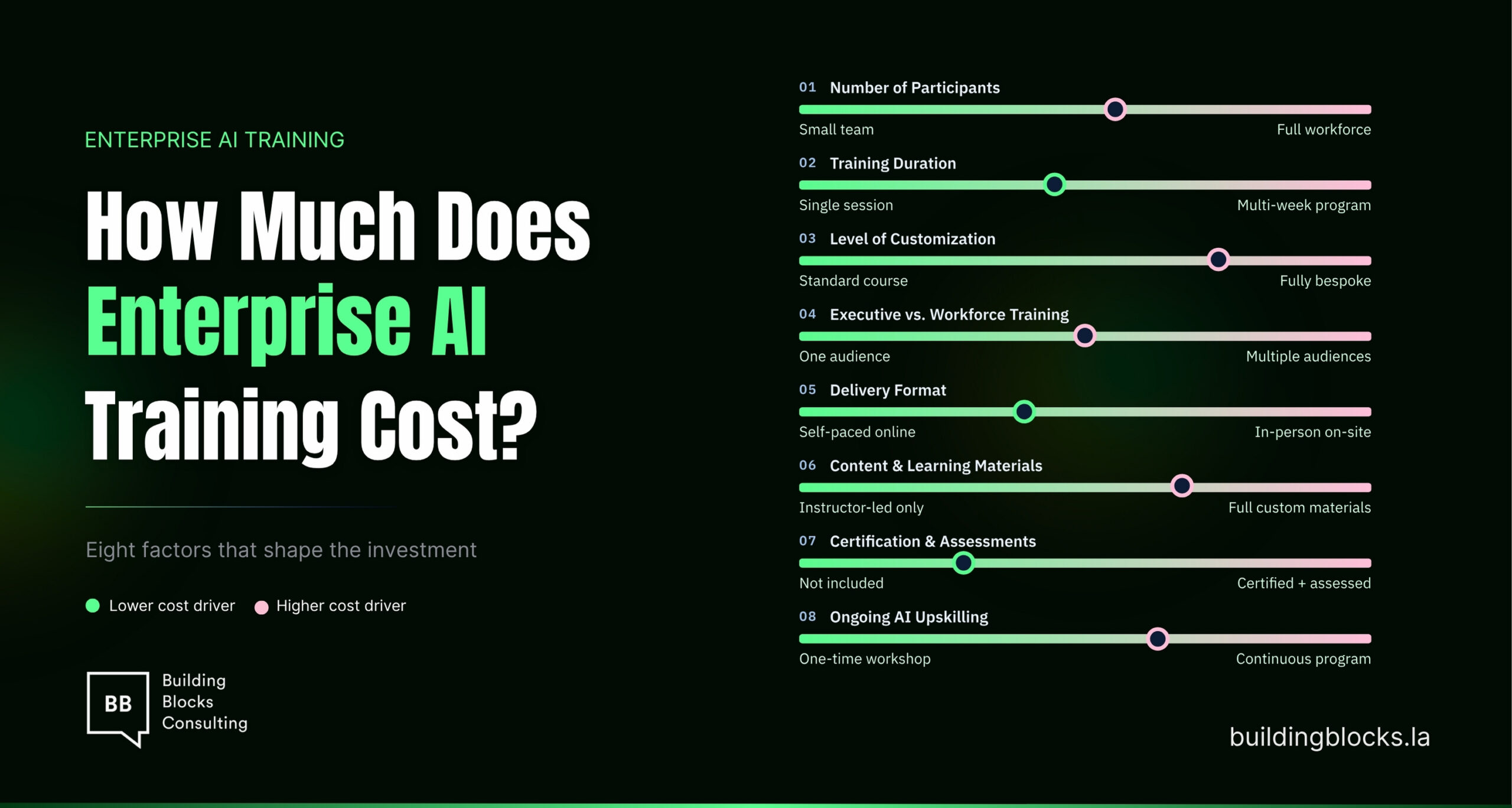
A short AI literacy workshop for a leadership team can have very different costs from a customized AI upskilling program delivered to hundreds or thousands of employees. The final investment depends on factors such as the number of participants, training format, program duration, level of customization, trainer expertise, and whether the organization needs ongoing support.
For companies planning an AI training initiative, understanding these cost factors is more useful than looking for a single fixed price.
What Is the Typical Cost of Enterprise AI Training?
Enterprise AI training can range from relatively simple group workshops to highly customized, multi-stage workforce programs.
A basic program may involve a short virtual session focused on AI awareness and fundamentals. More advanced programs can include executive workshops, hands-on learning, role-specific training, customized content, assessments, and ongoing AI upskilling.
Because enterprise requirements vary significantly, providers may price training based on:
- Number of participants
- Number and length of sessions
- Training format
- Level of customization
- Audience and job roles
- Training objectives
- Subject-matter expertise required
- Hands-on exercises and workshops
- Assessments or certification
- Ongoing learning requirements
For this reason, businesses should evaluate what is included in a training proposal rather than comparing prices alone.
What Factors Affect Enterprise AI Training Costs?
1. Number of Participants
The size of the audience is one of the most obvious cost factors.
Training a group of 10 executives is different from training several hundred employees across multiple departments.
Larger programs may require multiple cohorts, additional trainers, different schedules, or separate learning paths.
However, a larger participant count does not necessarily mean that the cost simply increases on a per-person basis. Enterprise providers may structure pricing differently for organization-wide programs.
2. Training Duration
A one-hour AI awareness session will generally require less investment than a multi-week learning program.
Enterprise training can range from:
- Executive briefings
- Half-day or full-day workshops
- Multi-session programs
- Department-specific training
- Long-term AI upskilling initiatives
The right duration depends on the learning objectives.
If the goal is simply to establish AI literacy, a short program may be sufficient. If employees need to develop practical AI skills for their roles, additional learning and hands-on practice may be necessary.
3. Level of Customization
Customization can have a significant effect on the cost of enterprise AI training.
A standard AI course uses existing material that can be delivered to many organizations.
A customized program may require the training provider to understand the organization’s:
- Industry
- Business objectives
- Employee roles
- Existing AI capabilities
- Technology environment
- Internal workflows
- AI use cases
- Responsible AI requirements
For example, an executive team in financial services may need training that addresses different business scenarios and risks than a manufacturing organization.
The more specialized the training requirements, the more preparation and content development may be involved.
4. Executive Workshops vs. Workforce Training
Not every employee needs the same type of AI education.
Executive AI training typically focuses on business impact, AI opportunities, investment decisions, risks, governance, and organizational readiness.
Employee programs may focus more on practical AI tools, productivity, prompting, workflow automation, and role-specific applications.
Because these programs have different objectives, their delivery and pricing can also differ.
Organizations should define their audiences before requesting training proposals.
5. Delivery Format
The format of training can influence the overall investment.
Common options include:
- Live virtual training
- In-person workshops
- Hybrid programs
- Self-paced learning
- Instructor-led online courses
- On-site executive sessions
In-person programs may involve additional costs related to travel, location, and logistics.
Virtual programs can make it easier to train geographically distributed teams and organize multiple cohorts.
The best format depends on the size and location of the workforce, the learning objectives, and the level of interaction required.
6. Training Content and Learning Materials
Some organizations need only instructor-led sessions, while others require a more complete learning experience.
Additional components may include:
- Customized presentations
- Practical exercises
- AI use-case workshops
- Assessments
- Learning resources
- Internal AI guidelines
- Role-specific materials
- Follow-up sessions
When comparing proposals, businesses should determine whether these elements are included in the quoted price or treated as additional services.
7. Certification and Assessments
Some corporate AI training programs include assessments or certificates.
Certification can be useful when an organization wants to document employee participation or establish structured learning requirements.
However, certification should not be the primary measure of a successful enterprise AI training program.
For many organizations, the more important question is whether employees and leaders can apply what they learned to real business situations.
8. Ongoing AI Upskilling
AI technologies and workplace applications are changing quickly.
A one-time workshop may establish awareness, but some organizations need continuous learning as new tools, capabilities, policies, and use cases emerge.
An ongoing program could include:
- Refresher training
- New AI tool education
- Advanced workshops
- Role-specific learning
- Leadership sessions
- New generative AI training
- Periodic assessments
Organizations planning long-term AI adoption should consider ongoing learning when estimating their overall training investment.
How Much Should a Company Budget for AI Training?
There is no universal enterprise AI training budget because organizations have different workforce sizes, objectives, and levels of AI maturity.
Instead of starting with a fixed number, businesses should first define the scope of the program.
Consider these questions:
Who needs training?
Is the program for executives, managers, technical teams, business users, or the entire workforce?
What should participants learn?
Is the goal AI awareness, generative AI literacy, practical skills, or role-specific AI capability?
How much customization is required?
Will a standard curriculum work, or does the organization need content based on its industry and workflows?
How will training be delivered?
Will employees attend virtual sessions, in-person workshops, or a combination?
Is this a one-time program or an ongoing initiative?
The answers to these questions provide a much better basis for estimating cost than a generic industry average.
Enterprise AI Training Cost vs. Business Value
Cost should not be evaluated in isolation.
The more useful question is:
What business value could the training create?
Effective AI training can help organizations improve AI literacy, identify practical use cases, increase employee confidence, reduce inappropriate use of AI tools, and prepare teams for broader AI adoption.
For example, if training helps employees reduce repetitive administrative work or use AI more effectively for research, analysis, documentation, or content workflows, the resulting productivity improvements may become part of the program’s business case.
Leadership training can also help organizations avoid poorly defined AI investments by giving decision-makers a better understanding of AI capabilities and limitations.
How to Evaluate the ROI of Enterprise AI Training
Measuring AI training ROI can be challenging, particularly when benefits develop over time.
Organizations can track indicators such as:
- Employee participation and completion
- Improvement in AI knowledge
- Employee confidence using AI
- Number of practical AI use cases identified
- Adoption of approved AI tools
- Productivity improvements
- Time saved on selected workflows
- Reduction in inappropriate AI usage
- Progress toward AI capability goals
The metrics should match the purpose of the training.
For example, an executive AI workshop may be successful if it improves leadership alignment and helps identify high-value AI opportunities. An employee training program may be evaluated more heavily through skill development and workflow improvements.
How to Compare Enterprise AI Training Proposals
When comparing providers, looking only at the lowest price can lead to the wrong decision.
Instead, compare what each proposal actually includes.
Look at:
- Training hours
- Number of participants
- Number of cohorts
- Customization
- Trainer expertise
- Delivery format
- Learning materials
- Practical exercises
- Assessments
- Follow-up support
- Reporting and measurement
A lower-cost program may provide fewer customization options or less practical learning. A higher-cost program may include content development and delivery designed specifically around the organization’s needs.
The best option is not necessarily the cheapest. It is the one that provides the right level of capability for the organization’s goals.
When Does Customized Enterprise AI Training Make Sense?
Customized training is generally worth considering when an organization has specific learning requirements that generic courses cannot address.
This may include organizations that:
- Have multiple employee skill levels
- Need executive and workforce training
- Have specific AI use cases
- Operate in a specialized industry
- Want training based on internal workflows
- Are introducing generative AI across teams
- Need role-specific AI skills
- Want to establish a broader AI upskilling program
For organizations with simple AI literacy requirements, a standard program may be more appropriate.
What Should You Ask an AI Training Provider About Pricing?
Before selecting a program, ask the provider to clearly explain the pricing structure and scope.
Useful questions include:
- Is pricing based on participants, sessions, or the overall program?
- How much customization is included?
- Are additional cohorts priced separately?
- Are training materials included?
- Are assessments or certifications included?
- Are travel and on-site expenses included?
- What support is available after training?
- Can the program scale to additional employees?
- How will training outcomes be measured?
Clear answers make it easier to compare providers and avoid unexpected costs.
Is Enterprise AI Training Worth the Investment?
For organizations planning to use AI at scale, training can be an important part of building internal capability.
The value is not simply in teaching employees how to use AI tools. Effective enterprise training can help leaders make better decisions, help employees apply AI responsibly, and create a stronger foundation for AI-enabled workflows.
The right investment depends on what the organization is trying to achieve.
A leadership team may need a focused executive workshop. A large workforce may need structured AI upskilling. Another organization may need customized training around specific generative AI applications.
The scope should follow the business need.
Building an Enterprise AI Training Program
BuildingBlocks Consulting helps organizations develop practical AI capabilities through structured enterprise training for leaders, employees, and teams.
The focus can include AI literacy, generative AI training, practical AI skills, leadership education, and workforce AI upskilling based on organizational requirements.
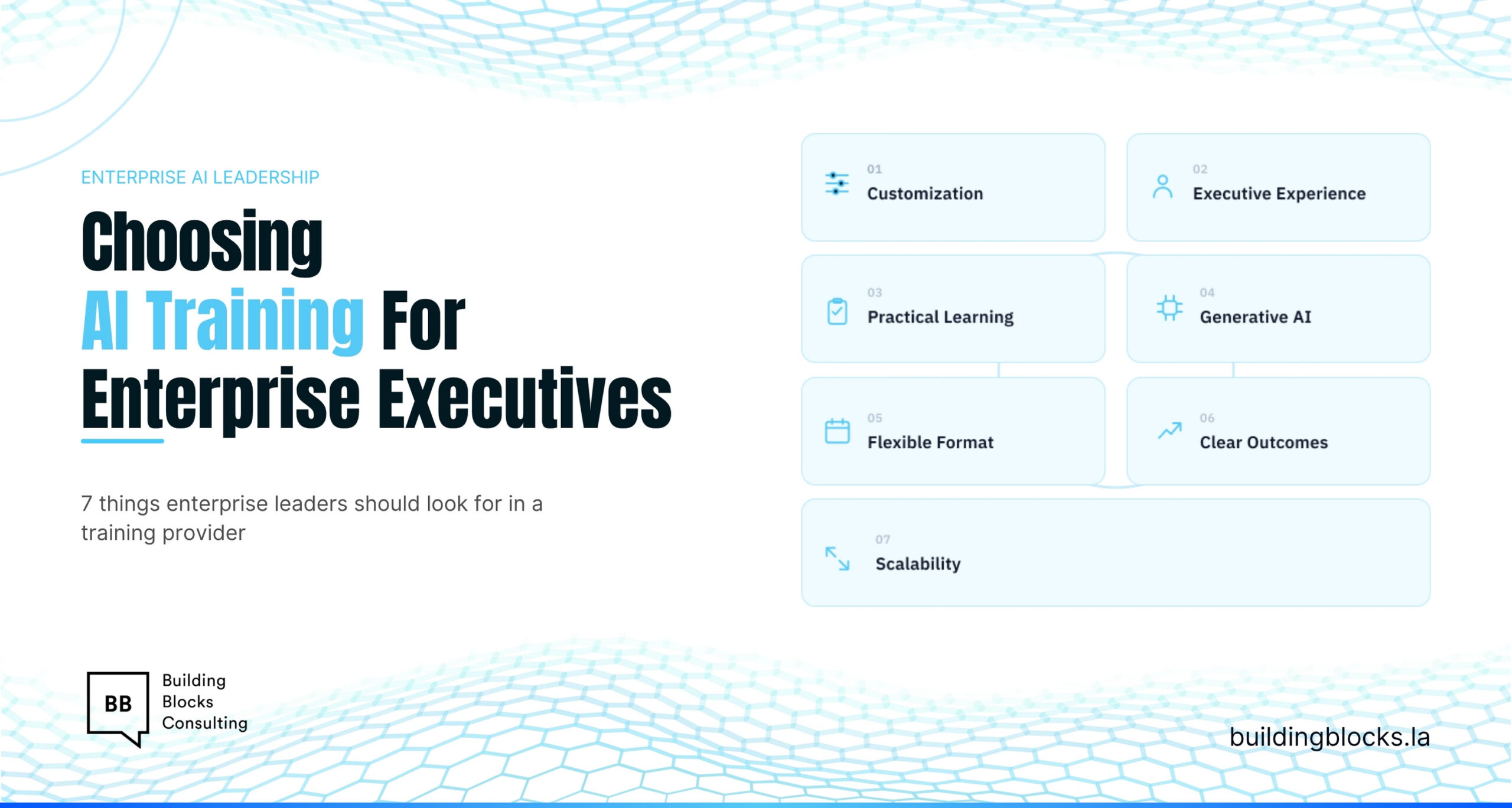
If your organization is evaluating the cost and scope of an AI training initiative, you can explore the AI Training for Enterprises service to understand what an enterprise training program can include.
Final Takeaway
There is no single price for enterprise AI training.
The cost depends on the number of participants, training duration, customization, delivery format, audience, learning objectives, and whether the organization needs ongoing AI upskilling.
Instead of choosing a program based solely on price, enterprise leaders should evaluate the training’s relevance, practical value, expected outcomes, and ability to support the organization’s longer-term AI goals.
A well-designed training program should do more than introduce employees to AI. It should help the organization build the knowledge and practical capability needed to use AI effectively and responsibly.




By Chris Clifford
Chris Clifford was born and raised in San Diego, CA and studied at Loyola Marymount University with a major in Entrepreneurship, International Business and Business Law. Chris founded his first venture-backed technology startup over a decade ago and has gone on to co-found, advise and angel invest in a number of venture-backed software businesses. Chris is the CSO of Building Blocks where he works with clients across various sectors to develop and refine digital and technology strategy.