


How can we help?
Let's Talk
How can we help?
Let's Talk
Organizations need to know who can access their data, why they need access, and whether those permissions remain appropriate over time.
This becomes especially important when businesses manage customer information, financial records, employee data, health information, intellectual property, or other sensitive information.
Data access governance provides a structured approach to managing these decisions. It establishes ownership, policies, responsibilities, access requirements, and review processes that help organizations control how data is accessed and used.
Strong access governance can support security and regulatory requirements, but it is important to understand that governance alone does not guarantee compliance.
What Is Data Access Governance?
Data access governance defines how an organization determines who should have access to data and under what conditions.
Technical access controls enforce permissions, but governance addresses the business decisions behind those permissions.
For example, an organization may need to determine:
- Who owns the data?
- Who should have access?
- Why is access required?
- Who approves it?
- When should access be reviewed?
- What happens when an employee changes roles?
These decisions create accountability around technical access controls.
Why Data Access Governance Matters
Data environments become more complex as organizations add applications, cloud platforms, data warehouses, analytics systems, and AI solutions.
Employees also change roles, contractors join and leave, and business requirements evolve.
Without a defined governance process, permissions can remain active longer than necessary or become difficult to review.
Access governance helps organizations establish a consistent process for managing these changes.
Start With Data Ownership
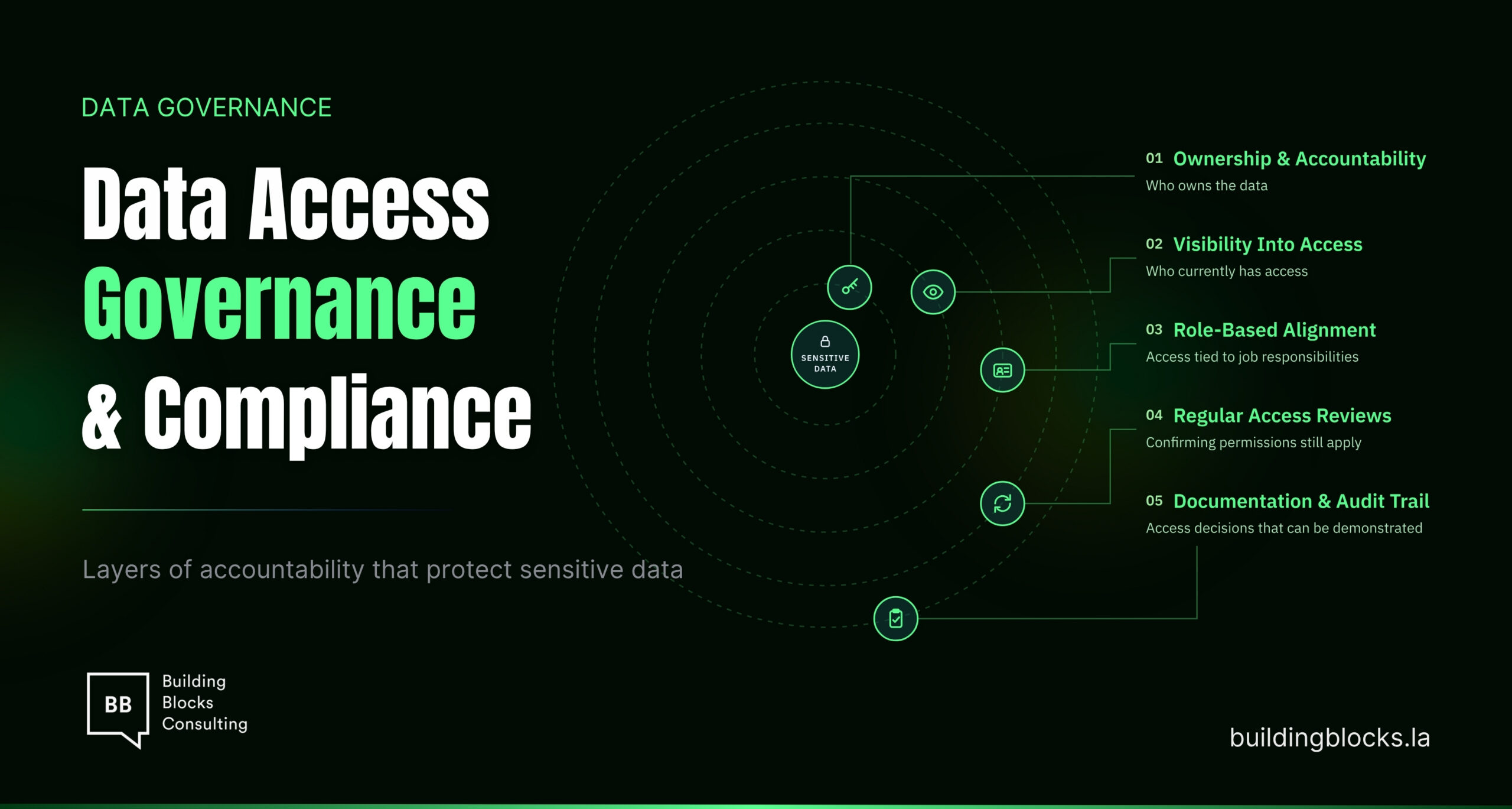
Effective access governance starts with knowing who is responsible for the data.
A data owner can help determine who should have access to a particular data domain, what access is appropriate, and how requirements should change over time.
For example, an organization may assign ownership for customer, financial, employee, or product data.
The data owner does not necessarily manage technical permissions. Instead, they provide business accountability for how the information should be accessed and used.
Connect Access to Business Roles
Role-based access can help organizations align permissions with job responsibilities.
For example, employees in finance may require access to certain financial information, while customer service employees may need access to customer records but not sensitive financial data.
The goal is to ensure that access reflects legitimate business requirements.
When employees change roles or responsibilities, their access should be reviewed and updated accordingly.
Use Data Classification to Guide Access
Not all data requires the same level of protection.
Organizations can classify information based on factors such as sensitivity, confidentiality, business importance, or regulatory requirements.
Sensitive data may require stronger restrictions, additional approvals, more frequent reviews, or increased monitoring.
Classification therefore helps organizations determine where access governance requires the greatest attention.
Review Access Regularly
Granting access is not a one-time decision.
Employees change roles, projects end, contractors leave, and business requirements evolve. Access that was appropriate when originally granted may no longer be necessary.
Regular access reviews allow organizations to confirm that permissions remain appropriate.
A review should consider whether access is still required, whether it matches the employee’s current responsibilities, and whether it complies with organizational policies.
How Access Governance Supports Compliance
Data access governance can support security and compliance efforts by creating clearer accountability and better documentation.
A governance program can help organizations establish:
- Clear ownership of sensitive data
- Appropriate access requirements
- Periodic access reviews
- Documented approval processes
- Evidence of access decisions
- Greater visibility into data usage
These practices can strengthen an organization’s overall control environment.
However, the specific requirements depend on the organization’s industry, location, data, and applicable regulations.
Governance Does Not Automatically Mean Compliance
This distinction is important.
Implementing data access governance does not automatically make an organization compliant with every applicable regulation.
Compliance may also require security controls, privacy practices, risk management, technical safeguards, policies, documentation, and other measures.
Data access governance should therefore be viewed as one component of a broader security, privacy, and compliance program.
Data Access Governance in Modern Data and AI Environments
Data is increasingly distributed across cloud platforms, databases, applications, data warehouses, APIs, and AI systems.
This makes access governance more complex.
For example, an AI application may retrieve information from internal documents or business databases. If a user is not authorized to access certain information, the AI system should not unintentionally expose that information through its responses.
As organizations adopt AI, existing access models may need to be reviewed to ensure they work across new ways of interacting with business data.
How to Strengthen Data Access Governance
Organizations can begin by identifying their most sensitive and business-critical data.
Then determine:
Who owns it?
There should be clear accountability for access decisions.
Where does it reside?
Important data may exist across multiple systems and platforms.
Who currently has access?
Organizations need enough visibility to identify inappropriate or unnecessary permissions.
Are permissions connected to job responsibilities?
Access should reflect legitimate business requirements.
Are permissions reviewed regularly?
Review processes should reflect the sensitivity and risk of the data.
Can access decisions be demonstrated?
Documentation and auditability can support security reviews and compliance activities.
Starting with critical data domains can make improvements more manageable before expanding governance across the broader environment.
How BuildingBlocks Can Help
BuildingBlocks Consulting provides Data Governance Services to help organizations establish clearer data ownership, access responsibilities, standards, metadata, lineage, and governance processes.
For organizations managing sensitive information or preparing their data environment for analytics and AI, a practical governance approach can help clarify how data should be accessed, managed, and used.
Building a More Accountable Data Environment
Data access governance is ultimately about creating clarity around organizational data.
Businesses need to know what data is sensitive, who owns it, who should access it, why access is required, and how those decisions are reviewed.
With the right governance structure, organizations can strengthen accountability, support security efforts, and create a better foundation for compliance as their data and AI environments grow.




By Chris Clifford
Chris Clifford was born and raised in San Diego, CA and studied at Loyola Marymount University with a major in Entrepreneurship, International Business and Business Law. Chris founded his first venture-backed technology startup over a decade ago and has gone on to co-found, advise and angel invest in a number of venture-backed software businesses. Chris is the CSO of Building Blocks where he works with clients across various sectors to develop and refine digital and technology strategy.