


How can we help?
Let's Talk
How can we help?
Let's Talk
The cost of Managed Data & AI Services varies significantly from one organization to another. There is no single fixed price because managed support depends on the systems being operated, level of support required, data and AI workloads, infrastructure, integrations, and service expectations.
For businesses evaluating managed services, the most useful approach is to understand the factors that influence pricing and determine which level of operational support the environment actually requires.
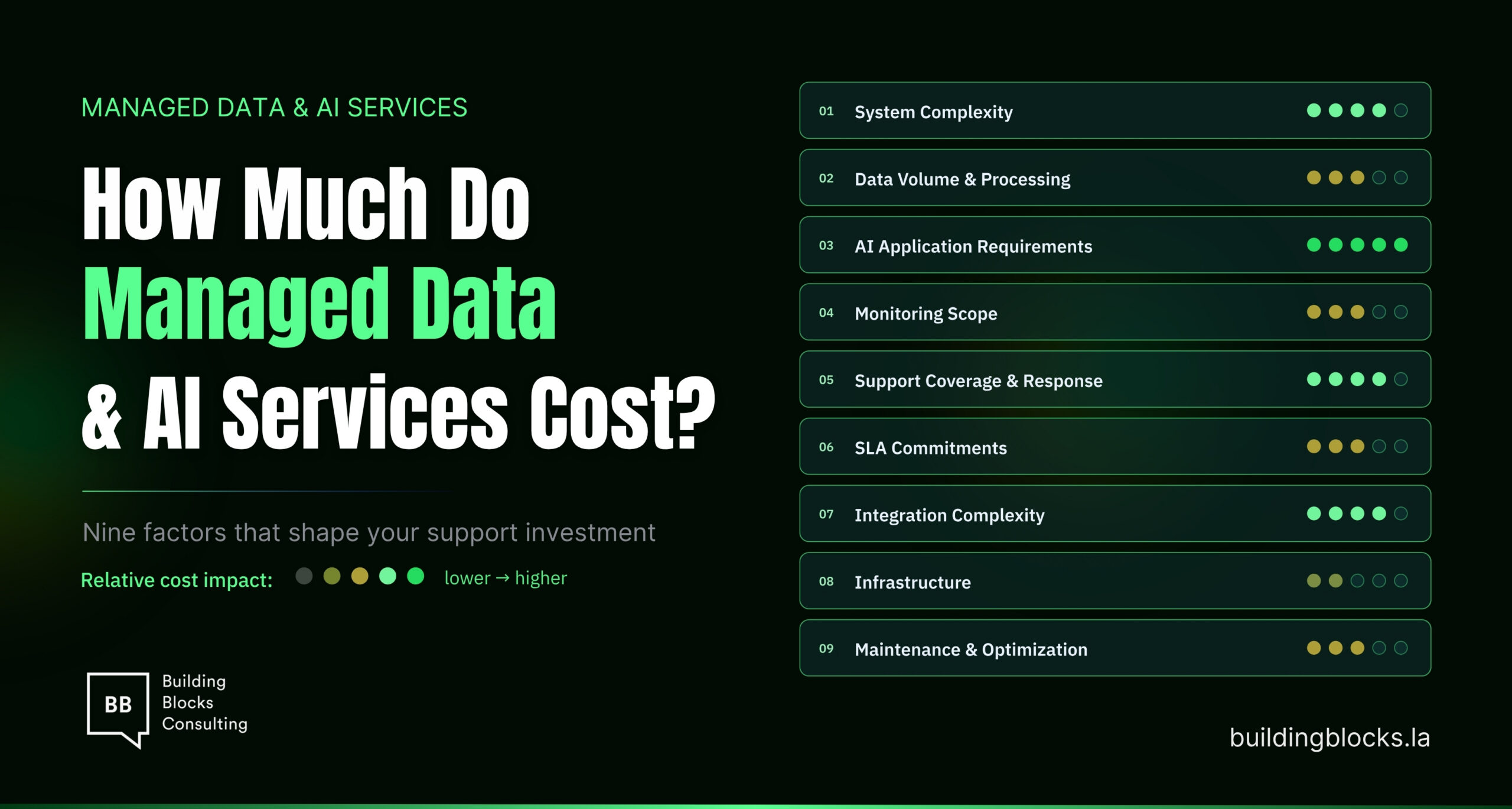
What Determines the Cost of Managed Data & AI Services?
Several factors typically influence the overall cost of a managed data and AI services engagement.
1. Number and Complexity of Systems
Supporting a single data platform is different from managing a broader environment containing multiple databases, pipelines, AI applications, APIs, analytics systems, and cloud services.
More systems and dependencies generally require more monitoring, maintenance, troubleshooting, and coordination.
2. Data Volume and Processing Requirements
Data volume can affect the infrastructure, monitoring, processing, and operational effort required to maintain an environment.
Pricing may therefore depend on factors such as:
- Data volume
- Processing frequency
- Number of pipelines
- Data sources
- Processing workloads
- Growth in data usage
Larger or more complex data environments typically require greater operational capacity.
3. AI Application Requirements
AI systems can have different operational requirements depending on how they are built and used.
Costs may be influenced by:
- Number of AI applications
- Model complexity
- Application usage
- Model or application monitoring
- AI infrastructure
- API dependencies
- Performance requirements
An organization running production AI applications may require more specialized support than one managing a smaller experimental environment.
4. Monitoring Requirements
The scope of monitoring is another important cost factor.
Some organizations may need basic system monitoring, while others require more comprehensive monitoring across data pipelines, AI applications, integrations, infrastructure, and performance.
The more systems and operational conditions that need to be monitored, the more involved the support model can become.
5. Support Coverage and Response Times
Support requirements directly affect managed service costs.
Organizations should consider:
- Business-hours versus extended support
- Incident response requirements
- Critical-system coverage
- Response targets
- Escalation procedures
- After-hours support
A system that requires rapid response to production incidents will generally need a different support model from a non-critical environment.
6. SLA Expectations
Service-level agreements define expectations around response and operational support.
Higher service requirements may involve tighter response targets, broader coverage, more structured escalation, and additional operational processes.
The SLA should therefore reflect the business importance of the systems being managed.
7. Integration Complexity
Data and AI environments often depend on multiple applications, APIs, platforms, and external services.
Maintaining these connections can require ongoing technical support, particularly when source systems, APIs, configurations, or business requirements change.
Complex integration environments can increase the level of expertise and operational effort required.
8. Infrastructure
The infrastructure supporting data and AI workloads can also affect the overall cost.
This may include:
- Cloud platforms
- Databases
- Data warehouses
- Compute resources
- Storage
- AI infrastructure
- Networking and related services
It is important to distinguish between provider service fees and the underlying infrastructure or platform costs associated with running the environment.
9. Maintenance and Optimization Requirements
Some organizations primarily need monitoring and incident support. Others require continuous maintenance, performance analysis, configuration changes, integration updates, and optimization.
A broader optimization and maintenance scope can increase the overall engagement cost but may also help reduce recurring operational problems and improve system performance.
Why Managed Data & AI Services Are Not Usually Priced as a Simple Package
Managed services are closely tied to the environment being supported.
Two businesses may both need managed data and AI support but have completely different requirements.
For example, one organization may have a small number of data pipelines and require business-hours monitoring. Another may operate multiple production AI applications, complex integrations, and critical data platforms that require faster incident response.
Their managed service requirements—and therefore their costs—would be very different.
What Should You Include When Requesting a Managed Services Quote?
To receive a more meaningful estimate, provide potential providers with information about your current environment.
Useful details include:
- Data platforms and technologies in use
- Number of critical systems
- Data pipelines and integrations
- AI applications in production
- Infrastructure and cloud environment
- Current monitoring capabilities
- Support hours required
- Expected response times
- Security requirements
- Maintenance and optimization needs
The more clearly the operational scope is defined, the easier it is for a provider to develop an appropriate support model.
How to Evaluate Managed Data & AI Services Pricing
Price should not be evaluated separately from service scope.
When comparing proposals, look at:
- Systems covered
- Monitoring scope
- Support hours
- SLA commitments
- Incident response
- Maintenance activities
- Integration support
- Optimization services
- Infrastructure responsibilities
- Reporting and communication
A lower price may reflect a narrower scope or fewer support commitments. A higher price may include broader coverage or more intensive operational support.
The important question is whether the proposed service matches the organization’s actual requirements.
Is Managed Data & AI Support Worth the Cost?
For organizations with production data and AI systems, the cost of managed support should be considered alongside the operational cost of managing those systems internally.
Managed services may help reduce the burden of ongoing monitoring, troubleshooting, maintenance, and technical support while giving internal teams more capacity for development and strategic initiatives.
The value depends on the complexity of the environment, business impact of downtime, internal capabilities, and level of support required.



By Chris Clifford
Chris Clifford was born and raised in San Diego, CA and studied at Loyola Marymount University with a major in Entrepreneurship, International Business and Business Law. Chris founded his first venture-backed technology startup over a decade ago and has gone on to co-found, advise and angel invest in a number of venture-backed software businesses. Chris is the CSO of Building Blocks where he works with clients across various sectors to develop and refine digital and technology strategy.