


How can we help?
Let's Talk
How can we help?
Let's Talk
An AI proof of concept can often be built with a relatively simple technical setup. A developer connects a model, tests a few use cases, connects some data, and demonstrates that the idea works.
Production is different.
Once employees, customers, or business processes depend on an AI system, the organization needs to think about much more than the model itself. The system needs reliable access to data, appropriate computing resources, secure connections to other applications, controlled deployment, monitoring, and enough capacity to handle real-world usage.
So, what infrastructure does an enterprise need to deploy AI in production?
There is no single architecture that fits every organization. The infrastructure depends on the AI application, data requirements, model strategy, security requirements, number of users, and expected workload.
However, most enterprise AI deployments need to address several core areas: compute, data, cloud or hosting infrastructure, APIs and integrations, deployment, security, monitoring, reliability, and scalability.
Why Production AI Requires More Than a Working Model
A model can produce useful results in a development environment without being ready for production.
Imagine an organization builds an internal AI assistant that answers employee questions using company documents. During testing, a small group of employees submits a few dozen questions each day. Everything appears to work.
After launch, hundreds or thousands of employees may use the assistant simultaneously. The system now needs to retrieve current information, respect user permissions, respond within an acceptable timeframe, handle failures, record operational events, and control infrastructure and model costs.
The AI model has not necessarily changed. The engineering requirements around it have. Production AI infrastructure exists to make the entire system reliable enough for its intended business use.
Start With the AI Workload
The infrastructure should be designed around what the AI system actually needs to do.
A forecasting system processing large datasets may require a very different environment from a customer-facing application using a large language model through an API.
Before choosing infrastructure, an enterprise should understand:
- What data the system needs
- Where that data currently resides
- How often the AI system will be used
- Whether responses need to be real time
- Which models will be used
- How sensitive the information is
- How many users are expected
- What level of availability is required
- How the system may grow over time
These requirements provide the foundation for the technical architecture.
Cloud Infrastructure and Hosting
Many enterprise AI systems are deployed using cloud infrastructure because cloud platforms can provide flexible access to computing, storage, databases, networking, security services, and managed AI capabilities.
An organization may use a public cloud environment, private infrastructure, or a hybrid approach depending on its requirements.
For example, an enterprise may keep certain sensitive data within its controlled environment while using cloud-based compute or model services for other parts of the application.
The important question is not simply whether an organization should “use the cloud.” The better question is:
Where should each part of the AI workload run, and why?
The answer may be influenced by data residency, security, performance, existing infrastructure, cost, compliance requirements, and the capabilities of the organization’s technical team.
Compute: Where Does the AI Actually Run?
AI workloads require computing resources, but not every production AI system needs dedicated GPU infrastructure.
Some applications rely on external model APIs. In that case, the organization’s infrastructure may primarily run the surrounding application, integrations, data processing, and business logic.
Other workloads may require substantial CPU or GPU resources for model inference, machine learning, fine-tuning, or other processing.
The right compute architecture therefore depends on the model and workload.
An enterprise should consider expected request volume, response-time requirements, processing requirements, and future growth before committing to a particular infrastructure configuration.
Using more computing power than necessary can increase costs. Using too little can result in slow or unreliable applications.
Data Infrastructure Is Part of the AI Architecture
Production AI depends heavily on data.
An AI application may need to access information from databases, data warehouses, document repositories, business applications, cloud storage, or other enterprise systems.
That means data storage and processing cannot be treated as completely separate from the AI architecture.
Consider an AI assistant that answers questions about internal company policies. If the underlying documents are outdated, poorly organized, or difficult to retrieve, increasing the model’s computing power will not solve the fundamental problem.
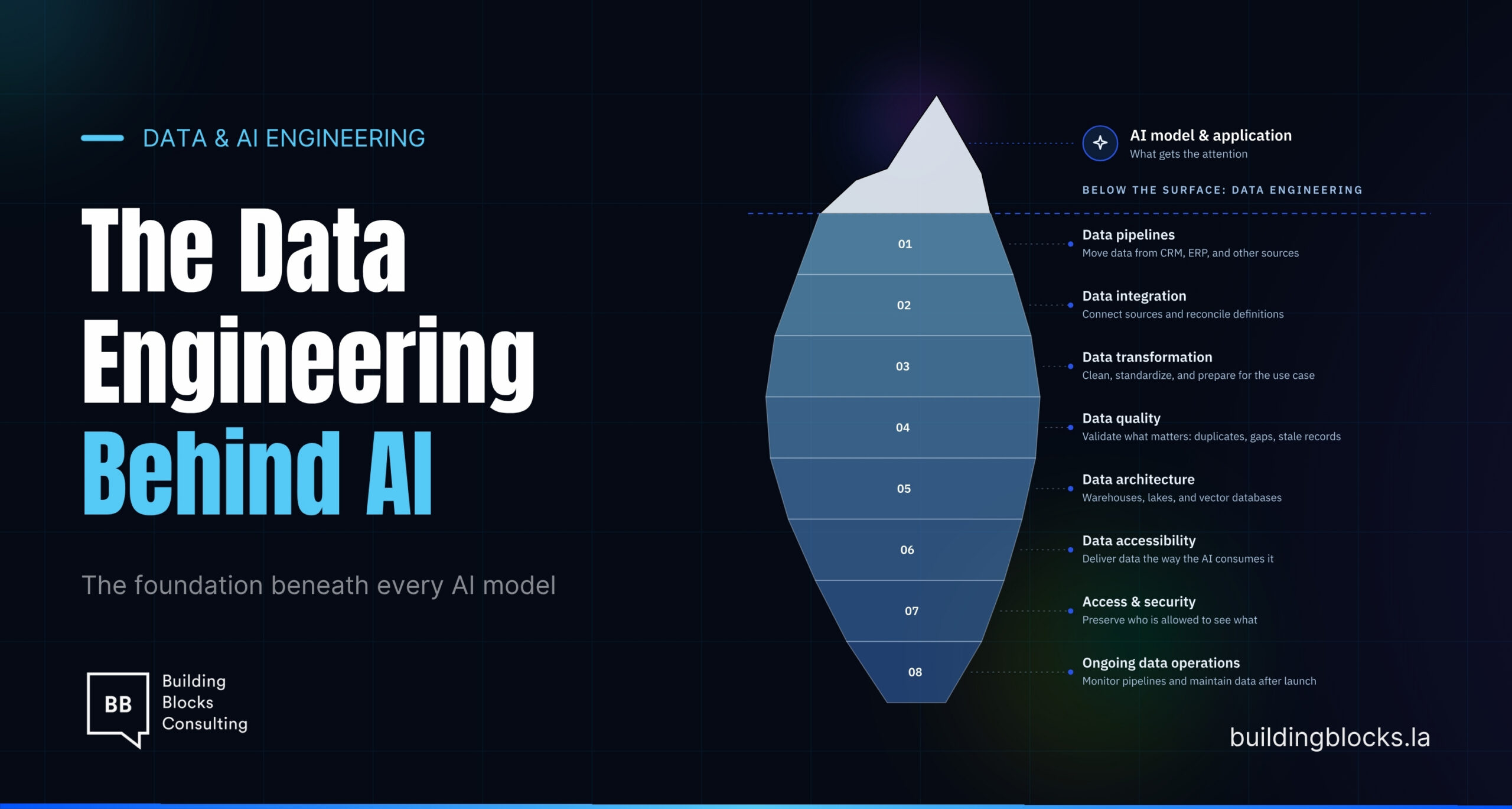
The production environment may therefore require reliable data pipelines, transformation processes, databases, document storage, or retrieval systems that make the right information available to the AI application.
For many enterprise projects, AI infrastructure starts with a reliable data foundation.
APIs and Integration With Existing Systems
Enterprise AI rarely operates in isolation.
An AI application may need to communicate with a CRM, ERP, database, internal application, customer portal, workflow platform, or other business system.
APIs provide one of the primary mechanisms for these connections.
For example, an AI application might retrieve customer information from an existing system, process it using an AI capability, and then return the result to another business workflow.
Production integration needs to account for authentication, authorization, error handling, rate limits, data formats, logging, and reliability.
This is one reason moving AI from a proof of concept into production can require substantial engineering work. The model may be ready, but the surrounding systems still need to be connected properly.
Model Deployment and Serving
The organization also needs to determine how the AI model will be made available to the production application.
There are several possibilities.
A business may access a model through an external API, use a managed AI platform, host a model within its own cloud environment, or deploy a model on dedicated infrastructure.
The appropriate approach depends on factors such as model capabilities, data sensitivity, latency, cost, availability, and operational requirements.
Model selection and infrastructure design should therefore be considered together rather than as completely separate decisions.
Deployment Environments Matter
Production AI should not normally be developed and changed directly in the live environment.
Organizations typically need separate environments for development, testing, staging, and production.
This allows engineering teams to make changes, test integrations, evaluate AI behavior, and identify problems before releasing changes to users.
Automated deployment processes can also help reduce manual errors and make it easier to manage application and infrastructure changes consistently.
For AI systems, deployment processes may need to account for changes to application code, models, prompts, retrieval systems, data pipelines, or other AI components.
Security Must Be Designed Into the Infrastructure
Enterprise AI can have access to valuable and sensitive information.
The infrastructure therefore needs to address security from the beginning rather than treating it as a final deployment step.
Security architecture may include identity management, authentication, authorization, encryption, secrets management, network controls, logging, and appropriate data-access restrictions.
Consider an AI application connected to internal documents. If two employees have different permissions in the underlying document system, the AI application should not automatically give both users access to the same information.
This makes data access and identity management important parts of enterprise AI infrastructure.
Security requirements will vary by organization and use case, but they should be considered during architecture design rather than added after development is complete.
Monitoring: How Do You Know the System Is Working?
A production AI system needs visibility.
It is not enough to know that the application is technically online. Engineering teams may need to understand how quickly requests are being processed, whether APIs are failing, whether infrastructure is reaching capacity, and how much the system is being used.
AI applications can also require additional monitoring.
Depending on the use case, teams may need to examine retrieval quality, model usage, unexpected outputs, response quality, or changes in the underlying data.
For example, an AI application might continue responding normally from an infrastructure perspective while the quality of its answers declines because the source data or retrieval process has changed.
Monitoring helps organizations identify these problems and respond before they become larger operational issues.
Scalability Changes the Infrastructure Equation
A system that works for 20 users may not work the same way for 20,000.
As adoption increases, the organization may experience higher demand for compute, storage, database access, model requests, and network resources.
Scalability should therefore be considered before a production launch.
This does not mean building the largest possible architecture on day one. In many cases, that would create unnecessary complexity and cost.
A better approach is to understand expected usage and design an architecture that can expand as demand grows.
Reliability and Failure Recovery
Production systems fail. APIs become unavailable, data pipelines stop processing, infrastructure reaches capacity, and external services can experience interruptions.
An enterprise AI system needs an appropriate response to these situations.
Depending on the importance of the application, this could involve timeouts, retries, health checks, alerting, backups, recovery procedures, or alternative processing paths.
The level of resilience should match the business importance of the AI system.
An internal experimentation tool does not necessarily need the same availability requirements as an AI application supporting a critical customer workflow.
AI Infrastructure Also Has a Cost Dimension
Infrastructure decisions directly affect the economics of an AI application.
Costs may come from computing resources, cloud storage, databases, model usage, data processing, networking, monitoring, and other supporting services.
Model usage can be particularly important for generative AI applications. A system that performs well during a small pilot may become significantly more expensive when usage increases.
This is why production architecture should consider cost alongside performance.
The objective is not simply to make the AI system work. It is to make it work reliably at a cost that makes sense for the business.
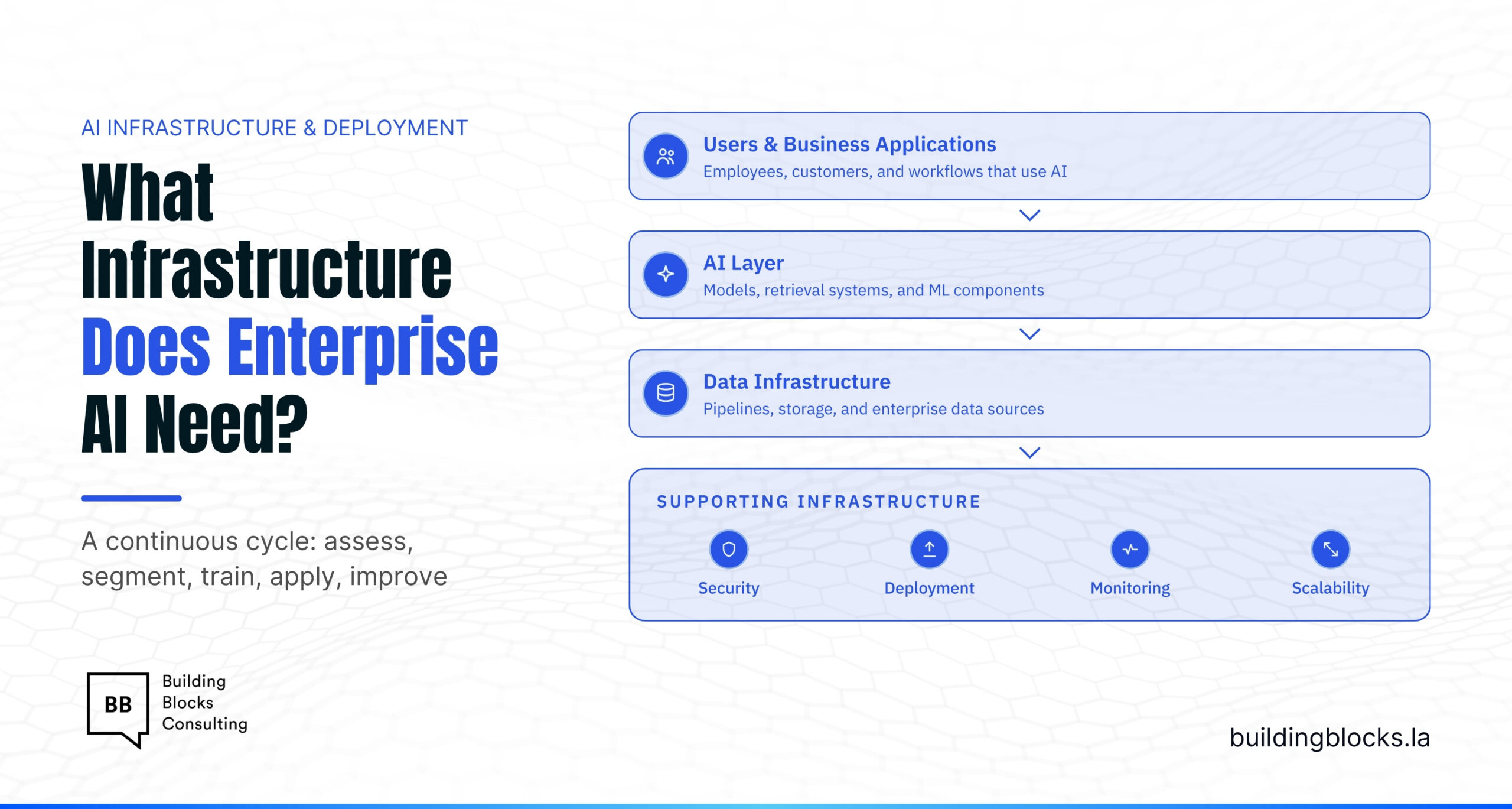
What Does a Typical Enterprise AI Architecture Look Like?
Although architectures vary, a production AI system can generally be thought of as several connected layers.
Users or business applications interact with an AI-enabled application. That application handles business logic and communicates with AI services through APIs.
The AI layer may connect to a model, retrieval system, machine learning component, or other AI capability.
Behind that, data infrastructure provides access to the information required by the application.
Supporting everything are infrastructure, security, deployment, monitoring, and operational systems.
The important point is that the AI model is only one part of the production architecture.
The surrounding systems determine how securely, reliably, and efficiently the model can be used within the business.
From AI Proof of Concept to Production
One of the most common challenges organizations face is moving an AI proof of concept into a production environment.
A prototype may demonstrate that an AI application can generate useful results. But production requires the organization to answer additional questions:
Can it handle real users?
Can it access the right data?
Can it integrate with existing systems?
Can users be restricted to the information they are authorized to see?
Can the system be monitored?
What happens when something fails?
Can the architecture scale?
Who will maintain it?
These questions often reveal engineering requirements that were not part of the original experiment.
This is where enterprise AI engineering becomes important. The goal is to turn an AI concept into a reliable technical system that fits the organization’s existing environment.
When Does an Enterprise Need AI Infrastructure Engineering?
Organizations may need specialized engineering support when an AI initiative has moved beyond experimentation and needs to operate as part of the business.
This is particularly relevant when the project involves multiple data sources, existing enterprise applications, production deployment, complex integrations, security requirements, or significant expected usage.
At this stage, the work may involve designing data pipelines, building application infrastructure, integrating AI capabilities, deploying models, establishing monitoring, and preparing the environment for ongoing operation.
BuildingBlocks Consulting supports these requirements through Data & AI Engineering Services, including AI infrastructure and deployment, data engineering, AI application development, integrations, data platform engineering, and production optimization.
The focus is on engineering the technical environment around the organization’s actual AI requirements rather than applying the same infrastructure approach to every project.
Building a Production-Ready AI Environment
Deploying AI in production is not simply a matter of choosing a model and putting it behind an application.
The surrounding infrastructure needs to support the complete system: data, compute, applications, APIs, security, deployment, monitoring, reliability, and growth.
The right architecture depends on the organization’s use case and technical environment. A customer-facing generative AI application may have very different requirements from an internal machine learning workflow or an AI-powered data processing system.
For that reason, enterprises should begin with the business and technical requirements, then design the infrastructure around them.
When the architecture is designed properly, AI can move beyond experimentation and become a reliable part of the organization’s technology environment.



By Chris Clifford
Chris Clifford was born and raised in San Diego, CA and studied at Loyola Marymount University with a major in Entrepreneurship, International Business and Business Law. Chris founded his first venture-backed technology startup over a decade ago and has gone on to co-found, advise and angel invest in a number of venture-backed software businesses. Chris is the CSO of Building Blocks where he works with clients across various sectors to develop and refine digital and technology strategy.