


How can we help?
Let's Talk
How can we help?
Let's Talk
Choosing a vendor for a Generative AI project is different from choosing a general software development company.
A production GenAI system may need to work with large language models, business data, existing applications, APIs, retrieval systems, security controls, and enterprise infrastructure.
The vendor therefore needs more than basic familiarity with generative AI tools. They need the engineering capability to design, build, test, deploy, and improve a system around your organization’s actual requirements.
So how should a business evaluate a generative AI engineering vendor?
The most important factors are technical experience, data integration, LLM expertise, retrieval
architecture, security, evaluation, production deployment, scalability, and the ability to work within your existing technology environment.
Start With the Business Use Case
Before comparing vendors, define what you want the GenAI system to accomplish.
Possible use cases include:
- Internal knowledge assistants
- Customer support applications
- Document analysis
- Research and summarization
- Content workflows
- Enterprise search
- AI-assisted software development
- Workflow automation
- Retrieval-based AI applications
- AI features embedded into existing products
A vendor should be able to connect the proposed technology to the business problem.
If a vendor immediately recommends a particular model or framework without first understanding the use case, data, users, workflows, and technical environment, that should prompt further questions.
1. Evaluate Generative AI Engineering Experience
Look beyond whether a vendor says it “works with AI.”
Ask what types of GenAI systems the team has actually designed and built.
Relevant experience may include:
- Large language model applications
- LLM API integration
- Retrieval-augmented generation
- AI agents and workflows
- Prompt and context engineering
- Model evaluation
- AI application development
- Enterprise data integration
- Production deployment
The goal is to determine whether the vendor has practical engineering experience rather than simply experience experimenting with AI tools.
2. Ask About LLM Experience
Large language models are a central component of many GenAI applications, but selecting and integrating a model is only one part of the project.
Ask how the vendor evaluates different models and determines which approach is appropriate.
Depending on the application, the solution may use a hosted model API, an open model, multiple models, or a combination of approaches.
A capable vendor should be able to discuss tradeoffs involving:
- Capability
- Cost
- Latency
- Context requirements
- Privacy
- Reliability
- Model availability
- Performance
The best model is not necessarily the largest or newest model. It is the model and architecture that appropriately support the business requirement.
3. Evaluate RAG and Enterprise Data Experience
Many enterprise GenAI applications need to work with proprietary business information.
Retrieval-augmented generation (RAG) is one approach for connecting an LLM application with relevant information from business data sources.
For example, a company could build an internal AI assistant that retrieves relevant policies, procedures, product documentation, or other approved business information before generating a response.
If your project requires this type of architecture, ask whether the vendor has experience with:
- Document ingestion
- Data processing
- Chunking and indexing
- Embeddings
- Vector search
- Retrieval
- Context management
- Source attribution
- Access controls
A vendor should also understand that RAG quality depends on the underlying data and retrieval process, not just the language model.
4. Look at Data Integration Capabilities
Enterprise GenAI applications rarely operate on isolated data.
The system may need to connect with:
- Databases
- Data warehouses
- Document repositories
- APIs
- CRM platforms
- ERP systems
- Internal applications
- Cloud storage
- Knowledge management systems
Ask how the vendor plans to connect the GenAI application with these sources.
The integration architecture should account for data access, transformation, permissions, reliability, and changes to source systems.
This is especially important when the AI system needs current or frequently updated information.
5. Ask How Security Is Designed
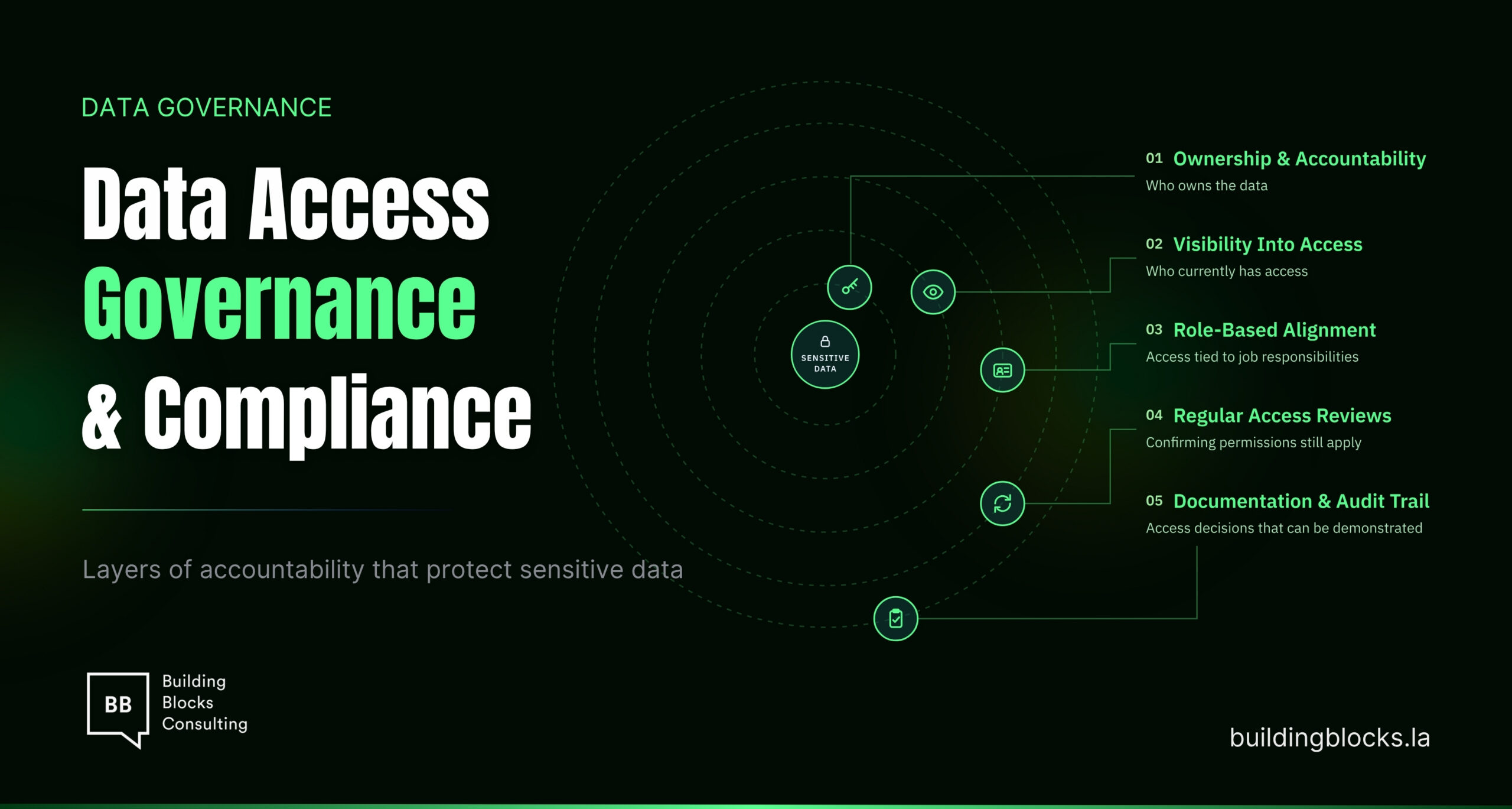
Security should be part of the GenAI architecture from the beginning.
A vendor may be handling sensitive company information, customer records, intellectual property, employee information, or confidential documents.
Ask how the proposed system addresses:
- Authentication Authorization Data access Encryption Secrets management Sensitive information Logging Data retention Third-party model providers User-level permissions
For retrieval-based applications, ask an additional question:
Can the system ensure that users only retrieve information they are authorized to access?
This can be a critical consideration when GenAI is connected to internal enterprise data.
6. Understand Their Approach to AI Testing
Traditional software testing alone isn’t enough for many GenAI applications.
AI outputs can vary, and a system can technically function while still producing inaccurate, irrelevant, or unsafe responses.
Ask the vendor how they evaluate the application’s outputs.
Depending on the use case, testing may consider:
- Accuracy
- Relevance
- Completeness
- Consistency
- Hallucination
- Retrieval quality
- Safety
- Response latency
- Failure scenarios
The vendor should be able to explain what success means for the particular application and how that performance will be measured.
7. Ask How They Handle Hallucinations and Incorrect Outputs
Generative AI systems can produce confident responses that are incorrect.
A responsible engineering approach should therefore include controls appropriate to the use case.
These might include:
- Grounding responses in trusted data
- Retrieval mechanisms
- Output validation
- Human review
- Confidence or relevance thresholds
- Restricted workflows
- Clear escalation paths
The appropriate controls depend on how consequential the AI system’s output is.
A brainstorming application may tolerate more variation than an application providing information used in important business decisions.
8. Evaluate Production Deployment Experience
A GenAI prototype can often be created quickly.
Production deployment is more demanding.
Ask whether the vendor has experience moving AI applications from experimentation into operational environments.
Important areas include:
- Deployment architecture
- Infrastructure
- Monitoring
- Logging
- Performance
- Error handling
- Security
- Version management
- Cost monitoring
- Operational support
A vendor should be able to explain how the system will be operated after launch, not just how it will be demonstrated.
9. Consider Scalability and Cost
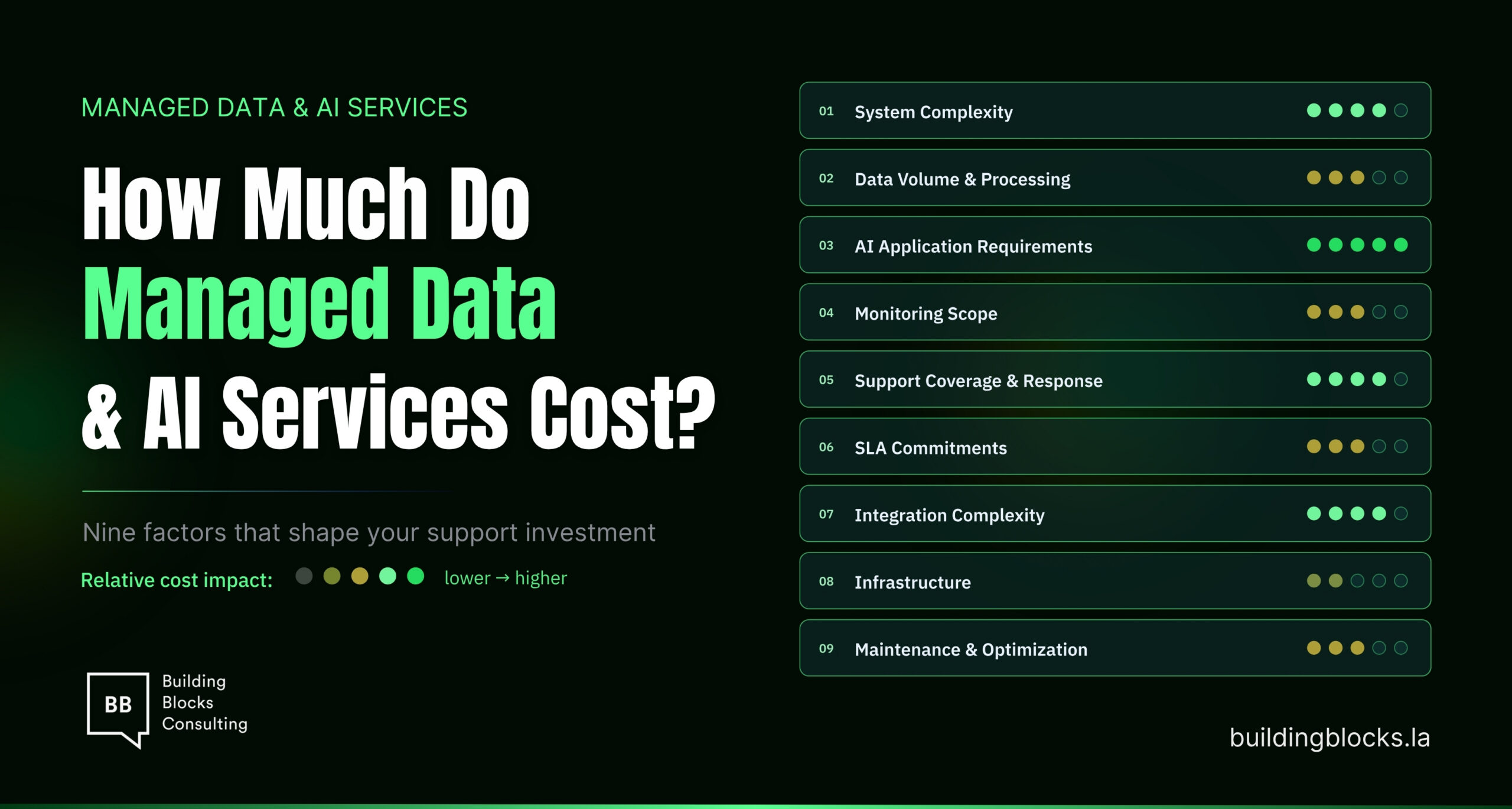
GenAI applications can generate significant usage costs as adoption grows.
Ask how the vendor approaches scalability and cost management.
Consider:
- Number of users
- Request volume
- Token consumption
- Model selection
- Response latency
- Infrastructure requirements
- Caching
- Rate limits
- Usage monitoring
A good architecture should be designed around expected usage rather than assuming that a successful prototype will automatically scale.
10. Evaluate the Vendor’s Software Engineering Capabilities
Generative AI engineering is still software engineering.
The project may require backend development, APIs, databases, frontend applications, authentication, cloud infrastructure, monitoring, and integrations.
Evaluate whether the vendor can handle the broader application rather than only the AI component.
This matters particularly when you are building a complete business application rather than adding a simple AI feature to an existing product.
11. Ask About Architecture Before Development Begins
A strong vendor should be willing to explain the proposed architecture before significant development starts.
The architecture discussion should cover how:
- Users interact with the system
- AI models are accessed
- Business data is retrieved
- Existing systems are integrated
- Permissions are enforced
- Outputs are evaluated
- The application is deployed
- The system is monitored
You don’t need every technical detail finalized at the beginning.
But the vendor should demonstrate that it has considered the major components and dependencies.
12. Check Whether the Vendor Can Work With Your Existing Team
Your internal engineering, data, security, or product teams may need to remain involved.
Ask how the vendor collaborates with internal teams.
A good working relationship may include:
- Architecture discussions
- Technical documentation
- Code reviews
- Knowledge transfer
- Security reviews
- Deployment collaboration
- Ongoing maintenance
This can also make it easier for your organization to maintain the system after the initial project.
13. Review the Vendor’s Project Approach
Ask how the vendor expects to move from idea to production.
A typical GenAI engineering project may involve:
- Defining the use case and requirements
- Reviewing available data and systems
- Designing the architecture
- Selecting appropriate AI technologies
- Building an initial implementation
- Testing and evaluating outputs
- Integrating with business systems
- Preparing for production
- Deploying and monitoring
- Improving the system based on real-world performance
The exact process will vary, but the vendor should have a clear methodology for moving beyond experimentation.
Questions to Ask a Generative AI Engineering Vendor
Before selecting a provider, consider asking:
- What types of GenAI applications have you built?
- What experience do you have with LLM integration?
- Have you built RAG systems using enterprise data?
- How do you integrate GenAI with existing applications and databases?
- How do you handle security and user permissions?
- How do you test AI output quality?
- How do you address hallucinations?
- How do you prepare GenAI applications for production?
- How do you manage scalability and AI infrastructure costs?
- How will you work with our internal engineering and data teams?
- What happens after deployment?
The answers should help you understand whether the vendor can address the full engineering problem rather than only the model or chatbot component.
Red Flags When Choosing a GenAI Vendor
Some warning signs are worth considering during the evaluation process.
Be cautious if a vendor:
- Focuses entirely on a specific AI model without understanding your use case
- Cannot explain how business data will be integrated
- Has no clear approach to testing AI outputs
- Treats security as a later-stage concern
- Has experience only with demonstrations or prototypes
- Cannot explain the production architecture
- Makes broad claims about AI accuracy without explaining how it will be evaluated
- Cannot clearly define what happens after deployment
A strong vendor should be able to discuss both the opportunities and limitations of the technology.
When Should You Bring in a GenAI Engineering Vendor?
External engineering support can make sense when your organization has identified a real GenAI opportunity but does not have all the capabilities needed to build it internally.
This may be the case when:
- You need to build a production GenAI application.
- Your application must work with enterprise data.
- You need RAG or retrieval-based functionality.
- GenAI needs to connect with existing applications or APIs.
- Your internal team lacks specialized LLM engineering experience.
- A proof of concept needs to become a production system.
- You need help with deployment, infrastructure, or scalability.
The right engagement may involve the vendor building the complete system or providing specialized engineering support alongside your existing team.
How BuildingBlocks Approaches Generative AI Engineering
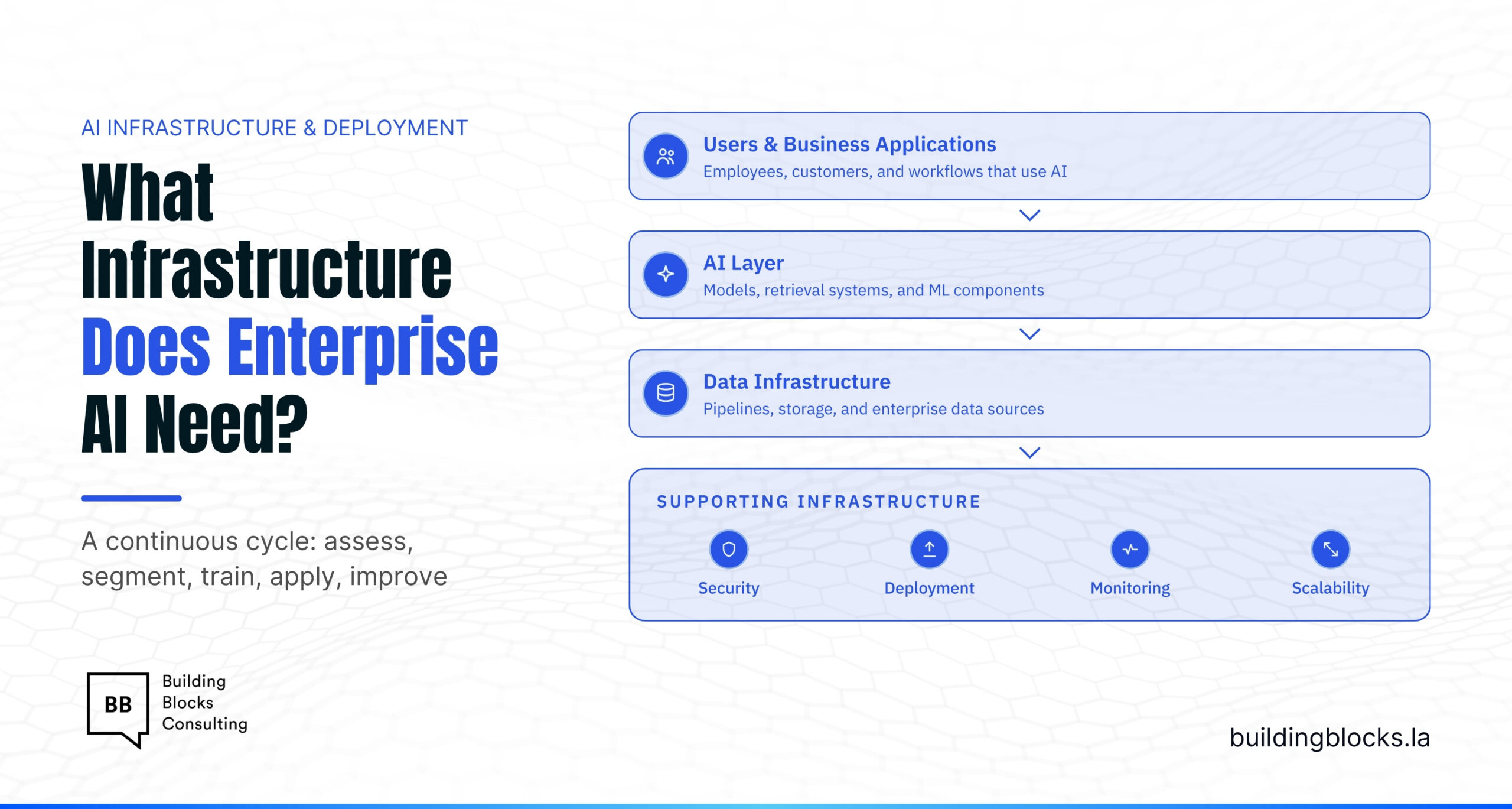
BuildingBlocks Consulting provides Generative AI Engineering as part of its broader Data & AI Engineering capabilities.
The work can involve developing GenAI applications, connecting models with business data and applications, building retrieval-based AI systems, integrating APIs and enterprise systems, and preparing AI solutions for production environments.
For organizations evaluating a GenAI engineering project, the first step is to understand the business use case, existing technology environment, data requirements, and production expectations.
From there, the engineering approach can be designed around what the organization actually needs rather than starting with a predetermined AI technology.
Choosing a GenAI Engineering Vendor
Choosing a Generative AI vendor should be treated as an engineering and business decision, not simply a technology purchase.
The right partner should understand the AI technology while also being capable of working with your data, applications, APIs, infrastructure, security requirements, and operational environment.
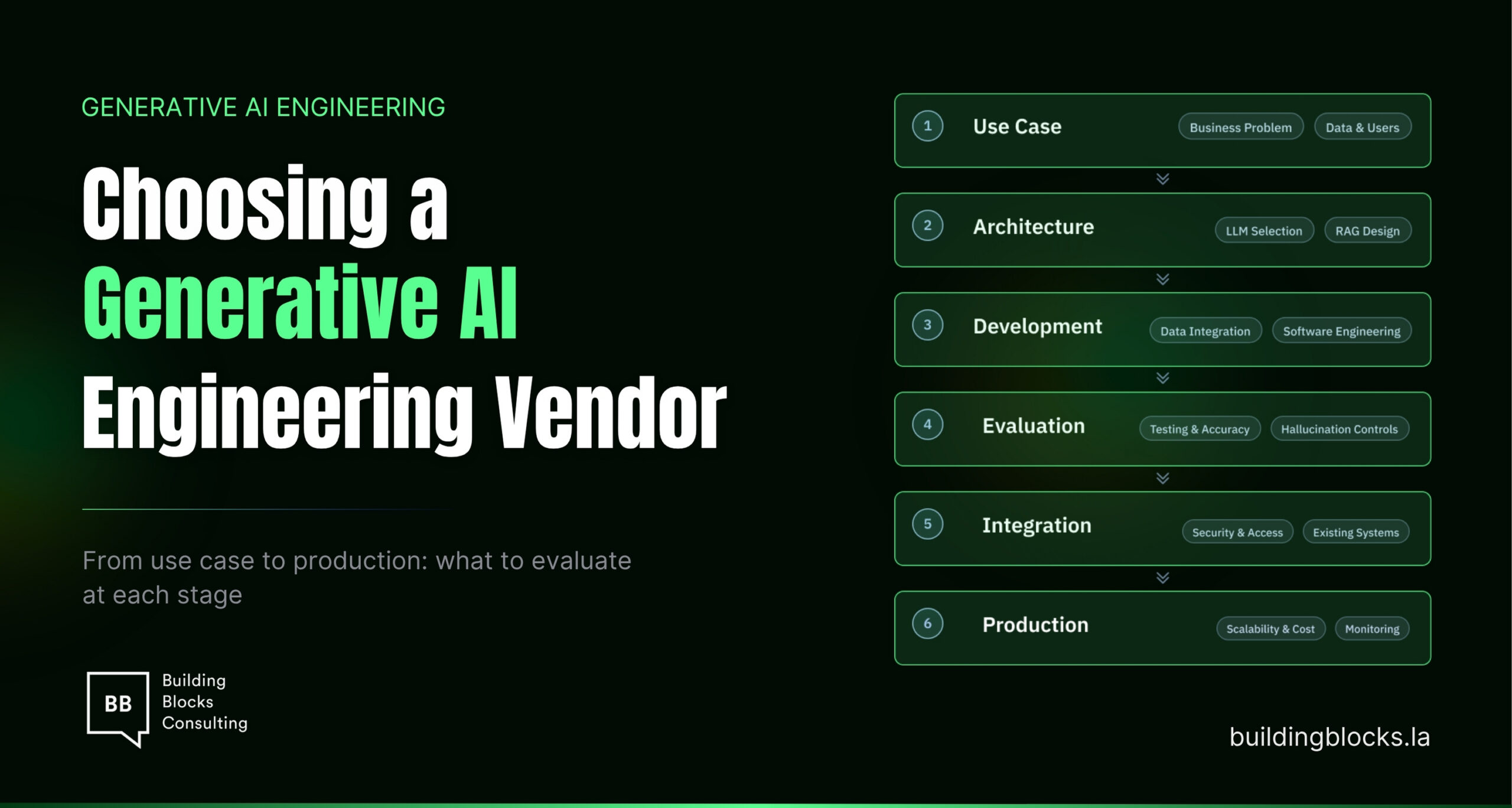
Before signing a project, make sure the vendor can explain how the proposed solution will move from use case → architecture → development → evaluation → integration → production.
That is ultimately what separates a GenAI demonstration from a system that can deliver reliable value in a real business environment.
If your organization is evaluating a Generative AI project, Data & AI Engineering Services can provide the broader engineering capabilities needed to design, build, integrate, deploy, and improve AI systems within existing business environments.



By Chris Clifford
Chris Clifford was born and raised in San Diego, CA and studied at Loyola Marymount University with a major in Entrepreneurship, International Business and Business Law. Chris founded his first venture-backed technology startup over a decade ago and has gone on to co-found, advise and angel invest in a number of venture-backed software businesses. Chris is the CSO of Building Blocks where he works with clients across various sectors to develop and refine digital and technology strategy.