


How can we help?
Let's Talk
How can we help?
Let's Talk
Managing data and AI systems internally gives organizations direct control over their technology and operations. Managed Data & AI Services provide an alternative by bringing in external technical support for ongoing monitoring, maintenance, troubleshooting, and optimization.
Neither approach is automatically better. The right choice depends on internal expertise, system complexity, staffing capacity, operational requirements, scalability needs, and cost.
In-House vs. Managed Data & AI Services
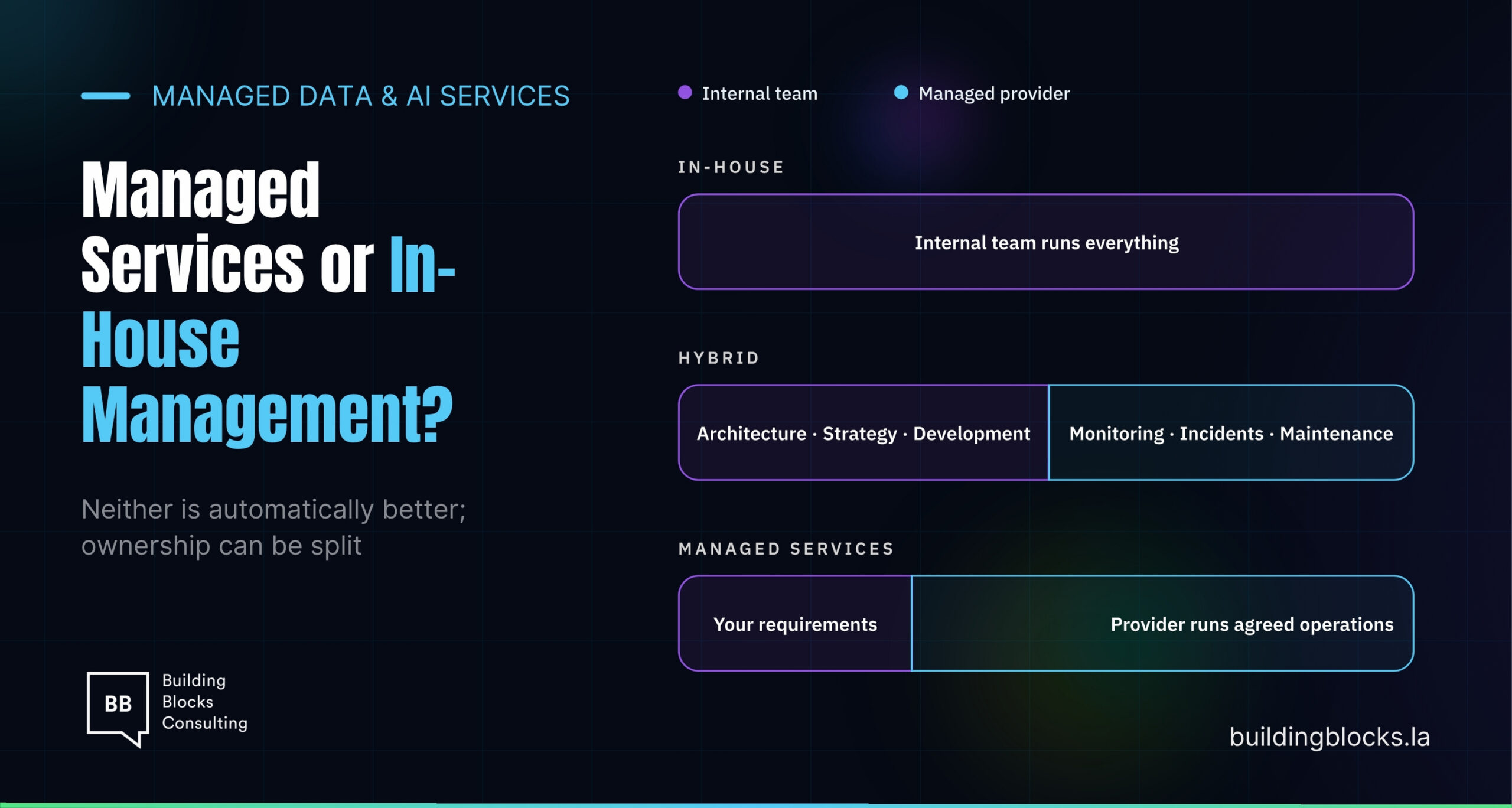
With in-house management, internal employees are responsible for operating and maintaining the organization’s data and AI environment.
With managed services, an external provider takes responsibility for agreed operational activities while working within the organization’s requirements and processes.
A third option is a hybrid model, where internal teams retain ownership of architecture, development, and strategy while a managed provider handles defined operational responsibilities.
What Does In-House Management Require?
Managing data and AI systems internally requires more than building the technology.
Teams may need to handle:
- Ongoing system monitoring
- Data pipeline troubleshooting
- Infrastructure maintenance
- AI application support
- Integration maintenance
- Production incidents
- Performance optimization
- Platform updates
- Operational documentation
Organizations also need enough technical capacity to provide this support consistently as systems and workloads grow.
What Are the Benefits of In-House Management?
Greater Direct Control
Internal teams have direct visibility into systems, processes, priorities, and business requirements.
Internal Knowledge
Employees can develop deep knowledge of the organization’s data, applications, architecture, and business context.
Direct Collaboration
Engineering, data, IT, and business teams can work closely without depending on an external provider for every operational decision.
However, maintaining these advantages requires sufficient technical expertise and staffing capacity.
What Are the Benefits of Managed Data & AI Services?
Reduce Operational Burden
A managed provider can take responsibility for defined monitoring, maintenance, troubleshooting, and support activities.
Access Specialized Expertise
Organizations can access technical expertise without hiring specialists for every operational requirement.
Support Ongoing Monitoring
Managed services can provide structured monitoring and incident-response processes for production data and AI environments.
Improve Scalability
External support can provide additional operational capacity as systems, data volumes, integrations, and AI applications grow.
Free Internal Teams for Higher-Value Work
Internal engineers can spend more time on development, architecture, and strategic initiatives rather than routine operational support.
Key Factors to Consider
1. Internal Expertise
Consider whether your existing team has the skills required to operate your data and AI environment consistently. If specialized expertise is difficult to hire or retain, managed support can provide additional technical capacity.
2. Ongoing Monitoring Requirements
Some environments require continuous monitoring across data pipelines, AI applications, infrastructure, and integrations.
Consider whether your internal team has the capacity to monitor and respond to these systems effectively.
3. Staffing Requirements
In-house management requires enough people to cover operational responsibilities, including incidents, maintenance, and system changes.
The staffing requirement can increase as the environment becomes more complex.
4. Incident Response
Consider how quickly your organization needs to respond when production systems fail.
A managed services agreement can establish defined response processes and support expectations, while internal teams retain direct control over incident management when operations remain in-house.
5. Maintenance and Optimization
Data and AI systems require ongoing updates and improvements.
Ask whether your internal team has enough capacity for routine maintenance while continuing to deliver new projects.
6. Scalability
As data volumes, AI usage, infrastructure, and integrations increase, operational requirements can increase as well.
A managed model can provide additional capacity without requiring the organization to build an equally large internal operations function.
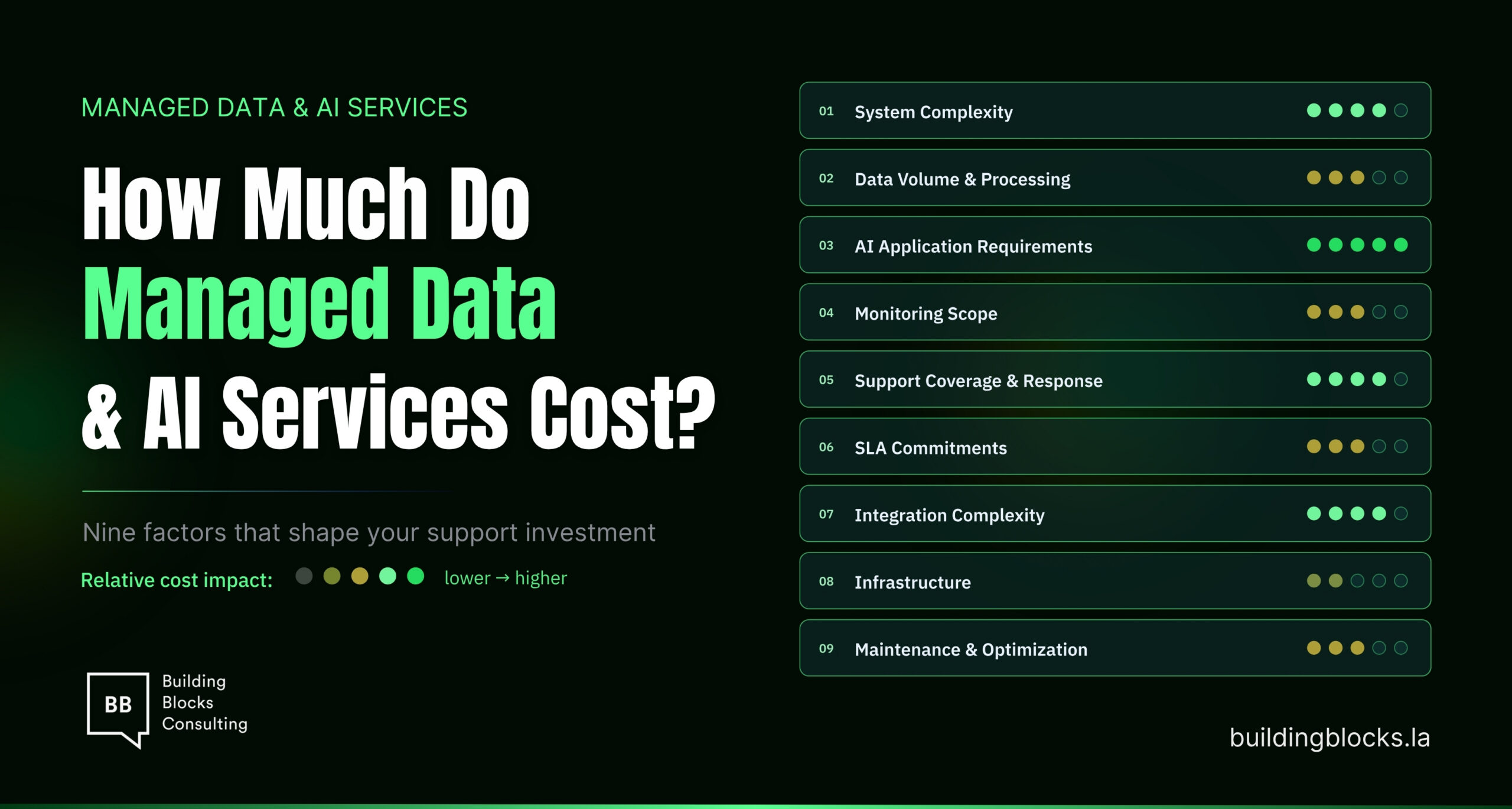
7. Cost
Cost should be evaluated beyond the provider’s service fee.
For in-house management, consider:
- Salaries and hiring
- Specialist skills
- Training
- Infrastructure
- Monitoring tools
- Support coverage
- Employee availability
- Operational overhead
For managed services, consider the provider’s fees, infrastructure costs, service scope, support coverage, and SLA requirements.
The better comparison is the total cost of providing the required level of operational support, rather than comparing a provider’s fee directly with one employee’s salary.
Can Managed Services Work With Internal Engineering Teams?
Yes. A managed services provider does not have to replace an internal engineering team.
A hybrid model can divide responsibilities based on strengths.
For example, internal teams may own:
- Architecture
- Product development
- AI strategy
- New data and AI initiatives
- Business requirements
A managed provider may support:
- Monitoring
- Incident response
- Pipeline support
- Application maintenance
- Integration support
- Performance optimization
Clear ownership and escalation processes are essential for this model to work effectively.
When Does In-House Management Make Sense?
In-house management may be appropriate when an organization has:
- Strong internal data and AI expertise
- Sufficient staffing capacity
- Mature monitoring and operational processes
- Systems that require highly specialized internal knowledge
- A strong preference for direct operational control
When Should You Consider Managed Services?
Managed services may make sense when:
- Internal teams are overloaded with operational work
- Production systems require ongoing monitoring
- Specialized expertise is difficult to hire
- Data and AI environments are becoming more complex
- Operational support requirements are growing
- The organization needs additional technical capacity
- Internal teams need to focus more on strategic development
Which Approach Is Right for Your Business?
The choice does not have to be all or nothing.
For some organizations, a fully internal model provides the right level of control and expertise. Others may benefit from outsourcing defined operational responsibilities. A hybrid approach can provide a balance between internal ownership and external operational support.
The right model depends on your technical environment, internal capabilities, operational workload, support requirements, and growth plans.
Before making a decision, assess what your team needs to manage today and what the environment is likely to require as it grows.



By Chris Clifford
Chris Clifford was born and raised in San Diego, CA and studied at Loyola Marymount University with a major in Entrepreneurship, International Business and Business Law. Chris founded his first venture-backed technology startup over a decade ago and has gone on to co-found, advise and angel invest in a number of venture-backed software businesses. Chris is the CSO of Building Blocks where he works with clients across various sectors to develop and refine digital and technology strategy.