


How can we help?
Let's Talk
How can we help?
Let's Talk
Most AI projects do not fail because the technology stopped working.
They fail before the technology ever gets a real chance.
Across industries, businesses are investing heavily in artificial intelligence – allocating budget, forming internal teams, engaging vendors, and launching initiatives with genuine strategic intent. Yet a significant portion of these projects either stall before reaching production, get quietly abandoned after months of development, or go live and deliver far less value than originally expected.
The reasons are rarely dramatic. There is no single catastrophic failure point. Instead, AI projects tend to fail gradually, through a series of decisions made early in the process that compound into expensive problems later.
For founders, technology leaders, and enterprise decision-makers, understanding why AI projects fail is genuinely more valuable than understanding how AI works. The technical knowledge is widely available. The organizational and strategic judgment to avoid predictable failure patterns is far harder to find.
This guide covers the most common – and most costly – reasons AI projects fail inside businesses, what the warning signs look like before they become full problems, and what organizations can do differently to improve their odds of building AI that actually works in production.
Why AI Project Failure Is More Common Than Most Organizations Admit
The honest reality is that AI project failure rates are high across the industry – and most organizations underreport them.
Failed AI projects rarely get announced. They get reframed as “pilots,” absorbed into roadmap changes, or simply defunded without a postmortem. The people involved move on. The lessons do not get captured.
This creates a dangerous information gap. Decision-makers hear about successful AI implementations – the companies that automated a major workflow, the startup that shipped an AI product in three months, the enterprise that reduced operational costs significantly. They rarely hear about the projects that consumed a year of budget and produced nothing usable.
The result is that organizations repeatedly walk into the same failure patterns with unrealistic expectations, because the distribution of real outcomes is not visible to them.
Understanding what actually goes wrong is the first step toward building AI that works.
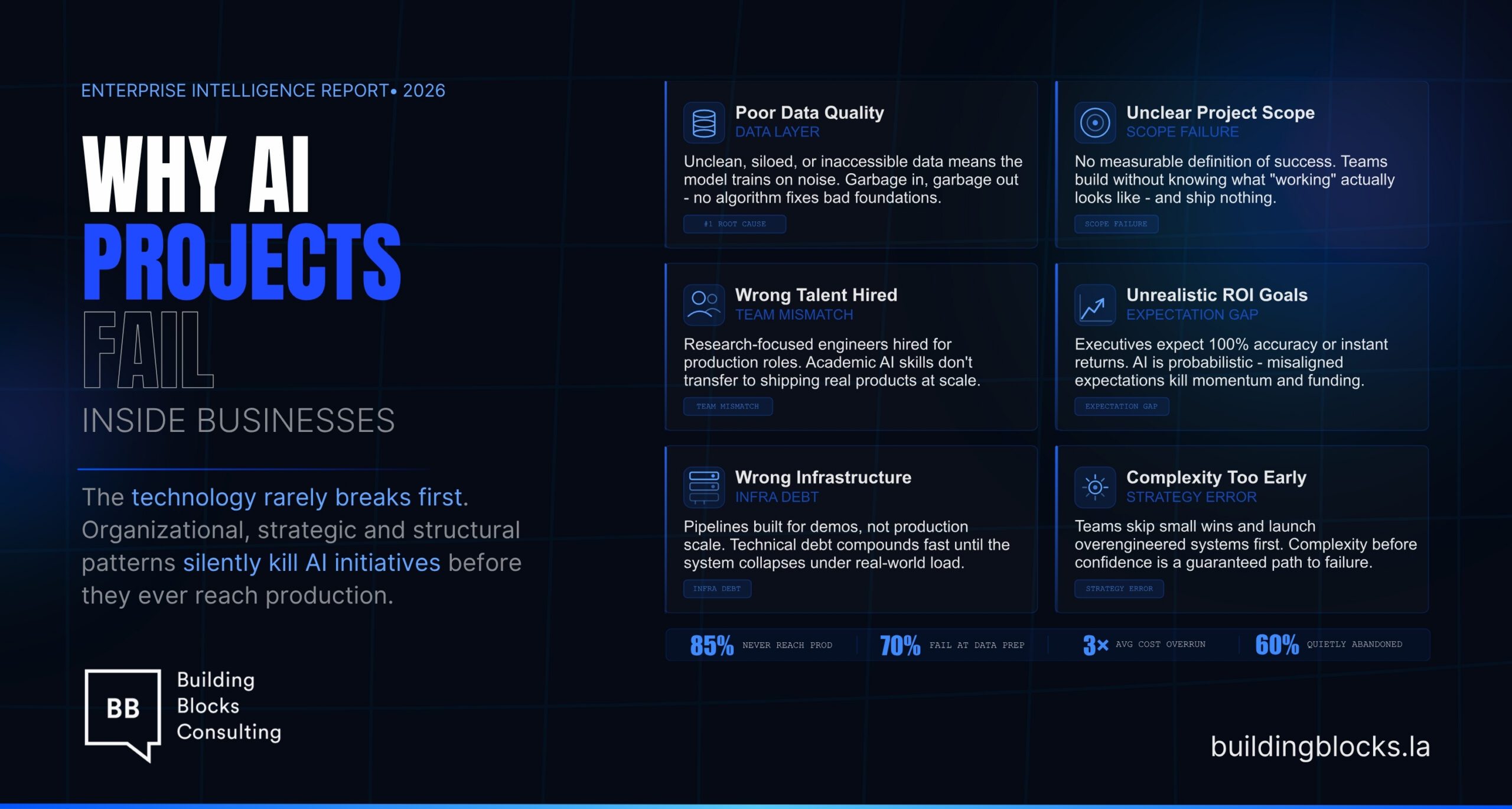
1. Poor Data Infrastructure
This is the most common reason AI projects fail – and the one that surprises businesses the most.
AI systems are entirely dependent on data. Not just the existence of data, but data that is accurate, consistent, accessible, and structured in a way the AI system can actually use.
Most organizations believe they have adequate data until they begin an AI project and discover the reality.
Common data problems that surface during AI implementation:
- Data is stored across disconnected systems that do not communicate with each other
- Records are incomplete, inconsistently formatted, or contain significant errors
- Historical data exists but was never cleaned or standardized for analytical use
- Different departments use different definitions for the same data fields
- Sensitive data is mixed with operational data in ways that create compliance complications
- The data that exists does not actually reflect the business problem the AI is supposed to solve
The gap between “we have data” and “we have data that can power an AI system” is enormous – and expensive to close.
A useful way to think about this: a machine learning model trained on poor data does not produce poor results slowly. It produces confident wrong results immediately. The model is doing exactly what it was designed to do. The problem is that it was trained on the wrong foundation.
Data infrastructure work is rarely glamorous, but it is almost always the first place a serious AI implementation assessment should start. Organizations that skip this step typically discover the problem at the worst possible time – midway through development, after significant budget has already been spent.
What good preparation looks like: Before beginning AI development, audit your data sources, map where critical data lives across your systems, identify inconsistencies, and define a realistic data readiness assessment. This work may add time to the initial planning phase, but it prevents far more costly problems downstream.
2. Unclear or Shifting Project Scope
The second most common failure pattern is starting an AI project without a precise definition of what success actually looks like.
This sounds basic. In practice, it is one of the hardest organizational problems to solve – because scope problems rarely announce themselves upfront. They develop gradually as stakeholders add requirements, as initial assumptions get tested against reality, and as the technical team discovers that the original brief had gaps.
AI projects are particularly vulnerable to scope problems for a specific reason: AI feels open-ended. The technology can, in theory, be applied to an enormous range of problems. This makes it genuinely difficult for non-technical decision-makers to know where to draw the boundary between what the project should do and what it should not.
What unclear scope looks like in practice:
- The project goal is defined in general terms: “we want to use AI to improve customer service” rather than “we want to reduce first-response time on tier-one support tickets by 40 percent through automated triage and suggested responses”
- Success metrics are not defined before development begins, which means there is no objective way to evaluate whether the project worked
- Stakeholders from different parts of the business have different – and sometimes conflicting – expectations about what the AI system will do
- Requirements expand significantly after development begins, a pattern commonly called scope creep, which in AI projects often means rebuilding foundational components rather than simply adding features
- The project tries to solve too many problems simultaneously instead of demonstrating value on one well-defined use case first
The compounding effect is significant. An AI project with unclear scope will consistently produce the wrong thing – not because the engineers made mistakes, but because no one agreed on what the right thing was before work began.
What good preparation looks like: Before any development begins, define the specific problem being solved, the measurable outcome that constitutes success, the data required to solve it, and the explicit boundaries of what the system will and will not do. Write this down. Get alignment across stakeholders. Treat scope changes after development begins as formal decisions with real cost implications, not casual adjustments.
3. Wrong Infrastructure Choices
AI systems have different infrastructure requirements than traditional software – and choosing the wrong infrastructure early creates problems that are extremely difficult and expensive to fix later.
This failure pattern typically happens in one of two ways.
Underbuilding infrastructure too early
Some organizations try to minimize initial costs by building on infrastructure that is adequate for development and early testing but cannot scale to production requirements. The AI system works in a controlled environment. It fails under real load, at production data volumes, or when integrated with live business systems.
Common examples include:
- Using local or low-cost cloud infrastructure for development that cannot handle real inference workloads
- Choosing vector databases or storage solutions that work for small datasets but degrade severely at production scale
- Building data pipelines that work in batch processing but cannot support the real-time requirements the product actually needs
- Ignoring latency requirements during development and discovering that the AI system is too slow for practical use once it reaches real users
Overbuilding infrastructure too early
The opposite mistake is equally costly. Organizations that try to build enterprise-grade, highly scalable AI infrastructure before they have validated the product concept spend enormous amounts of time and money on infrastructure complexity before they know whether the underlying AI system actually works.
This is a particularly common mistake at the enterprise level, where IT and engineering teams default to maximum robustness even when a leaner architecture would be both faster and more informative at an early stage.
The underlying problem in both cases:
Infrastructure decisions made without a clear understanding of actual production requirements – throughput, latency, data volume, security constraints, integration requirements – tend to be wrong in one direction or the other. Getting this right requires engineering judgment about both the current state and the realistic scaling trajectory of the system.
What good preparation looks like: Map your actual production requirements before making infrastructure decisions. Define expected data volumes, latency tolerances, integration points, and security requirements. Then design infrastructure that meets those requirements at your current stage, with a realistic path to scale – not infrastructure designed for a future state you have not yet validated.
4. The Wrong Hiring Decisions
AI projects consistently fail when the people building them do not have the right experience for the specific type of AI work required.
This is a more nuanced problem than it appears. The challenge is not simply a shortage of AI talent. The challenge is that “AI experience” covers an enormous range of skills, and organizations frequently hire people with genuine expertise in one area of AI for roles that require a fundamentally different set of capabilities.
A research-oriented ML engineer hired to build a production AI application may produce technically sophisticated work that never ships because it prioritizes model complexity over operational reliability. A general software engineer with limited AI experience hired to build an AI system may ship something quickly that works superficially but fails under real conditions because the AI-specific components were not implemented correctly.
Other common hiring failure patterns in AI projects:
Hiring too late: Many organizations begin AI projects with existing engineering teams and only bring in AI expertise after problems have already emerged. By that point, architectural decisions have been made that are difficult to reverse.
Underestimating operational roles: AI systems require ongoing monitoring, evaluation, and maintenance beyond the initial build. Organizations that hire only for the build phase, without planning for the operational phase, discover that their AI system degrades over time without the right people to maintain it.
Overreliance on generalist vendors: Some organizations engage technology vendors with broad capabilities but limited deep AI implementation experience. The vendor can deliver a system that technically functions – but it may not be designed for reliability, scalability, or the specific operational context of the business.
What good preparation looks like: Define what type of AI engineering work your project actually requires before making any hiring decisions. Evaluate candidates specifically on production AI experience, not credentials or general software engineering ability alone. Plan for both the build phase and the ongoing operational phase when structuring your team.
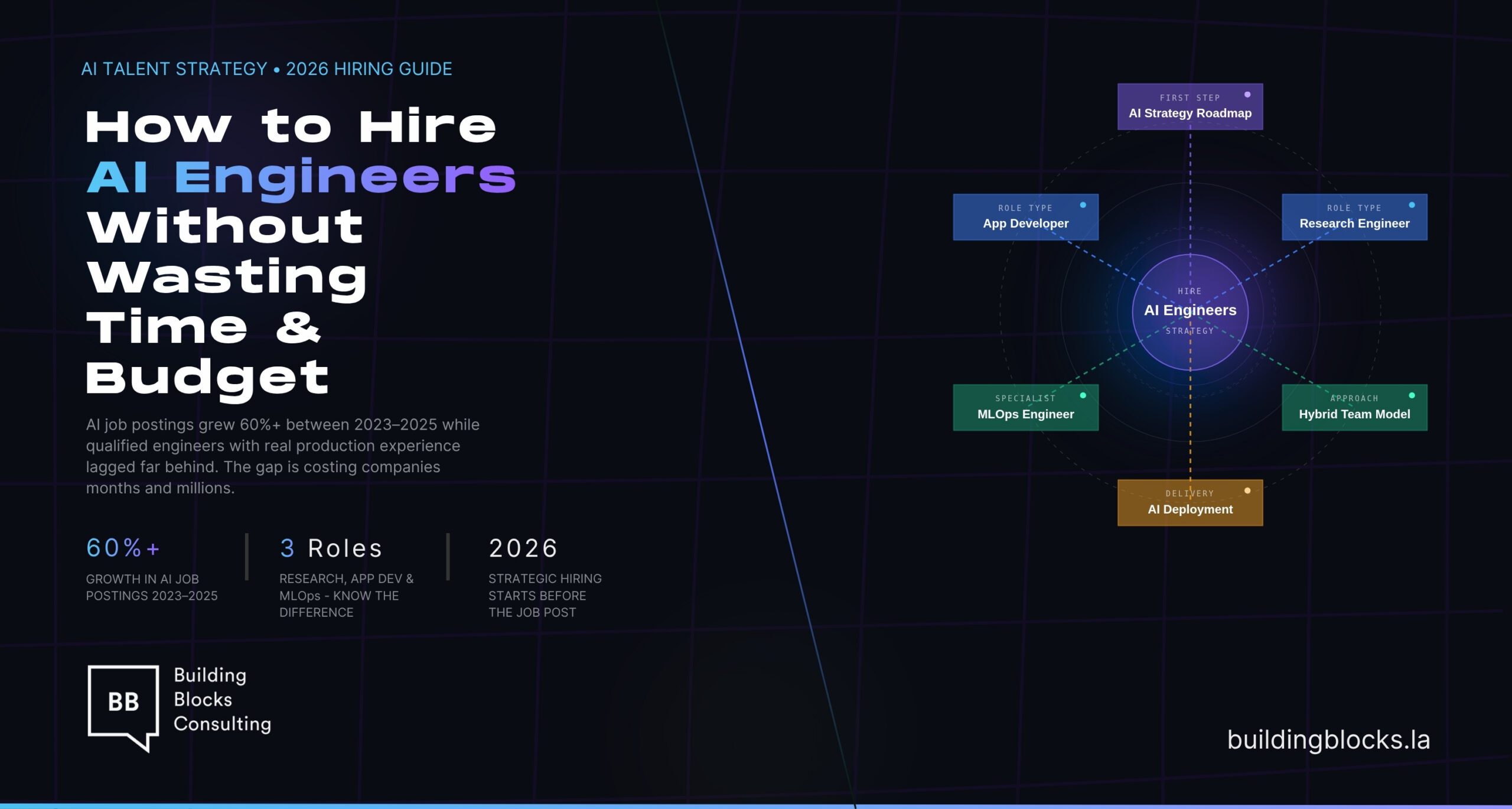
We covered the nuances of AI hiring in depth in our guide on how to hire AI engineers without wasting time and budget.
5. Unrealistic Expectations About What AI Can Do
This is perhaps the most pervasive failure pattern – and the hardest to address because it is often driven by enthusiasm rather than deliberate misrepresentation.
The public conversation about AI tends toward extremes. Either AI is described as a transformative technology that will automate everything, or it is described as overrated and failing to deliver. Neither characterization helps business decision-makers form accurate expectations about what a specific AI implementation will realistically do.
What unrealistic expectations look like in practice:
Expecting accuracy that AI cannot reliably deliver
AI systems, particularly those using large language models, produce probabilistic outputs. They are not deterministic. This means they will sometimes be wrong – and the frequency and nature of those errors matters enormously for whether the system is actually useful in a given business context.
Organizations that expect AI to perform with near-perfect accuracy on complex, nuanced tasks consistently discover that the gap between expected and actual performance makes the system impractical for real use. Managing this expectation upfront, and designing systems that handle errors gracefully, is critical.
Expecting instant ROI
AI systems require significant upfront investment in data preparation, infrastructure, development, and testing before they produce value. Organizations that expect positive ROI within the first few months of an AI project are frequently disappointed – not because the project is failing, but because the timeline for AI value realization is simply longer than for most other technology investments.
Expecting AI to replace human judgment entirely
The most successful AI implementations in 2026 augment human decision-making rather than replace it entirely. Organizations that design AI systems to fully automate decisions that genuinely require human judgment – in customer interactions, in legal contexts, in healthcare, in complex operational situations – typically discover that the AI performs poorly on edge cases in ways that create real problems.
Expecting implementation without organizational change
AI systems do not operate in isolation. They integrate into existing workflows, processes, and team structures. Organizations that treat AI as a purely technical implementation without planning for the organizational changes required to support it – in training, in process design, in governance – consistently underperform on their AI investments.
What good preparation looks like: Define realistic, measurable success criteria before development begins. Understand the error characteristics of the AI approach you are using. Design workflows that keep humans in the loop for high-stakes decisions. Plan the organizational change management required alongside the technical implementation.
6. Building the Wrong Thing First
A failure pattern specific to AI – and one that experienced teams consistently warn against – is starting with the most ambitious, complex use case rather than the most demonstrable one.
The logic that leads organizations here is understandable. Leadership wants to justify the investment. Teams want to demonstrate the full potential of AI. Vendors want to show off their most impressive capabilities. The result is a first AI project scoped around a complex, high-value use case that requires getting many things right simultaneously.
When that project stalls – due to data problems, scope complexity, infrastructure challenges, or any combination of the factors described above – it damages organizational confidence in AI broadly, consumes budget that could have validated a simpler use case first, and sometimes prevents the organization from trying again.
The companies with the strongest AI track records in 2026 almost universally started small. They identified one specific, well-defined workflow with clear success metrics, built a working AI implementation for that workflow, demonstrated measurable value, and then expanded from there.
This approach produces something far more valuable than a complex first project: organizational learning about how AI actually works inside your specific business context, your specific data environment, and your specific team structure. That learning is what makes subsequent AI projects faster and more reliable.
What good preparation looks like: Choose your first AI project based on two criteria: a well-defined problem with measurable success metrics, and the data infrastructure to support it. Resist the pressure to start with the highest-visibility use case. Start with the use case most likely to succeed and generate real learning.
The Pattern Underneath All These Failures
Looking across all of these failure patterns, a common thread emerges.
AI projects most often fail not because of the technology itself, but because of decisions made before any technology is built – decisions about data readiness, project scope, infrastructure requirements, team composition, and realistic expectations.
This is actually encouraging news for organizations that have not yet begun their AI journey, or that have experienced early setbacks. The factors that determine whether an AI project succeeds are largely within organizational control. They require discipline, clear thinking, and honest assessment – but they are not technical mysteries that only specialists can navigate.
The businesses that are building AI successfully in 2026 are not necessarily the ones with the most advanced technical capabilities. They are the ones that approach AI implementation with the same rigor they apply to other strategic investments: clear objectives, honest assessment of current capabilities, realistic timelines, and willingness to start smaller than feels impressive in order to build something that actually works.
Most AI Projects Fail Before the First Line of Code
Building Blocks helps businesses identify and solve the infrastructure, scope, and team gaps that cause AI projects to stall – before they become expensive problems.
How to Assess Your AI Readiness Before Starting
Before committing to an AI project, decision-makers should honestly evaluate their organization across five dimensions.
Data readiness: Do you have clean, accessible, consistent data that directly relates to the problem you are trying to solve? Have you audited where that data lives and what condition it is in?
Scope clarity: Can you define, in one or two specific sentences, what the AI system will do and what measurable outcome constitutes success? If you cannot, the scope is not ready.
Infrastructure fit: Have you mapped the actual production requirements – data volumes, latency tolerances, integration points, security constraints – that the AI system will need to meet? Have you matched those requirements to an infrastructure plan?
Team readiness: Do you have people with the right kind of AI experience for the specific work required? Have you planned for both the build phase and the ongoing operational phase?
Expectation alignment: Have stakeholders across the organization agreed on realistic success metrics, realistic timelines, and a realistic understanding of what the AI system will and will not do?
Organizations that can answer yes to all five of these questions are well-positioned to begin an AI project with a high probability of success. Organizations that cannot should treat addressing these gaps as part of the project itself – not obstacles to skip in order to start faster.
Not Sure If Your AI Project Is Set Up to Succeed?
We help startups and enterprise organizations assess AI readiness, close infrastructure gaps, and build AI systems that work reliably in production.
Final Thoughts
The businesses that succeed with AI in 2026 are not the ones that move fastest or invest the most.
They are the ones that start with the most clarity – about the problem they are solving, the data they have available, the infrastructure they need, the team required to build and operate the system, and the realistic outcomes they can expect.
Every failure pattern described in this guide is avoidable. None of them require sophisticated technical solutions. They require honest organizational assessment before development begins, and the discipline to address what that assessment reveals rather than proceeding anyway.
For organizations that have experienced AI project setbacks, the path forward is not to try the same approach with a larger budget. It is to go back to the foundational questions – data, scope, infrastructure, team, expectations – and get those right before investing further.
The companies building AI that actually works are doing exactly that. The technology is ready. The question is whether the organization around it is ready too. For businesses ready to approach AI development services with that kind of discipline, the opportunity is significant.




By Chris Clifford
Chris Clifford was born and raised in San Diego, CA and studied at Loyola Marymount University with a major in Entrepreneurship, International Business and Business Law. Chris founded his first venture-backed technology startup over a decade ago and has gone on to co-found, advise and angel invest in a number of venture-backed software businesses. Chris is the CSO of Building Blocks where he works with clients across various sectors to develop and refine digital and technology strategy.