


How can we help?
Let's Talk
How can we help?
Let's Talk
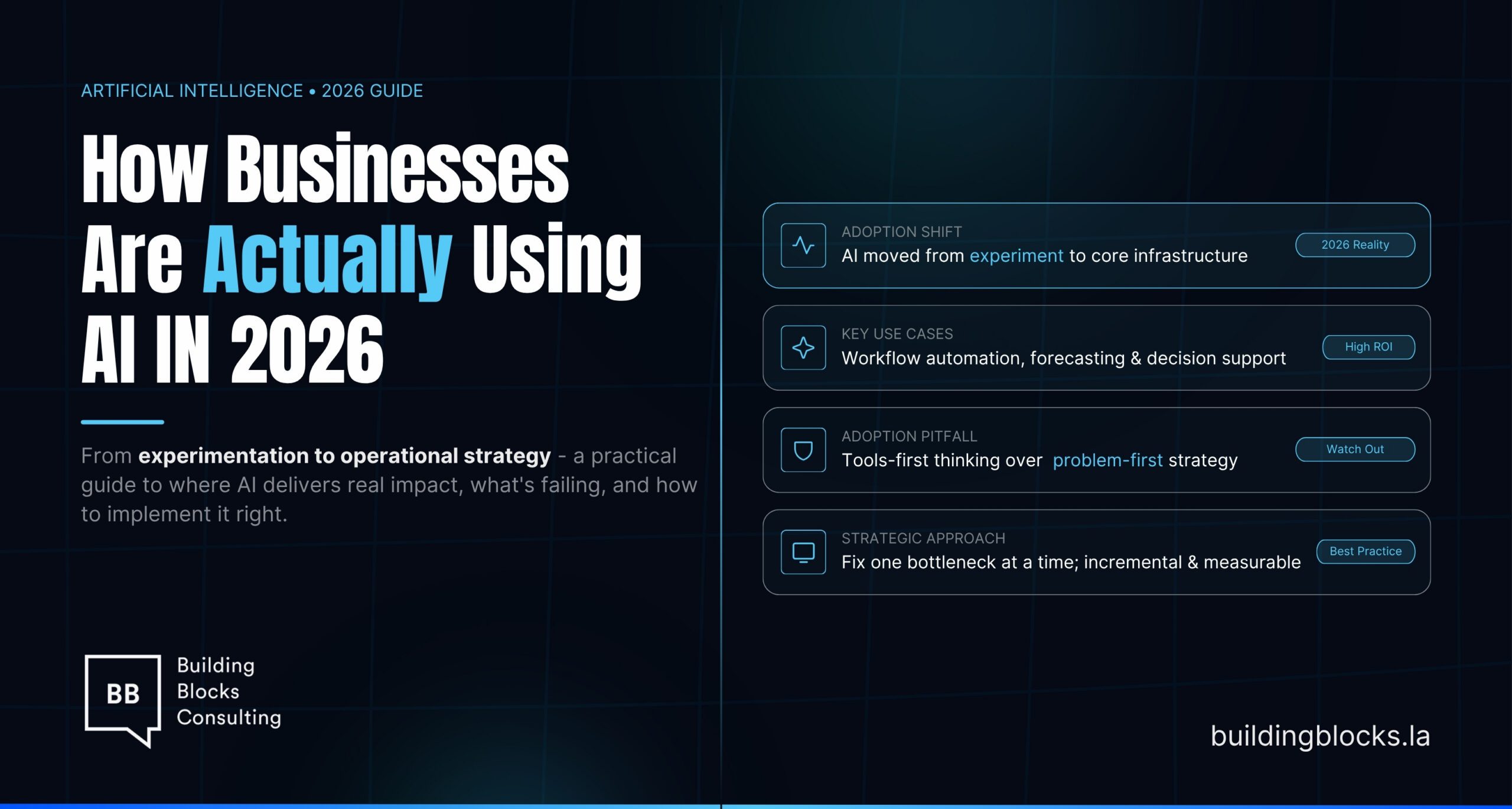
For years, artificial intelligence was discussed as a future opportunity.
In 2026, that conversation has changed completely.
Businesses are no longer asking whether AI matters. They are trying to understand how to implement it effectively without creating unnecessary complexity, operational risk, or infrastructure costs.
Across industries, companies are using AI to automate workflows, improve decision-making, reduce operational overhead, and build entirely new product experiences. What started as experimentation has quickly become operational strategy.
But despite the rapid growth of AI adoption, there is still a major gap between public perception and how businesses actually use AI day-to-day.
Most successful AI implementations are not futuristic robots or fully autonomous systems.
They are practical tools solving specific business problems:
- reducing repetitive work
- improving internal efficiency
- accelerating customer support
- organizing information
- automating workflows
- improving forecasting
- helping teams make faster decisions
The companies seeing the strongest results from AI are usually not chasing trends. They are applying AI carefully to operational bottlenecks that already exist inside the business.
This guide explains how businesses are actually using AI in 2026, where companies are seeing measurable impact, what implementation challenges still exist, and how founders should think about AI adoption strategically.
Why AI Adoption Accelerated So Quickly
Several factors pushed AI from experimental technology into mainstream business operations.
The first was accessibility.
Modern AI infrastructure became dramatically easier to use through:
- API-based AI services
- open-source models
- cloud infrastructure
- AI development frameworks
- low-friction integrations
Companies no longer needed massive research teams to begin implementing AI workflows.
The second shift was competitive pressure.
Businesses quickly realized AI could:
- reduce operating costs
- improve productivity
- automate internal processes
- enhance customer experiences
- accelerate product development
Once competitors began integrating AI into operations, adoption accelerated rapidly across nearly every major industry.
At the same time, generative AI changed expectations around software itself.
Users increasingly expect:
- intelligent search
- AI copilots
- automation
- personalized workflows
- conversational interfaces
AI is no longer viewed as a separate product category. It is becoming part of standard digital infrastructure.
Many organizations are now approaching AI implementation as part of a larger digital transformation strategy focused on long-term operational efficiency and scalable modernization.
AI Is Becoming Part of Modern Business Infrastructure
We help teams identify practical AI use cases and build scalable systems that improve efficiency and reduce implementation risk.
The Biggest Misconception About Business AI
One of the most common misconceptions is that AI automatically replaces entire teams.
That is rarely how successful companies use it.
In practice, most businesses use AI to:
- augment employees
- automate repetitive tasks
- accelerate workflows
- improve access to information
- reduce operational friction
The goal is usually not full automation.
The goal is operational leverage.
For example:
- customer support teams use AI assistants to reduce response times
- logistics companies use AI forecasting to improve planning
- finance teams automate reporting workflows
- SaaS companies integrate AI copilots into user experiences
- healthcare organizations automate documentation and data analysis
The strongest implementations usually focus on practical operational improvements rather than trying to replace human decision-making entirely.
How Businesses Are Actually Using AI in 2026
AI adoption looks different across industries, but several patterns have emerged consistently.
1. AI-Powered Internal Knowledge Systems
One of the fastest-growing use cases in 2026 is internal knowledge retrieval.
Businesses generate massive amounts of information:
- documentation
- contracts
- SOPs
- internal wikis
- support tickets
- meeting notes
- project data
Employees often waste significant time searching for information across disconnected systems.
AI-powered internal assistants now help organizations:
- search company knowledge
- summarize documentation
- answer operational questions
- retrieve workflows
- accelerate onboarding
These systems are becoming especially valuable for:
- enterprise operations
- legal teams
- customer support
- technical teams
- healthcare organizations
Many businesses discover that improving internal information access creates immediate operational gains with relatively manageable infrastructure complexity.
2. AI Automation for Operational Workflows
Operational automation has become one of the most practical AI investments for businesses.
Instead of focusing on flashy AI experiences, companies are automating repetitive internal processes.
Examples include:
- invoice processing
- reporting workflows
- customer onboarding
- sales qualification
- scheduling
- ticket routing
- document classification
- workflow approvals
These implementations reduce:
- manual overhead
- processing delays
- operational bottlenecks
- repetitive administrative work
Businesses are increasingly investing in AI systems that integrate directly into existing workflows rather than replacing entire operational systems.
Organizations evaluating operational automation often benefit from working with an experienced AI implementation partner capable of integrating AI into real-world business infrastructure effectively.
3. AI Assistants for Customer Support
Customer support has become one of the most mature AI use cases.
Modern AI assistants now help businesses:
- answer common questions
- summarize tickets
- suggest responses
- route customer issues
- retrieve account information
- automate support workflows
Importantly, the best companies are not fully replacing support teams.
Instead, they are combining:
- AI systems
- human escalation
- workflow automation
This hybrid model improves:
- response speed
- operational efficiency
- customer experience
- support scalability
Businesses that implement AI thoughtfully often reduce support overhead significantly without sacrificing service quality.
4. AI in SaaS Products
AI is increasingly becoming a built-in feature within SaaS platforms.
Many software companies now integrate:
- AI copilots
- intelligent recommendations
- content generation
- workflow suggestions
- predictive analytics
- conversational search
Users increasingly expect software products to include some level of AI functionality.
This shift is forcing SaaS businesses to rethink:
- product design
- onboarding
- workflow architecture
- feature prioritization
However, many companies underestimate the infrastructure complexity required to support scalable AI experiences inside production SaaS environments.
This is where engineering maturity becomes critical.
Building AI Features Into Your Product?
We help teams design and integrate scalable AI features with the right architecture, infrastructure, and reliability for production use.
5. AI for Forecasting and Decision Support
Businesses are increasingly using AI for:
- sales forecasting
- demand prediction
- operational planning
- financial analysis
- risk assessment
- inventory optimization
These systems help organizations process larger datasets faster than traditional reporting systems alone.
The value is not always full automation.
Often the biggest advantage is helping teams make better decisions faster.
This is especially valuable in industries like:
- logistics
- retail
- healthcare
- fintech
- manufacturing
where operational timing has direct financial impact.
6. AI-Driven Software Development Workflows
One of the fastest-growing internal AI use cases is software development acceleration.
Engineering teams now use AI to:
- generate boilerplate code
- assist debugging
- summarize documentation
- accelerate testing
- improve productivity
This does not eliminate the need for experienced engineers.
Instead, it changes how teams operate.
Strong engineering organizations are learning how to combine:
- AI-assisted development
- human review
- scalable architecture
- operational oversight
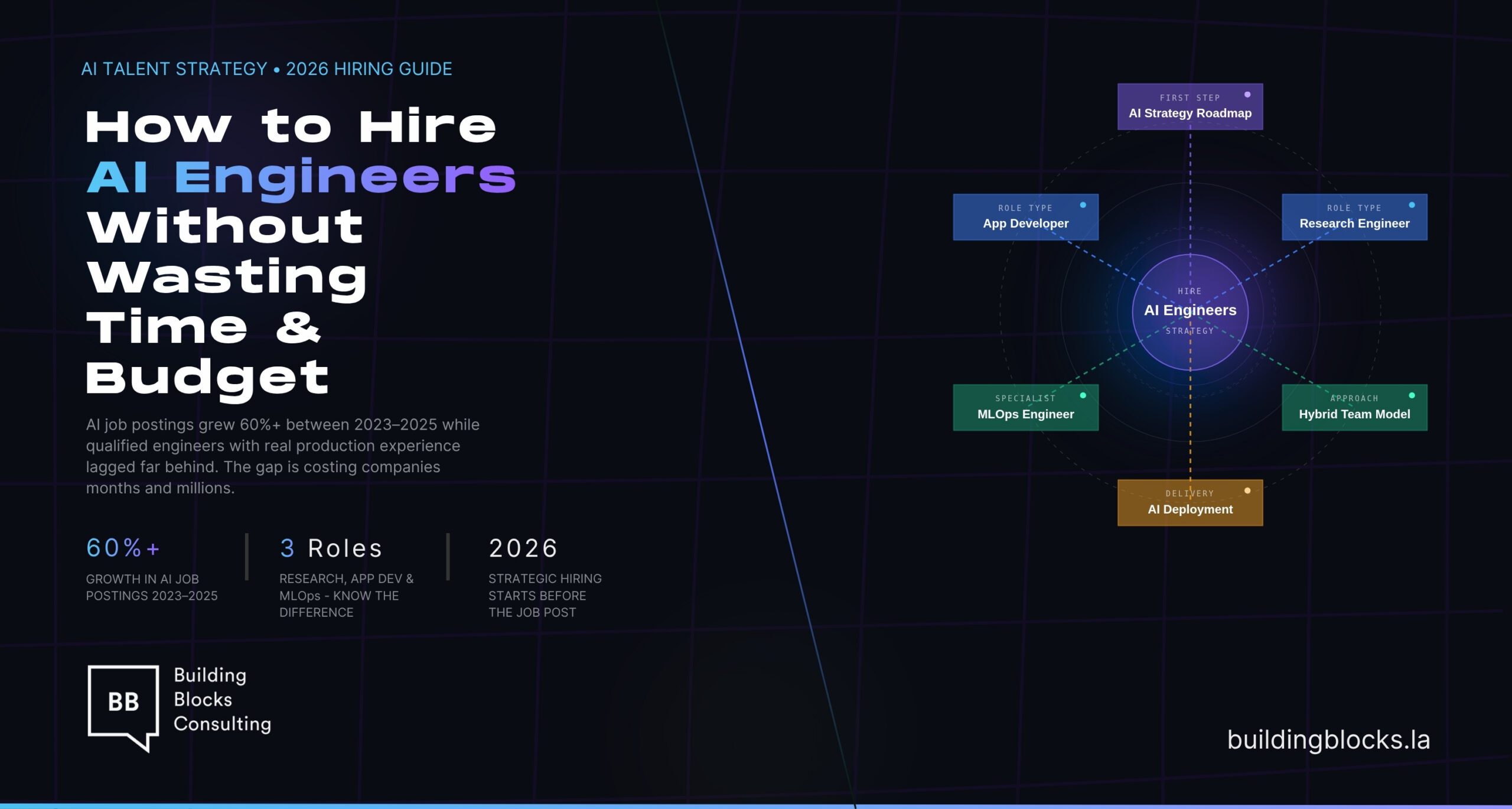
Businesses building AI-enabled products often need experienced engineering support capable of handling both software architecture and AI infrastructure simultaneously. Many companies therefore choose to hire AI developers with production experience rather than relying entirely on generalized engineering teams.
Why Some Businesses Still Struggle With AI Adoption
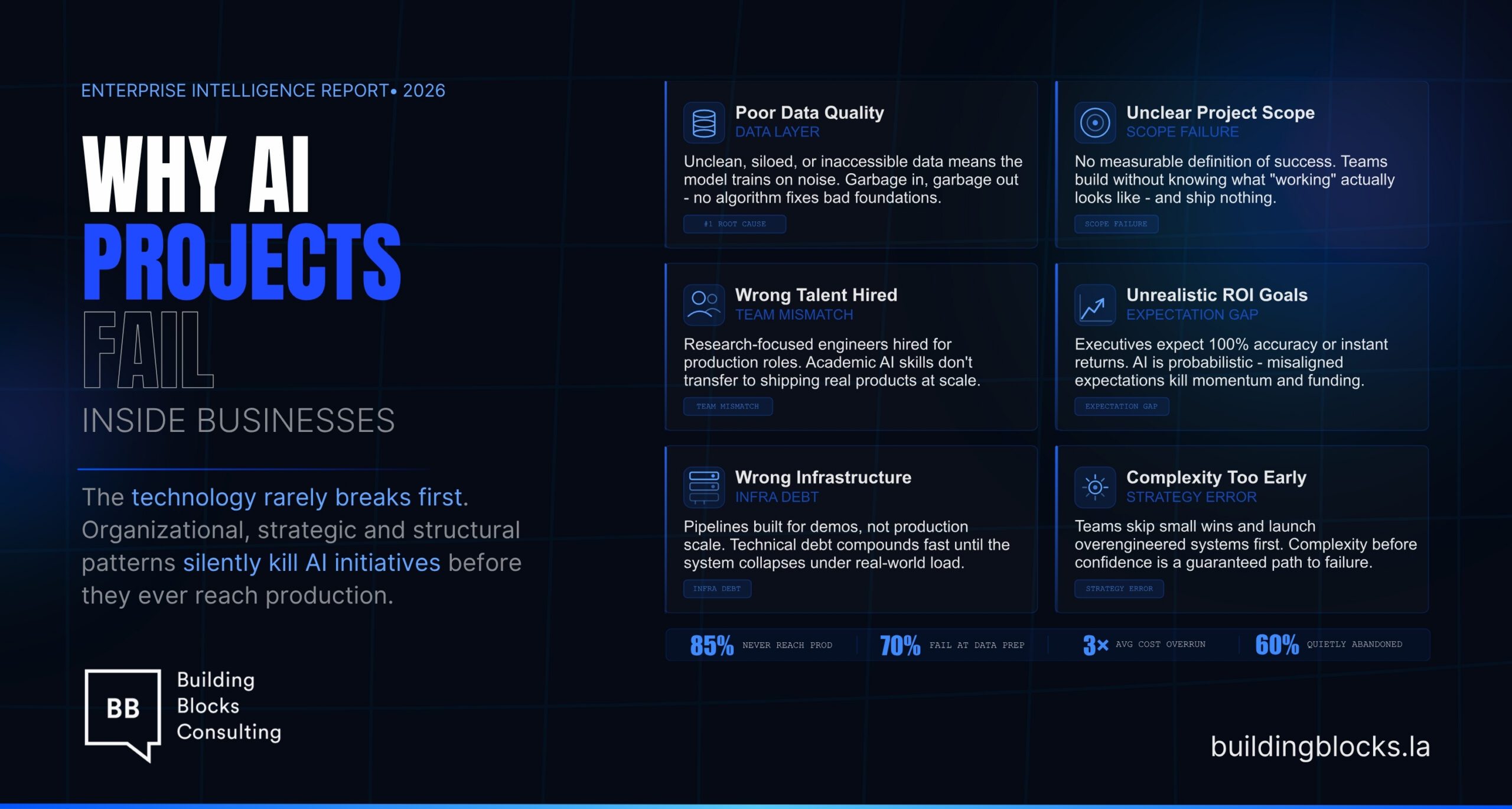
Despite rapid growth, many AI initiatives still fail to create measurable value.
Usually, the problem is not the technology itself.
The problem is implementation strategy.
Businesses Often Start With Tools Instead of Problems
One of the biggest mistakes companies make is beginning with:
“How can we use AI?”
instead of:
“What operational problem are we trying to solve?”
Strong AI implementations begin with:
- workflow inefficiencies
- operational bottlenecks
- repetitive tasks
- scalability problems
AI should support business objectives rather than exist purely for innovation branding.
Poor Data Infrastructure Creates Major Problems
AI systems depend heavily on data quality.
Many organizations discover:
- systems are disconnected
- information is inconsistent
- historical data is incomplete
- operational workflows are fragmented
This increases implementation complexity dramatically.
Strong infrastructure planning matters far more than most businesses initially expect.
Oversized AI Scope Slows Progress
Another common mistake is trying to build overly ambitious AI systems too early.
Businesses frequently attempt:
- enterprise-wide automation
- custom AI models
- advanced analytics platforms
- multiple AI workflows
before validating smaller operational improvements first.
Successful AI adoption usually happens incrementally.
The strongest companies focus on:
- one workflow
- one operational problem
- one measurable improvement
before scaling further.
What Founders Should Prioritize Before Investing in AI
For founders and business leaders, AI implementation should begin with operational clarity rather than technical hype.
Several questions matter before development begins.
What Problem Is AI Solving?
AI should improve:
- efficiency
- scalability
- user experience
- operational speed
- decision-making
Businesses should define measurable outcomes clearly before selecting technologies.
Is Existing Infrastructure Ready?
AI systems often expose infrastructure weaknesses.
Organizations should evaluate:
- data systems
- integrations
- security
- operational workflows
- cloud infrastructure
before scaling implementation.
Is AI Necessary Right Now?
Not every business problem requires AI.
Sometimes:
- automation
- process optimization
- workflow redesign
- standard software improvements
create stronger ROI with lower complexity.
The businesses succeeding with AI are usually making disciplined implementation decisions rather than chasing trends aggressively.
Why AI Is Becoming Part of Core Business Infrastructure
In 2026, AI is increasingly becoming embedded into:
- operations
- workflows
- products
- internal systems
- decision-making processes
This is similar to how cloud infrastructure evolved over the last decade.
Eventually, AI may no longer be viewed as a separate “feature.” It will simply become part of how modern businesses operate.
Companies investing strategically today are positioning themselves for long-term operational advantages as AI adoption continues accelerating across industries.
How Building Blocks Helps Businesses Implement AI Strategically
Building Blocks AI Intelligence Services helps startups and enterprise organizations design and deploy scalable AI systems focused on real operational outcomes.
Our team supports businesses through:
- AI strategy
- MVP planning
- automation infrastructure
- generative AI integration
- product development
- deployment architecture
- scalable engineering support
Rather than treating AI as a trend, we help organizations identify practical opportunities where AI can create measurable business value while reducing implementation risk.
For organizations modernizing operations more broadly, our digital transformation services help businesses align technology decisions with long-term scalability and operational growth.
AI Adoption Is No Longer Just About Innovation
We help teams adopt AI strategically improving efficiency, automating workflows, and building scalable systems with reduced risk.
Final Thoughts
The businesses benefiting most from AI in 2026 are not necessarily the ones building the most advanced systems.
They are the ones applying AI strategically to real operational problems.
Successful AI adoption usually looks practical:
- automating repetitive work
- improving information
- access accelerating workflows
- supporting decision-making
- enhancing products gradually
For founders and business owners, the most important shift is understanding that AI is no longer experimental infrastructure.
It is increasingly becoming part of modern business operations.
The companies that implement AI thoughtfully today will likely be significantly better positioned as operational expectations continue evolving over the next several years.




By Chris Clifford
Chris Clifford was born and raised in San Diego, CA and studied at Loyola Marymount University with a major in Entrepreneurship, International Business and Business Law. Chris founded his first venture-backed technology startup over a decade ago and has gone on to co-found, advise and angel invest in a number of venture-backed software businesses. Chris is the CSO of Building Blocks where he works with clients across various sectors to develop and refine digital and technology strategy.