



How can we help?
Let's Talk
How can we help?
Let's Talk
Artificial intelligence is no longer only a technology-team concern. For enterprise leaders, AI increasingly affects investment decisions, operating models, workforce planning, customer experiences, data strategy, security, and long-term competitiveness.
That creates a different learning requirement for executives.
A CTO does not necessarily need to become a machine learning engineer. A CEO does not need to learn how to build a large language model. But leadership teams do need enough AI knowledge to evaluate opportunities, understand limitations, challenge assumptions, assess risks, and make informed decisions.
This is why choosing an executive AI training program requires more than comparing course length, certificates, or the number of AI tools covered.
The right program should help leaders understand how AI can work within an enterprise environment and, more importantly, how to make better decisions about it.
What Is Executive AI Training?
Executive AI training is designed to give senior business and technology leaders a practical understanding of artificial intelligence and its implications for an organization.
Unlike technical AI training, the objective is generally not to teach executives how to build models or develop AI applications.
Instead, executive training should help leaders understand:
- Where AI can create business value
- How generative AI and large language models work at a practical level
- What data AI systems require
- How AI can connect with existing business systems
- What security, privacy, and governance issues matter
- How to evaluate AI use cases
- What AI implementation may require
- How AI can affect employees and operating models
- How to evaluate vendors, investments, and expected outcomes
For CTOs and CIOs, the program should also provide enough technical context to support meaningful conversations with engineering, data, security, and business teams.
Why Executive AI Training Is Different From Employee AI Training
Enterprise AI training should not be treated as one program for everyone.
Employees may need training on using AI tools for productivity, content creation, research, automation, or everyday workflows.
Executives have different responsibilities.
A leadership team needs to understand questions such as:
Should we invest in this AI use case?
What data would it require?
Can it integrate with our existing technology environment?
What risks would it introduce?
Should we build, buy, or work with an external partner?
How should we measure business value?
What capabilities will our organization need to support it?
That difference is particularly important for CTOs and CIOs, who may be responsible for translating business expectations into technology decisions.
Recent guidance on executive AI education similarly emphasizes that leaders need enough knowledge to evaluate opportunities, understand risks, assess vendors, and guide organizational change rather than become AI engineers themselves. TechTarget
1. Look for Business and Technology Relevance
The first question should be simple:
Will this training help our leaders make better decisions about AI?
An executive program should connect AI concepts with actual enterprise challenges.
For example, leaders may need to evaluate AI for:
- Customer service
- Internal knowledge management
- Business intelligence
- Sales and marketing
- Software development
- Operations
- Document processing
- Employee productivity
- Data analysis
- Workflow automation
For CTOs and CIOs, the discussion should go beyond business use cases and include topics such as data architecture, integration, APIs, security, scalability, monitoring, and production considerations.
The objective is not technical depth for its own sake. It is enough technical understanding to make informed leadership decisions.
2. Evaluate the Generative AI Content
Generative AI should be an important part of modern executive AI education.
Leaders should understand what technologies such as large language models can do, where they perform well, and where they can introduce risk.
A useful program should cover areas such as:
- Large language models
- Generative AI applications
- Prompting and interaction
- Retrieval-based AI
- AI agents and automation
- Enterprise data and AI
- Hallucinations and accuracy
- Privacy and security
- Human oversight
Executives do not need to master every technical detail.
They do need to understand enough to distinguish between an impressive AI demonstration and an enterprise-ready capability.
A production AI system may require data integration, access controls, monitoring, security, governance, infrastructure, and ongoing maintenance in addition to the underlying model. TechTarget
3. Look for Practical Enterprise Use Cases
A training program becomes more valuable when executives can connect learning to their own organization.
Rather than relying entirely on theoretical examples, look for programs that allow participants to explore realistic business scenarios.
For example:
A CTO might examine how generative AI could integrate with internal applications.
A CIO might evaluate AI governance, data requirements, and enterprise architecture.
A COO might explore process automation and operational efficiency.
An HR leader might examine workforce productivity, AI skills, and organizational change.
A CEO might focus on competitive advantage, investment priorities, and new business opportunities.
The strongest programs should help leaders translate AI concepts into questions relevant to their own organization.
4. Check Whether the Program Covers AI Risk
AI training should not focus only on what AI can accomplish.
Executives also need to understand what can go wrong.
Important areas include:
- Data privacy
- Cybersecurity
- Intellectual property
- Inaccurate AI outputs
- Bias
- Regulatory requirements
- Sensitive data
- Model limitations
- Human oversight
- Accountability
- AI governance
For a CTO or CIO, this is particularly important because AI initiatives can introduce new technology, data, security, and operational considerations.
Good executive training should help leaders ask the right risk questions before an AI initiative moves from experimentation toward production.
5. Look for Training That Matches Executive Roles
A single generic curriculum may not be appropriate for every leader.
Different executives make different AI decisions.
A CTO may need deeper exposure to:
- AI architecture
- Data infrastructure
- Model integration
- APIs
- Security
- Production deployment
- Technical scalability
A CIO may place greater emphasis on:
- Enterprise systems
- Data governance
- AI operating models
- Vendor evaluation
- Organizational adoption
- Technology investment
A CEO may need greater focus on:
- Business value
- Competitive positioning
- Investment priorities
- Organizational transformation
- Risk
Role-specific learning can therefore make an executive AI training program more relevant and useful.
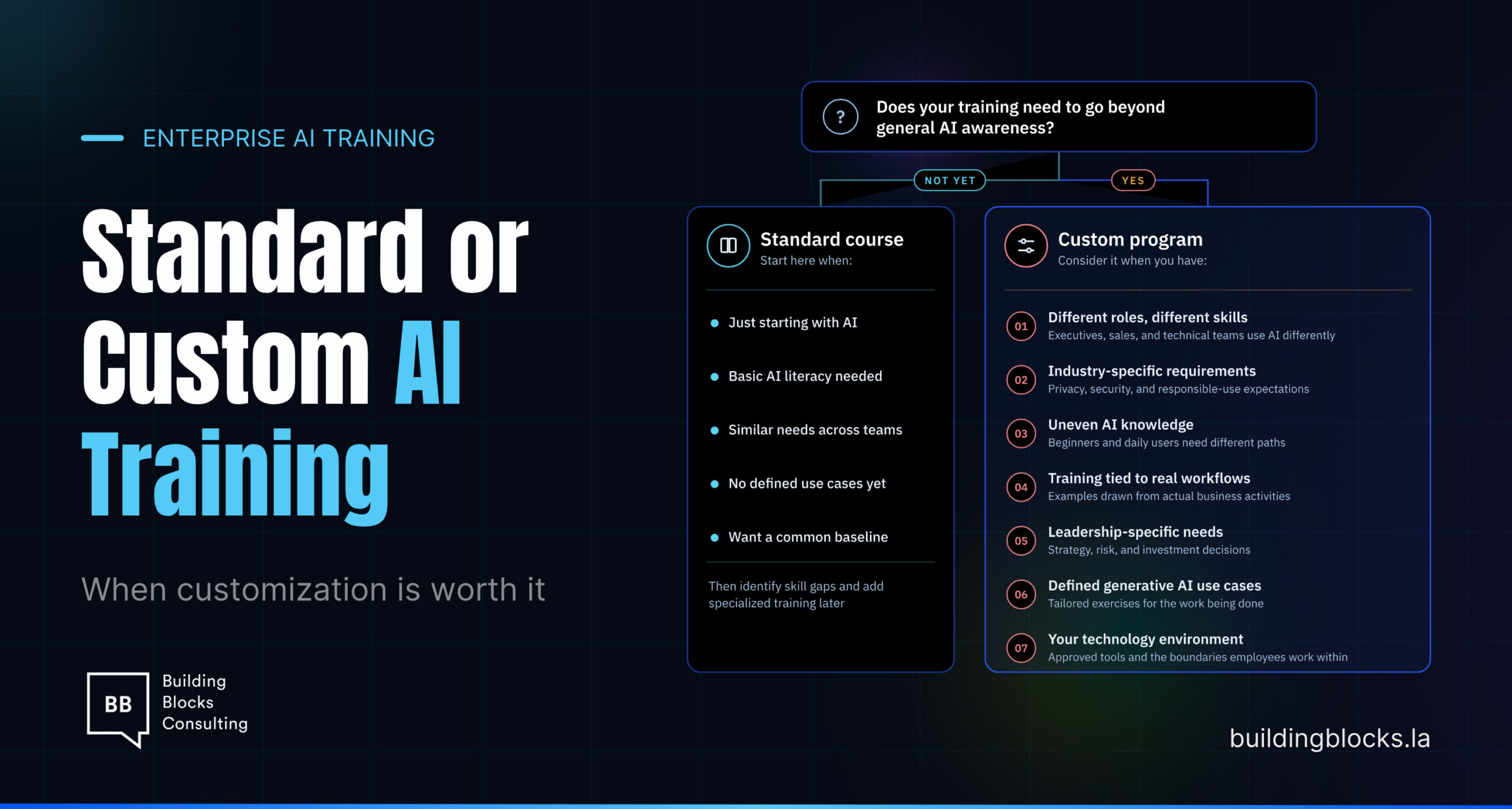
6. Consider How Much Customization Is Available
One of the biggest differences between a standard executive course and enterprise AI training is customization.
A public course may provide a strong general introduction to AI.
Enterprise leadership teams may need something more specific.
Customization can include:
- Industry-specific examples
- Organization-specific use cases
- Existing technology environments
- Leadership priorities
- Current AI initiatives
- Internal AI policies
- Workforce needs
- Generative AI workflows
This does not mean every part of a program needs to be created from scratch.
It means the training should reflect the organization’s actual challenges wherever practical.
7. Evaluate the Instructor’s Enterprise Experience
The person delivering the training matters.
Executives should look beyond academic credentials and ask whether instructors understand how AI works in real organizations.
Useful questions include:
- Have they worked on real AI initiatives?
- Do they understand enterprise technology environments?
- Can they explain technical concepts clearly?
- Can they discuss implementation challenges?
- Can they address business and technology questions?
- Can they adapt the discussion to executive concerns?
Current executive AI education guidance also emphasizes practitioner experience, business relevance, current content, and clear learning outcomes when evaluating programs. AI Business Magazine+1
8. Choose a Format That Fits Leadership Teams
The best format depends on what the organization is trying to accomplish.
Possible formats include:
- Executive workshops
- Live virtual sessions
- In-person training
- Short intensive programs
- Multi-session programs
- Blended learning
- Self-paced courses with live discussions
For a leadership team that needs a common AI foundation, a focused workshop may be appropriate.
For organizations preparing leaders for broader AI initiatives, a longer program may provide more opportunity for practical exercises, discussion, and application.
The important question is not simply how long the program lasts.
It is whether the format gives leaders enough time to understand the subject and connect it to their responsibilities.
9. Look for Measurable Learning Outcomes
A certificate alone does not demonstrate that an organization has developed AI capability.
Before selecting a program, define what leaders should be able to do after completing it.
For example, executives should be able to:
- Identify realistic AI opportunities
- Evaluate AI use cases
- Understand major AI risks
- Ask informed technical questions
- Evaluate AI vendors
- Understand data requirements
- Discuss AI investment decisions
- Identify workforce implications
- Understand responsible AI considerations
For enterprise programs, organizations can also evaluate changes in leadership confidence, AI knowledge, use-case identification, and alignment around AI priorities.
10. Consider Whether the Program Can Support Ongoing Learning
AI changes quickly.
New models, tools, capabilities, regulations, and enterprise applications continue to emerge.
That means executive AI education should not necessarily be viewed as a one-time event.
Organizations should consider whether a provider can support continued learning through:
- Updated content
- Follow-up sessions
- Executive workshops
- New use-case discussions
- Practical exercises
- AI capability assessments
- Ongoing learning resources
The goal is to ensure that leadership understanding does not become outdated as the technology evolves.
Questions CTOs and CIOs Should Ask Before Choosing an AI Training Program
Before selecting an executive AI training provider, technology leaders can ask:
- Is the program designed specifically for enterprise leaders?
- Does it cover both business and technical considerations?
- Does it include generative AI and large language models?
- Does it address security, privacy, governance, and responsible AI?
- Can the content be adapted to our organization?
- Does it include practical enterprise use cases?
- Can the program address different executive roles?
- Who delivers the training and what enterprise experience do they have?
- How current is the curriculum?
- How will we measure whether the training produced useful outcomes?
These questions can help distinguish between a general AI course and a program designed to build meaningful leadership capability.
When Should an Enterprise Consider Executive AI Training?
Executive AI training can be particularly useful when a leadership team is:
- Beginning to explore AI opportunities
- Evaluating generative AI initiatives
- Investing in AI applications
- Developing an AI roadmap
- Evaluating AI vendors
- Introducing AI into existing business systems
- Establishing responsible AI practices
- Preparing employees for AI-driven changes
- Trying to create greater alignment between business and technology leaders
It can also be useful when executives are hearing about AI from multiple teams and vendors but do not yet have a shared understanding of what is technically and commercially realistic.
The Goal Is Better AI Decision-Making
The purpose of executive AI training is not to turn every business leader into an AI engineer.
It is to give leadership teams enough knowledge to make better decisions. For a CTO, that may mean asking better questions about architecture, integration, data, security, and production readiness.
For a CIO, it may mean evaluating technology investments and organizational capabilities more effectively.
For a CEO, it may mean understanding where AI can create meaningful business value and where investment may not be justified.
The right executive AI training program should therefore connect AI knowledge with leadership decisions.
Building AI Capability Across Enterprise Leadership
Executive education is one part of building broader AI capability across an organization.
Once leaders understand the opportunities, risks, and requirements of AI, organizations can develop more targeted learning paths for technical teams, managers, and employees.
BuildingBlocks Consulting provides AI training for enterprises designed to help organizations build practical AI capability across leadership and workforce teams. Training can be structured around organizational roles, business priorities, AI literacy, generative AI, and practical applications.
If your leadership team is evaluating AI training, the first step is to identify what your executives need to understand and which decisions the training should help them make.
Final Takeaway
The best executive AI training program is not necessarily the longest, most technical, or most expensive.
It is the one that helps leaders understand what AI can do, where it can create value, what risks it introduces, and what their organization needs to do next.
For enterprise leaders, especially CTOs and CIOs, the most useful programs combine AI literacy with practical business and technology context.
That foundation can help leadership teams move from discussing AI to making more informed decisions about where and how it should be used.



By Chris Clifford
Chris Clifford was born and raised in San Diego, CA and studied at Loyola Marymount University with a major in Entrepreneurship, International Business and Business Law. Chris founded his first venture-backed technology startup over a decade ago and has gone on to co-found, advise and angel invest in a number of venture-backed software businesses. Chris is the CSO of Building Blocks where he works with clients across various sectors to develop and refine digital and technology strategy.