


How can we help?
Let's Talk
How can we help?
Let's Talk
AI projects often receive most of the attention for the model, application, or user experience. But behind a reliable AI system is another critical component: the data engineering that makes the right information available in the right form.
An AI application can only work as well as the data and systems supporting it.
Business data may be spread across databases, applications, data warehouses, documents, APIs, and other systems. It may also contain inconsistent formats, missing values, duplicate records, outdated information, or access restrictions.
Before AI can use that information effectively, the organization often needs to build the technical foundation that collects, integrates, transforms, validates, and delivers it.
So, what data engineering does an AI project need?
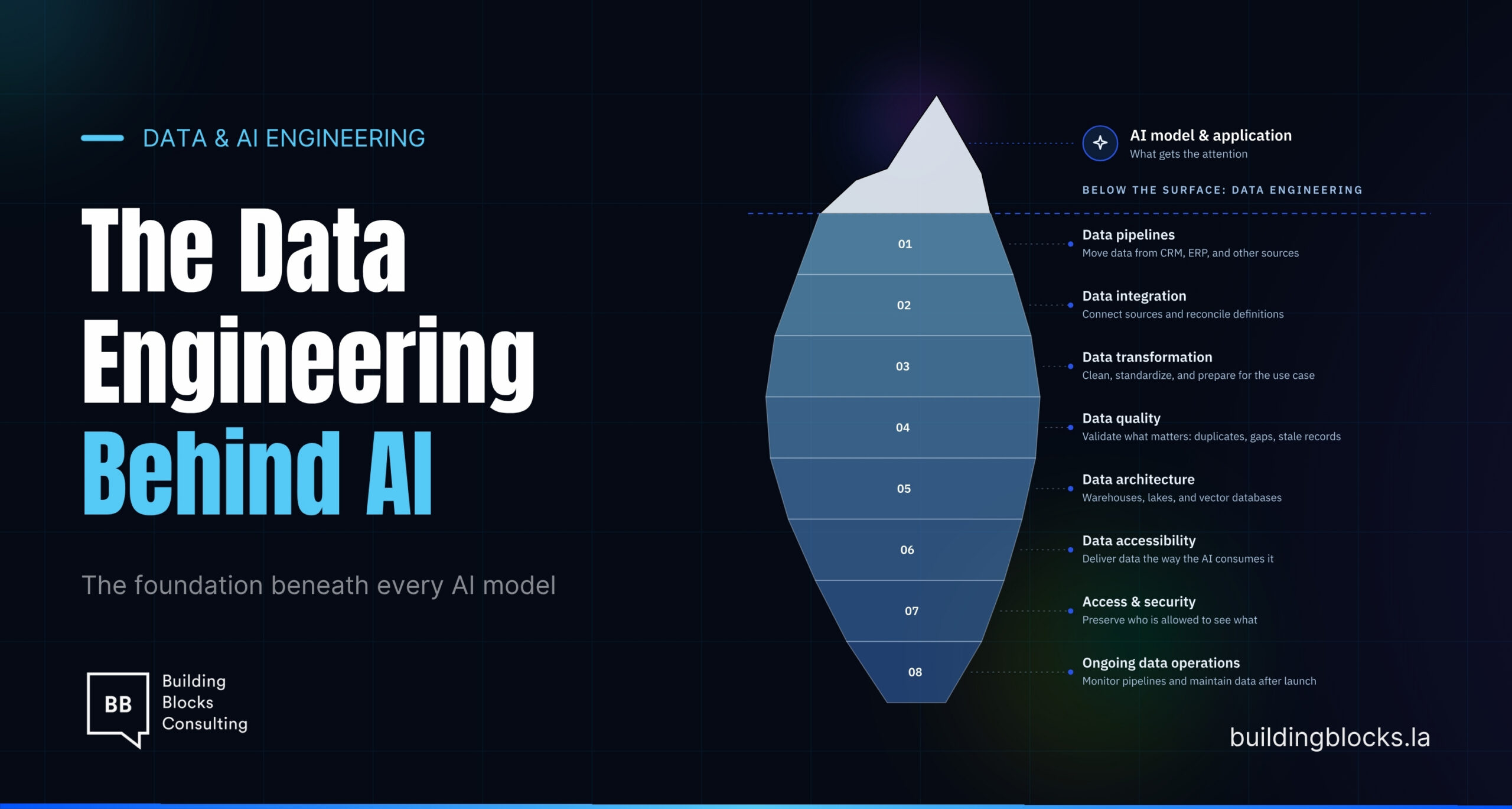
The answer depends on the type of AI system, but most projects need to consider data pipelines, integration, transformation, architecture, quality, accessibility, and ongoing data operations.
Why Data Engineering Matters for AI
An AI model does not automatically understand an organization’s business data.
Consider a company that wants to build an AI assistant for its customer service team. Relevant information might exist across a CRM, product database, support tickets, internal documentation, and customer-facing systems.
Simply connecting an AI model to one of these systems does not create a reliable solution.
The data needs to be identified, connected, processed, and made available to the application in a way that supports the intended use case.
This is where data engineering for AI becomes important.
The purpose is not just to move data from one system to another. It is to create a dependable data foundation that an AI application can actually use.
Start With the AI Use Case
Data engineering should begin with the AI requirement rather than with the available technology.
A forecasting system, recommendation engine, document-processing application, and generative AI assistant may all require very different data architectures.
For example, a machine learning project may depend on historical structured data that needs to be cleaned and transformed into training or inference datasets.
A generative AI application may instead need access to documents, knowledge bases, databases, or other information sources that can be retrieved when a user submits a question.
The first question should therefore be:
What data does the AI system need to perform its intended task?
Once that is understood, engineers can determine how that data needs to be collected, processed, stored, and delivered.
Data Pipelines: Moving Information Where It Needs to Go
Most enterprise data does not originate in one place.
Customer information might come from a CRM. Transaction data may come from an ERP system. Product information could live in a separate database. Documents might be stored in cloud storage or an internal content platform.
Data pipelines connect these sources to the environments where the information needs to be used.
For an AI project, pipelines may collect data from operational systems, transform it, validate it, and deliver it to a data platform or application.
Reliable pipelines also need to handle changes over time.
Source systems change. Data formats evolve. Records can be missing. Connections can fail.
A production AI system therefore needs pipelines that are designed for ongoing operation rather than a one-time data transfer.
Data Integration Connects AI to the Business
AI becomes more useful when it can work with the information already used by the organization.
That often requires integrating multiple data sources.
For example, an AI application could combine customer records with product information and support history to help a service representative understand a customer’s situation.
Data integration makes these connections possible.
The engineering challenge is not simply connecting systems. It is ensuring that information from different sources can be interpreted consistently.
Different systems may use different field names, identifiers, formats, or definitions for what appears to be the same business concept.
Without proper integration, an AI system may receive incomplete or contradictory information.
Data Transformation Makes Information Usable
Raw business data is rarely ready to be consumed directly by an AI application.
It may need to be cleaned, standardized, enriched, filtered, aggregated, or converted into another format.
This work is known as data transformation.
For example, dates may appear in different formats across systems. Customer identifiers may not match. Product categories may use different naming conventions. Historical records may contain values that are no longer valid.
Transformation processes help create a more consistent representation of the information.
For machine learning projects, transformation may also involve creating features or preparing datasets for training and inference.
For generative AI projects, it may involve preparing documents or other information for retrieval and context generation.
The transformation approach should always reflect the AI use case.
Data Quality Is an Engineering Concern
Poor data quality can undermine an otherwise well-designed AI system.
Problems such as missing values, duplicates, outdated records, inconsistent definitions, and incorrect information can affect AI outputs and model performance.
This does not mean every dataset needs to be perfectly clean before an AI project can begin.
Instead, organizations should determine which data-quality issues actually matter for the intended use case.
For example, a missing field may be irrelevant to one AI workflow but critical to another.
Data engineering can support quality through validation rules, automated checks, anomaly detection, data profiling, and processes for identifying problems as data moves through the system.
The important principle is that data quality needs to be managed according to how the AI system will use the data.
Data Architecture Provides the Foundation
Data pipelines and transformations need somewhere to operate.
The broader data architecture determines where information is stored, how systems communicate, how data moves through the environment, and how applications access it.
Depending on the organization and use case, an AI project may interact with:
- Operational databases
- Data warehouses
- Data lakes
- Cloud storage
- Document repositories
- Vector databases
- APIs
- Other enterprise data platforms
There is no single architecture that every AI project should use.
A small AI application may require a relatively simple data environment. A large enterprise AI initiative may need multiple storage and processing layers.
The architecture should be based on the volume, type, frequency, sensitivity, and intended use of the data.
Making Data Available to AI Applications
Having data somewhere in the organization does not necessarily mean the AI application can use it.
The data needs to be accessible in a way that fits the application’s technical requirements.
For example, a generative AI application using internal documents may need a retrieval layer that allows the system to find relevant information when responding to a user.
A predictive model may require structured data to be delivered at a particular frequency.
An AI-powered workflow may need real-time information from an operational application.
The data engineering approach therefore depends on how the AI system consumes information, not simply where the information is stored.
Data Engineering for Generative AI
Generative AI projects introduce some additional data considerations.
A company building an internal knowledge assistant, for example, may need to prepare large collections of documents before they can be effectively used by a retrieval-based AI system.
That can involve extracting content, removing unnecessary information, handling document structure, creating appropriate chunks, generating embeddings, indexing information, and maintaining the underlying knowledge as documents change.
Access controls also matter.
If different employees have different permissions, the retrieval system needs to account for those permissions rather than exposing all available information to every user.
This is why a successful enterprise GenAI application often requires substantial work on the data layer surrounding the language model.
Data Engineering for Machine Learning
Traditional machine learning projects have their own data engineering requirements.
Historical data may need to be collected from multiple sources and transformed into datasets that can support training and inference.
Engineers may also need to consider how new data will enter the system after deployment.
For example, a model used to predict customer churn may depend on continuously updated customer behavior and transaction information.
If the data pipeline stops working or the underlying data changes significantly, model performance can be affected even when the model itself has not changed.
Production machine learning therefore requires data engineering to continue beyond the initial model development stage.
Data Access and Security
Enterprise data often contains sensitive information.
AI applications may need access to customer records, financial information, employee data, intellectual property, or other restricted content.
Data engineering should therefore work alongside security and access requirements.
The system should determine what information the AI application can access and, where relevant, what individual users are authorized to retrieve.
This becomes particularly important when AI is connected to multiple enterprise systems.
A technically successful integration can still create a serious business problem if it provides access to information that users should not see.
Data Engineering Does Not End at Launch
One of the common mistakes in AI projects is treating data preparation as a one-time activity.
Production data changes continuously.
New records arrive. Business systems are updated. Fields change. Documents are replaced. APIs evolve. Business definitions are modified.
Data pipelines and transformations therefore need to be monitored and maintained.
A production AI system may require ongoing attention to pipeline failures, data quality issues, changing schemas, processing delays, and other problems that can affect the AI application.
In other words, AI-ready data is not a permanent state. It needs to be maintained.
How to Determine What Data Engineering Your AI Project Needs
The amount of data engineering required depends on several practical questions.
First, where does the information required by the AI system currently live?
Second, how many systems need to be connected?
Third, does the AI application need real-time, scheduled, or historical data?
Fourth, how much transformation is required before the data becomes useful?
Finally, how sensitive is the information, and what access restrictions need to be preserved?
A project using a single clean dataset may require relatively little engineering.
A project that combines information from multiple enterprise systems, processes continuously changing data, and supports thousands of users can require a much more substantial data platform.
Signs Your AI Project Needs More Data Engineering
You may need additional data engineering when your AI project has data spread across multiple systems, inconsistent information, unreliable pipelines, unclear data ownership, or difficulty accessing the information required by the application.
Another common signal is when an AI proof of concept works with manually prepared data but cannot operate using live business information.
That gap between a successful demonstration and a reliable production data flow is often where data engineering becomes necessary.
How BuildingBlocks Approaches Data Engineering for AI
BuildingBlocks Consulting provides Data & AI Engineering Services that include data pipelines, data integration, data transformation, data architecture, data platform engineering, and AI-ready data foundations.
The engineering approach starts by understanding the organization’s existing systems, data sources, applications, and requirements for the proposed AI solution.
From there, the necessary pipelines, transformations, integrations, and data infrastructure can be designed around the actual AI workload.
This helps organizations move from data that exists somewhere in the business to data that can reliably support an AI application.
Building the Data Foundation for AI
AI development does not begin with the model alone.
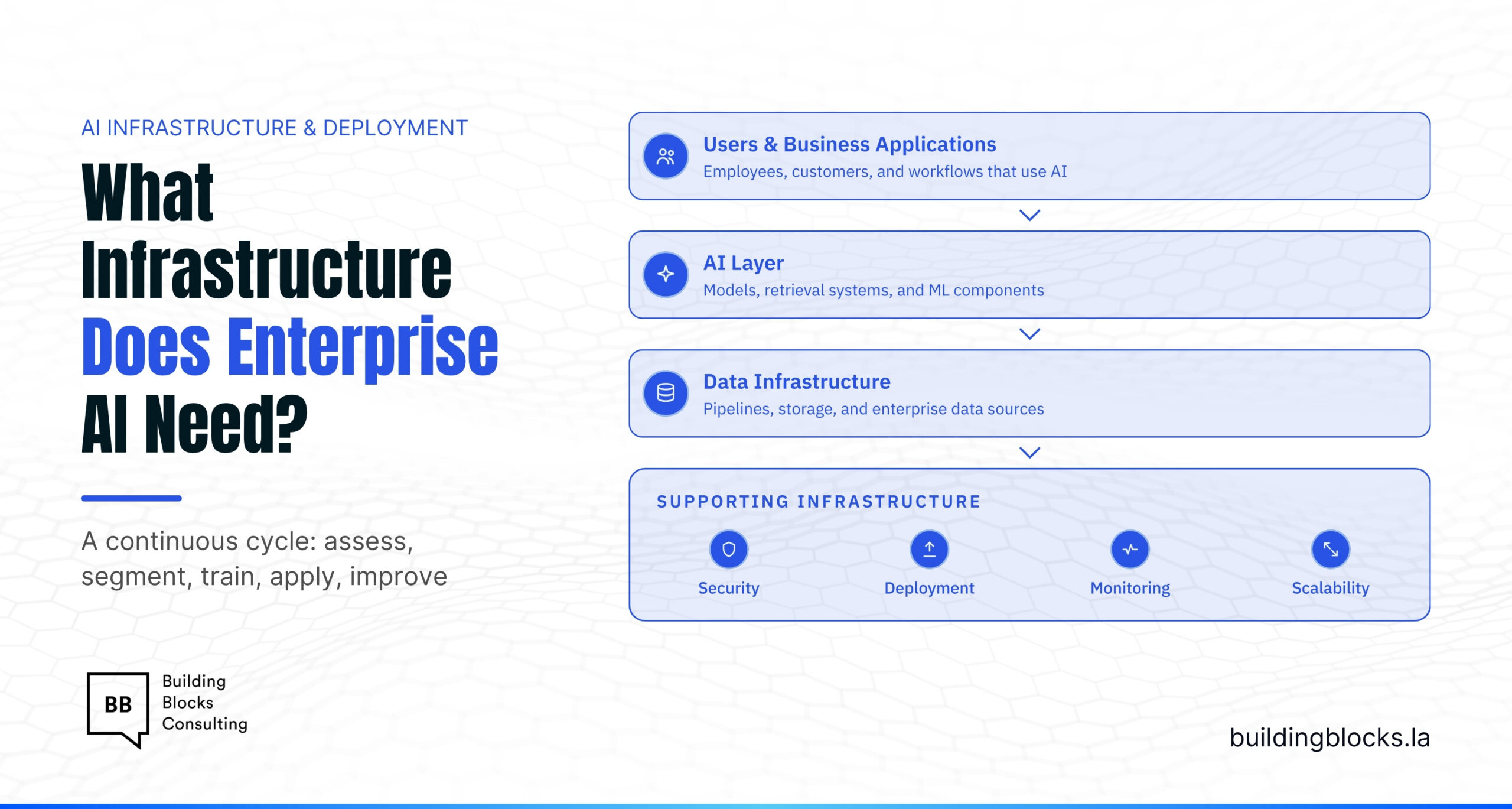
For many enterprise projects, the real technical foundation is the data infrastructure surrounding the model: the pipelines that move information, the integrations that connect systems, the transformations that make data usable, and the architecture that allows applications to access it reliably.
The amount of engineering required will vary from project to project.
The important step is to understand the AI use case first and then determine what data the system needs, where that data exists, how it should be processed, and how it will be maintained once the AI application is in production.
When that foundation is designed properly, the AI system has a much stronger technical basis for delivering useful results in the real business environment.



By Chris Clifford
Chris Clifford was born and raised in San Diego, CA and studied at Loyola Marymount University with a major in Entrepreneurship, International Business and Business Law. Chris founded his first venture-backed technology startup over a decade ago and has gone on to co-found, advise and angel invest in a number of venture-backed software businesses. Chris is the CSO of Building Blocks where he works with clients across various sectors to develop and refine digital and technology strategy.