

How can we help?
Let's Talk
How can we help?
Let's Talk
Los Angeles has become one of the fastest-growing artificial intelligence markets in the United States. Businesses across healthcare, fintech, logistics, media, and consumer technology are investing heavily in AI to automate operations, improve efficiency, and launch intelligent digital products.
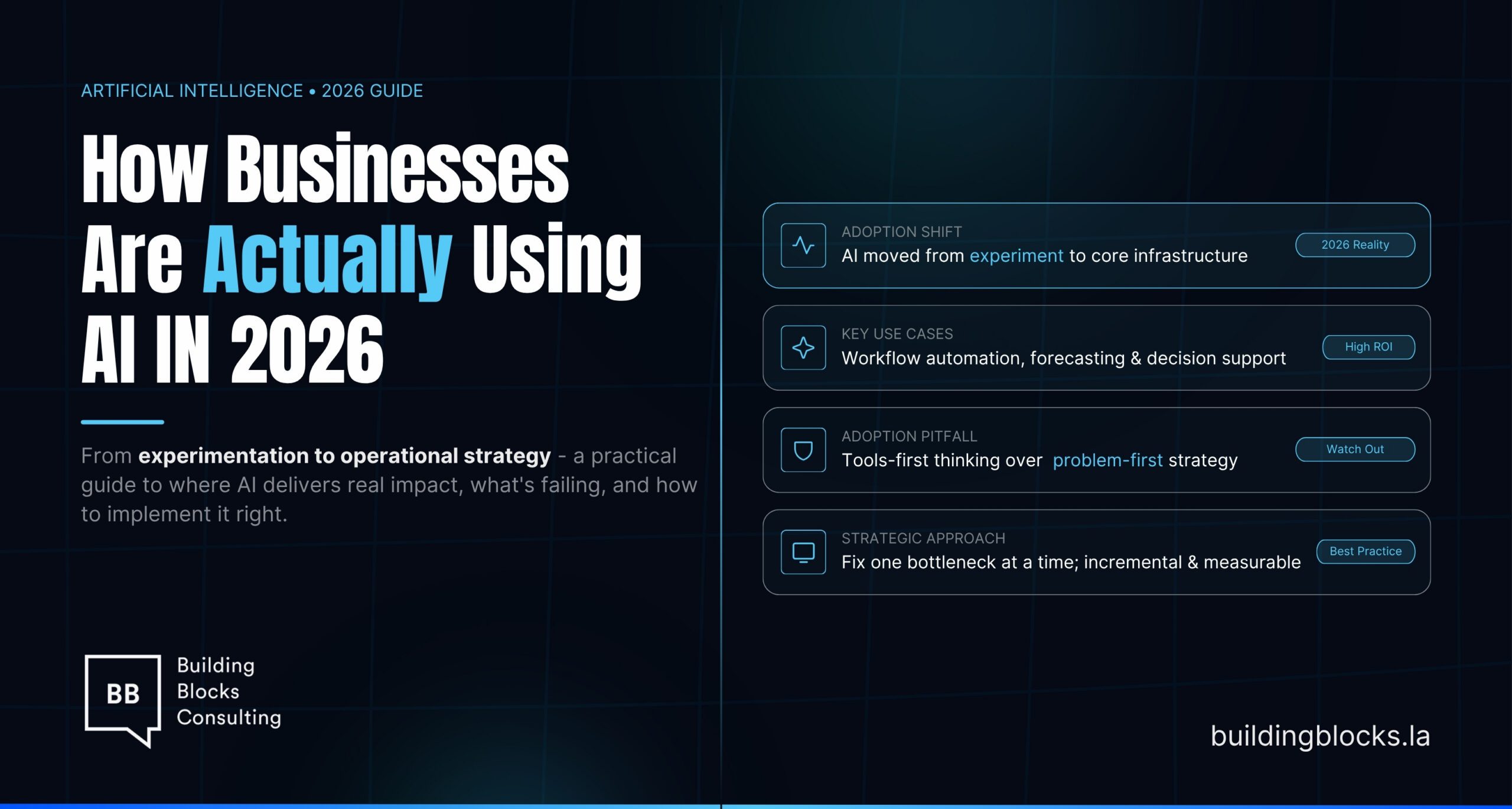
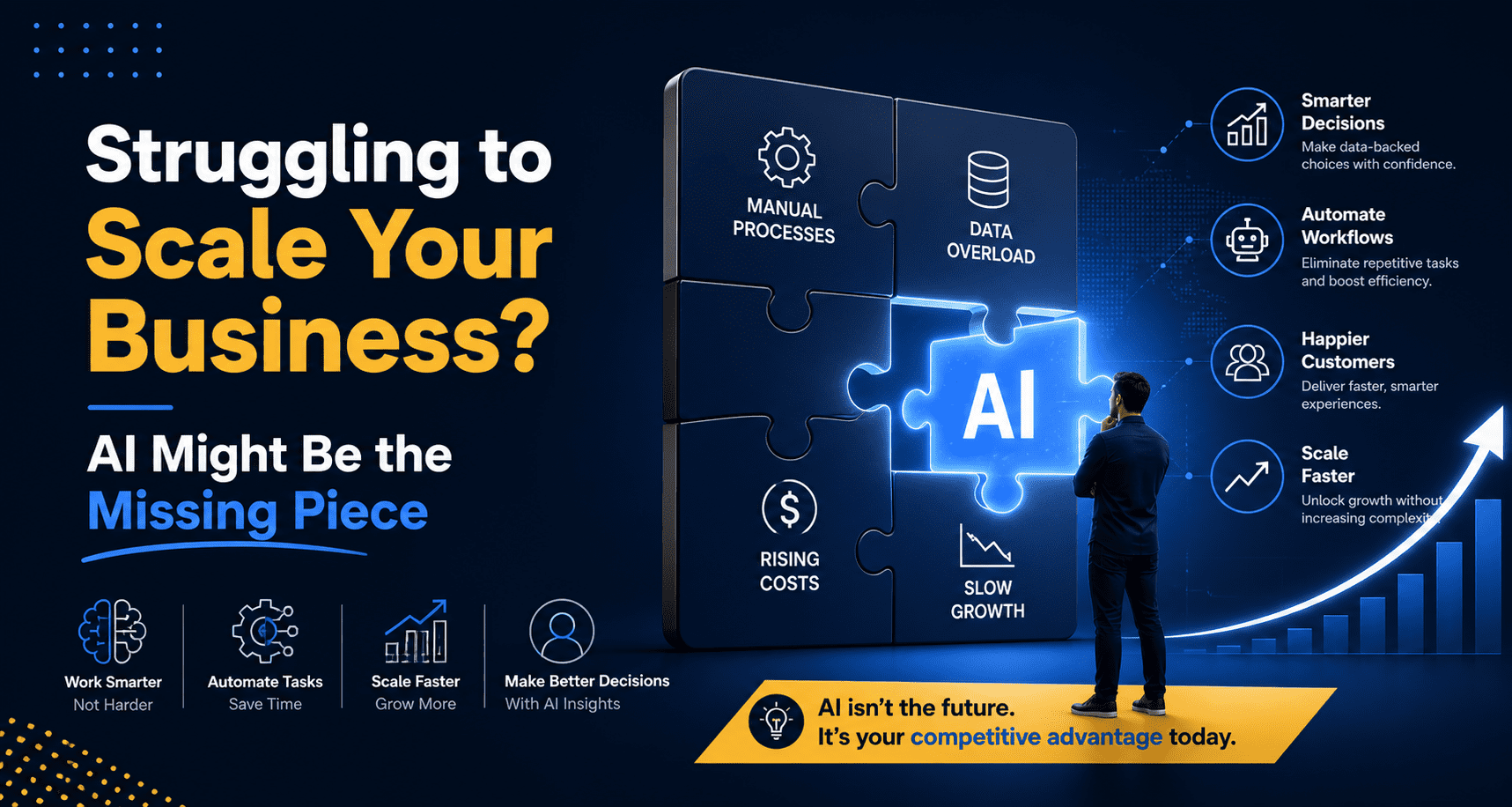
The demand for AI development services in Los Angeles continues growing because artificial intelligence is no longer viewed as experimental technology. It has become a core competitive advantage for companies that want to scale faster and operate more efficiently.
Businesses today are no longer asking whether AI matters. The real challenge is understanding how to build scalable AI systems, how much implementation costs, how to define the correct AI MVP scope, and how to choose the right technical partner.
This guide explains everything businesses need to know about AI implementation, including pricing expectations, hiring considerations, infrastructure planning, deployment timelines, and how to evaluate an experienced AI development partner.
What AI Development Services Actually Include
Modern AI development combines multiple engineering disciplines to create scalable, production-ready systems.
Understanding these capabilities helps businesses make better technical decisions before beginning development.
Machine Learning Development
Machine learning enables systems to learn from historical data and improve performance over time.
Businesses commonly use machine learning for:
- Predictive analytics
- Recommendation systems
- Fraud detection
- Customer behavior analysis
- Forecasting systems
- Intelligent automation
Professional machine learning teams typically handle:
- Data preparation
- Feature engineering
- Model training
- Performance optimization
- Production deployment
- Monitoring and maintenance
Machine learning forms the foundation of many enterprise AI systems.
AI Automation Solutions
Businesses are increasingly investing in AI automation solutions to streamline workflows, reduce repetitive tasks, and improve operational efficiency.
Common automation use cases include:
- AI-powered customer support
- Intelligent workflow systems
- Internal knowledge assistants
- Automated reporting
- Operational automation platforms
- Intelligent document processing
Modern automation infrastructure allows businesses to scale operations while reducing manual overhead.
Many organizations partner with an experienced AI automation agency to integrate automation into existing business systems efficiently.
Generative AI Integration
The rise of generative AI has changed how businesses approach software development and operational workflows.
Companies are implementing generative AI integration for:
- AI copilots
- Knowledge assistants
- AI-powered SaaS platforms
- Customer support systems
- Intelligent search systems
- Internal productivity tools
Production-ready generative AI requires infrastructure planning, security controls, prompt optimization, and ongoing monitoring.
Businesses frequently work with an experienced LLM application development service provider to build scalable AI applications integrated into real-world workflows.
AI Infrastructure and MLOps
Many companies focus entirely on AI models while overlooking infrastructure requirements.
MLOps includes:
- Cloud deployment
- Model monitoring
- Continuous retraining
- Infrastructure scaling
- Performance optimization
- Drift detection
Reliable AI systems require infrastructure that remains scalable, secure, and production-ready over time.
AI MVP Scope and Product Validation
One of the most important early-stage decisions in AI development is defining the correct AI MVP scope.
Many businesses attempt to build too much too early, which increases infrastructure complexity and delays deployment.
A properly scoped AI MVP focuses on:
- Solving one high-value business problem
- Validating user demand quickly
- Reducing infrastructure costs
- Accelerating time-to-market
- Creating measurable outcomes
Experienced AI teams help businesses define realistic MVP boundaries before full-scale development begins.
Ready to Build an AI Product?
Whether you need AI development services in Los Angeles, enterprise automation infrastructure, or scalable generative AI implementation, Building Blocks helps businesses launch production-ready AI systems built for real-world performance.
Our engineering team helps companies:
- Build AI-powered applications
- Develop machine learning systems
- Deploy automation infrastructure
- Integrate generative AI capabilities
- Scale AI platforms securely
Learn more about Building Blocks’ AI consulting services for enterprise AI strategy, implementation planning, and scalable infrastructure development.
Why Los Angeles Has Become a Serious AI Market
Los Angeles has evolved into one of the strongest AI ecosystems in the United States.
Several factors continue driving rapid AI growth across Southern California.
Strong Technical Talent Pipeline
Top institutions including USC, UCLA, and Caltech continue producing highly skilled engineers, researchers, and AI specialists.
This consistent talent pipeline supports long-term ecosystem growth.
Diverse Industry Demand
Los Angeles benefits from strong AI demand across multiple industries, including:
- Healthcare
- Logistics
- Fintech
- Entertainment
- Aerospace
- Consumer technology
Different industries create different AI requirements, strengthening the regional AI ecosystem.
Rapid Venture Capital Growth
Investment in AI startups across Southern California continues increasing rapidly.
Investors are actively funding:
- AI-first startups
- Automation platforms
- Enterprise AI companies
- AI-powered SaaS businesses
This investment environment continues attracting experienced technical talent.
Flexible Engineering Models
Modern hiring models allow Los Angeles businesses to combine local leadership with nationwide engineering talent.
This flexibility helps companies scale AI teams more efficiently.
What to Look for in an AI Development Company in Los Angeles
The market for AI vendors has become increasingly crowded.
Businesses should evaluate development partners carefully before making technical commitments.
Proven Production Experience
Many companies can build AI prototypes.
Far fewer can deploy scalable systems that operate reliably under real-world production conditions.
Businesses should ask potential partners for:
- Production deployment examples
- Infrastructure case studies
- Monitoring workflows
- Performance benchmarks
- Post-launch support processes
Production experience matters significantly more than prototype demonstrations.
End-to-End Development Capability
An experienced AI team should handle:
- Product strategy
- Backend engineering
- Data engineering
- API integration
- Infrastructure management
- Long-term maintenance
Businesses should avoid firms that focus only on AI models without handling deployment and scalability.
Transparent Communication
AI development involves technical uncertainty.
Reliable partners communicate openly about:
- Infrastructure requirements
- Data limitations
- Budget expectations
- Deployment timelines
- Technical risks
Transparency early in development prevents expensive operational issues later.
Industry-Specific Experience
Different industries require different technical approaches.
For example:
- Healthcare AI requires compliance-focused infrastructure
- Fintech systems require advanced security
- Logistics AI depends heavily on forecasting and optimization
Relevant industry experience improves project outcomes significantly.
LLM Evaluation and Optimisation
Many companies deploy large language models without properly measuring reliability or performance.
LLM evaluation helps businesses assess:
- Response consistency
- Hallucination rates
- Infrastructure efficiency
- Prompt reliability
- Cost optimization
- Model accuracy
Evaluation frameworks are critical for companies deploying enterprise-grade AI systems at scale.
How Much Do AI Development Services Cost in Los Angeles?
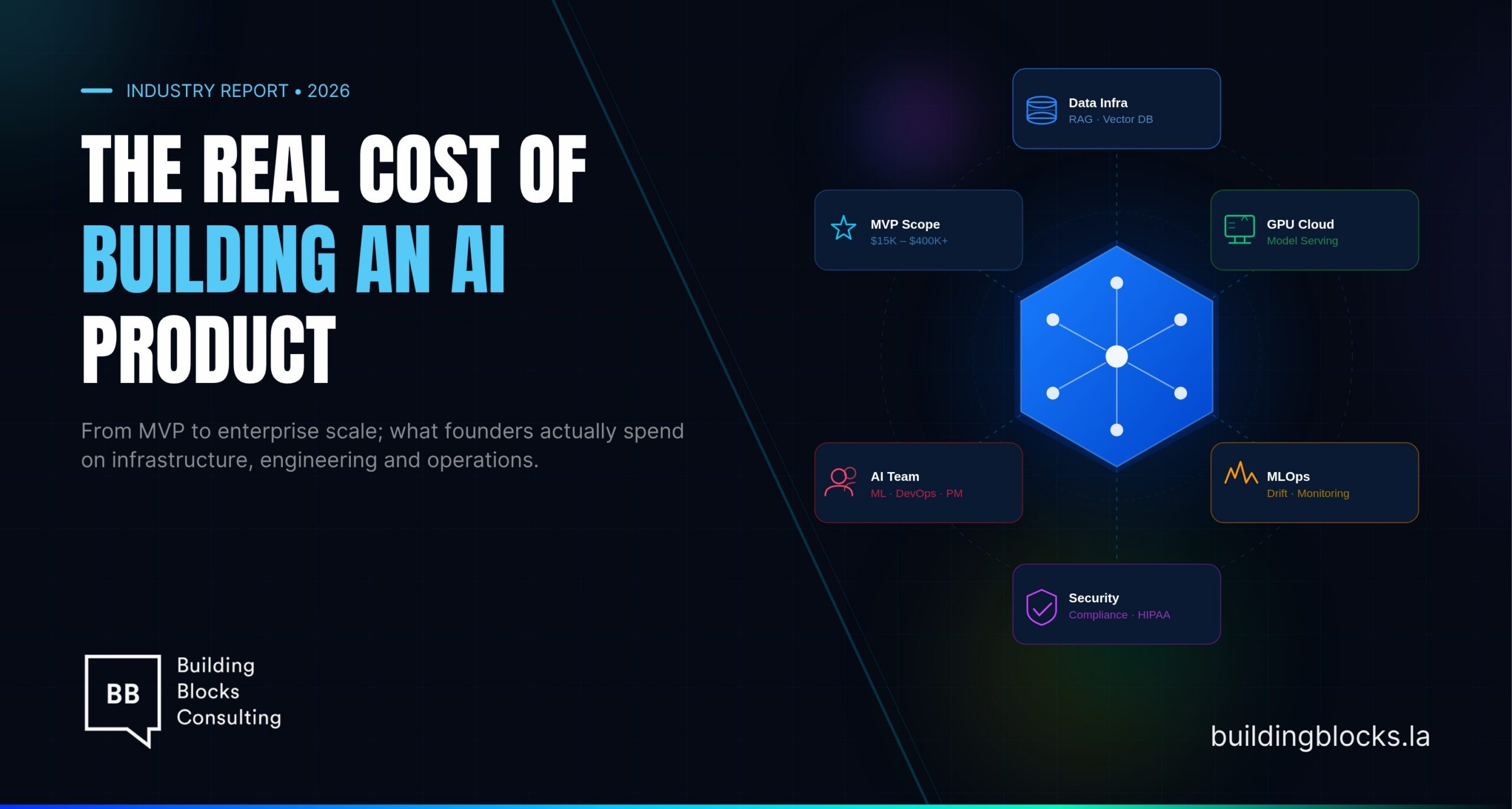
The cost of AI implementation depends on project complexity, infrastructure requirements, engineering scope, and deployment timelines.
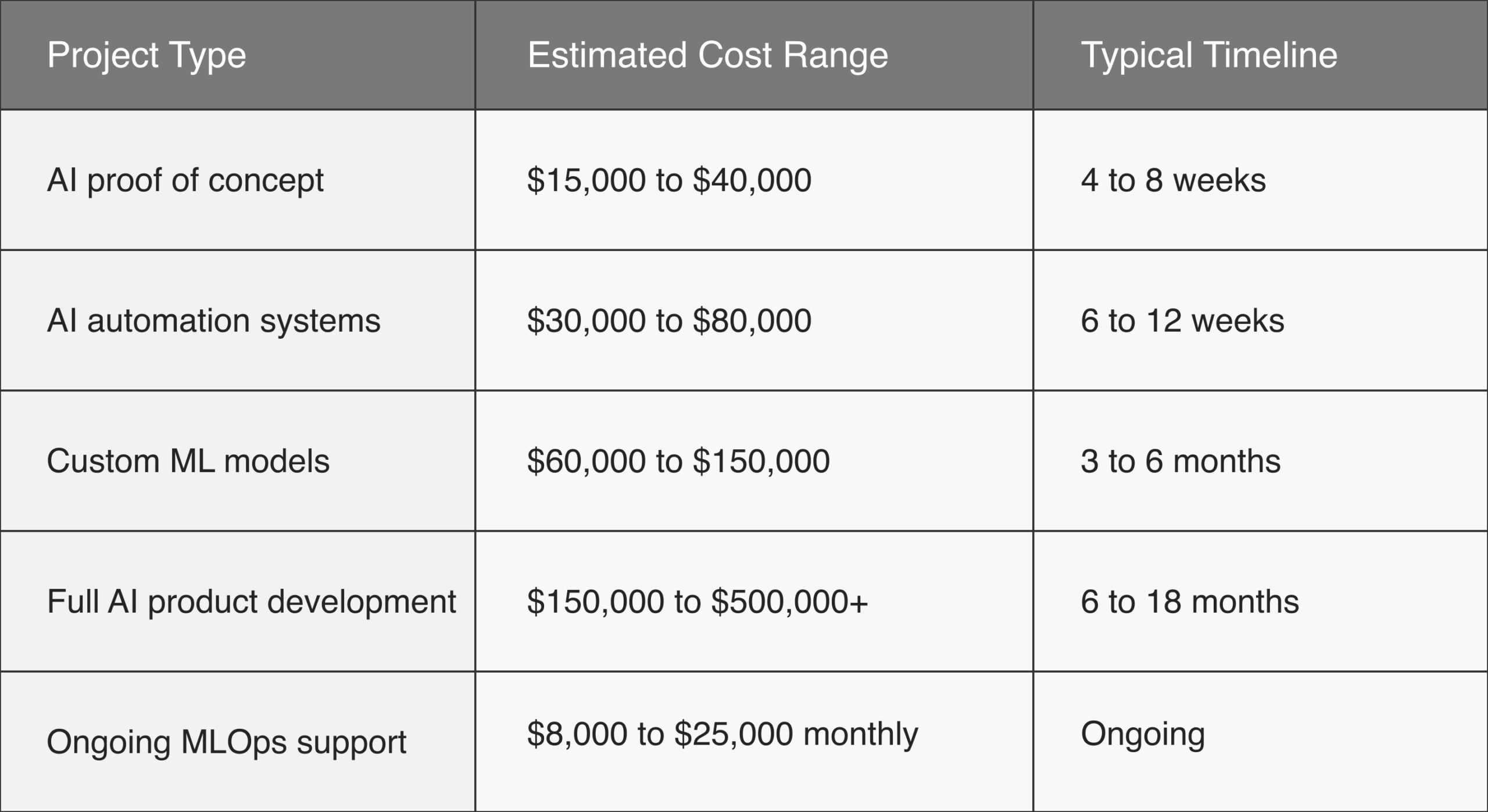
These estimates reflect current US market pricing for enterprise AI implementation.
Businesses evaluating AI investments often work with an experienced AI consulting firm to define infrastructure requirements, validate architecture decisions, and reduce implementation risk.
For deeper budgeting insights, review our detailed guide covering AI hiring and infrastructure costs.
The Building Blocks Approach to AI Development
Building Blocks provides end-to-end AI implementation for startups and enterprise organizations across healthcare, fintech, logistics, media, and consumer technology.
Our delivery process focuses on reducing technical risk while accelerating production readiness.
Discovery and Scoping
We evaluate:
- Business objectives
- Existing infrastructure
- Data quality
- Technical feasibility
- Integration requirements
before writing production code.
Architecture Design
Our engineers design systems with:
- Scalability
- Security
- Reliability
- Infrastructure efficiency
- Long-term maintainability
built into the architecture from the beginning.
Model Development and Iteration
We build, optimize, test, and refine models using real-world business data.
Every technical decision is documented clearly for operational transparency.
Integration and Deployment
We integrate AI systems into existing platforms or build surrounding infrastructure when required.
Monitoring and Continuous Improvement
After deployment, we continuously monitor:
- Model performance
- Infrastructure stability
- Operational reliability
- Drift detection
- Cost efficiency
to ensure long-term scalability.
Start Your AI Project with Building Blocks
Building Blocks delivers enterprise-grade AI development services in Los Angeles for startups and enterprise organizations looking to scale AI systems successfully.
We help businesses:
- Validate AI product ideas
- Launch machine learning systems
- Build automation infrastructure
- Integrate generative AI capabilities
- Deploy scalable AI platforms
To discuss your project requirements, explore our AI consulting services for AI strategy, implementation planning, and scalable infrastructure development.
Common Mistakes Businesses Make When Hiring for AI
Many companies invest in AI successfully. Others struggle because they overlook operational realities.
Choosing Based on Price Alone
Low-cost proposals often exclude:
- Infrastructure setup
- Data engineering
- Monitoring systems
- Maintenance
- Post-launch support
Projects that initially appear inexpensive often become significantly more expensive later.
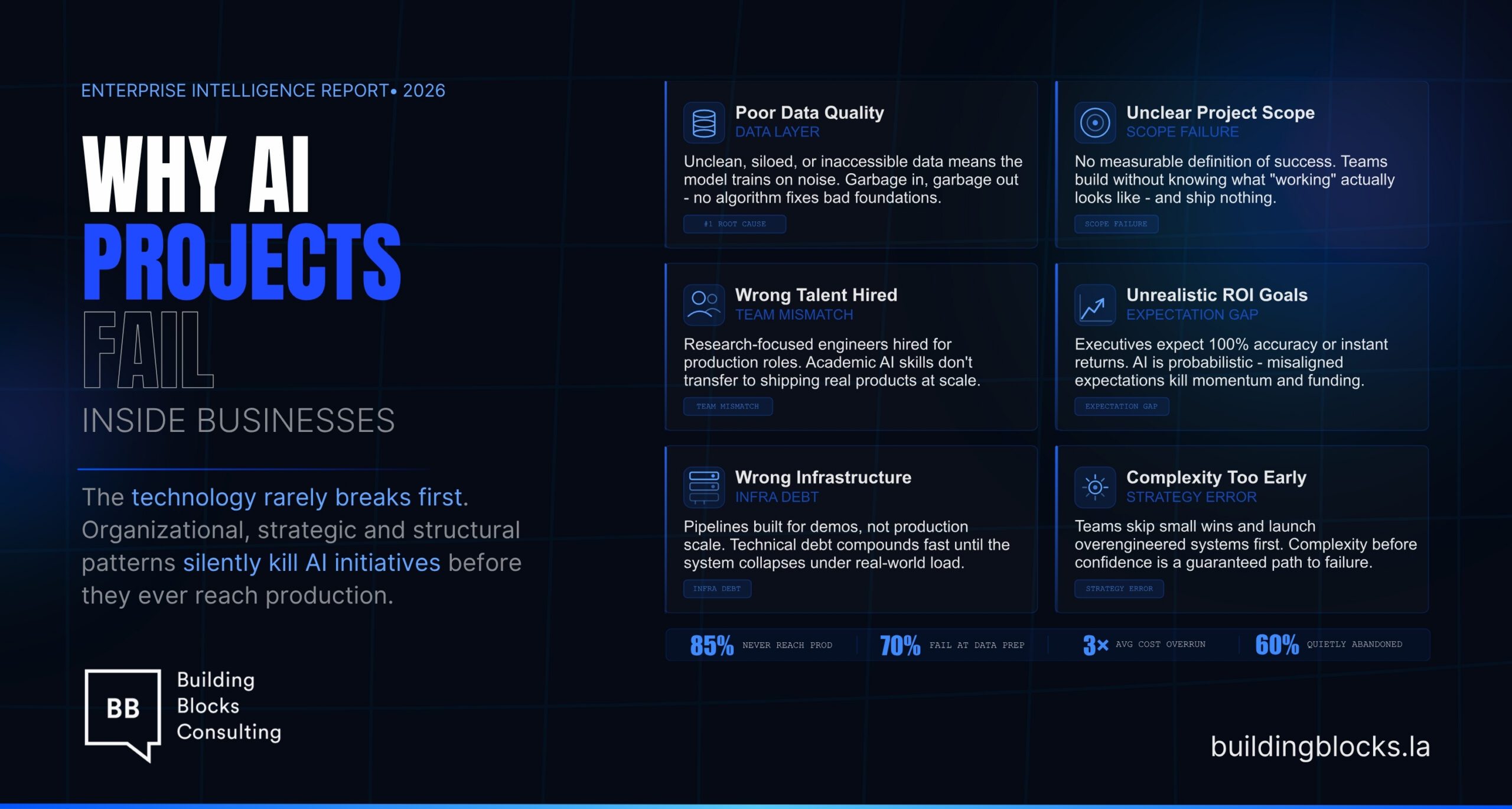
Underestimating the Data Problem
AI systems depend entirely on data quality.
Incomplete or inconsistent datasets reduce model performance regardless of engineering quality.
Strong AI teams identify data problems early.
Building Without Business Alignment
AI projects fail when engineering teams operate separately from business stakeholders.
Successful implementation requires collaboration between:
- Engineers
- Product leaders
- Operations teams
- Business stakeholders
Delaying Technical Hiring Decisions
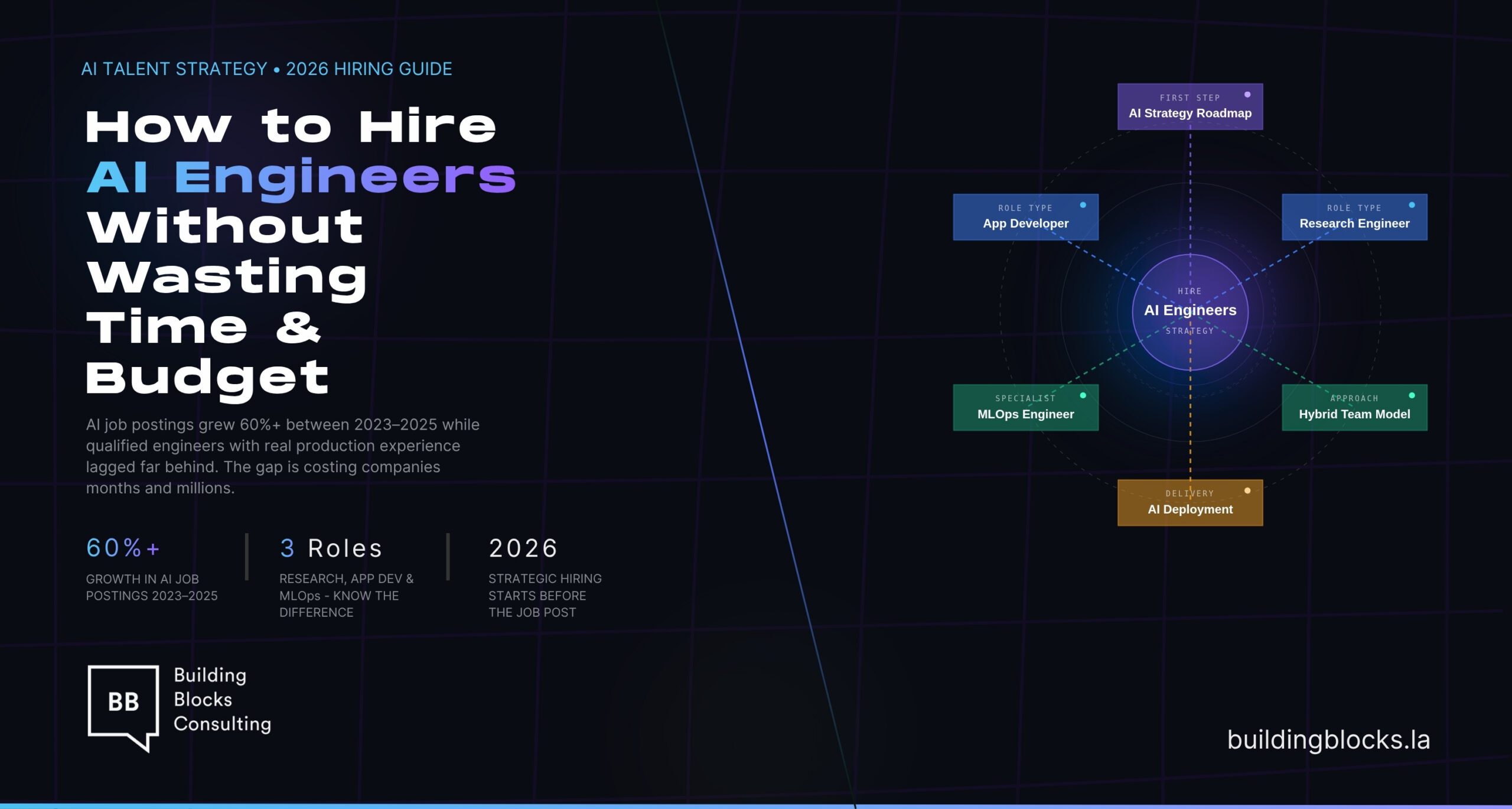
Some businesses wait too long before they hire experienced AI developers capable of scaling production systems effectively.
The AI hiring market remains highly competitive, especially for senior infrastructure and machine learning engineers.
AI Services for Startups vs Established Enterprises
Different organizations require different AI implementation strategies.
Startup AI Development
Startups prioritize:
- Speed
- MVP development
- Product validation
- Rapid iteration
- Investor readiness
An experienced AI team helps startups launch faster while minimizing technical debt.
Enterprise AI Development
Enterprise organizations focus more heavily on:
- Governance
- Security
- Compliance
- Infrastructure stability
- System integration
Enterprise deployment requires deeper operational planning and coordination.
Choosing Between an AI Agency and an In-House Team
Businesses frequently debate whether to outsource AI implementation or build internal engineering teams.
When an Agency Makes Sense
An agency is often the best option when:
- Rapid execution is required
- Internal expertise is limited
- Budget predictability matters
- AI ideas need validation
- Specialized talent is required temporarily
Many businesses work with an experienced AI consulting Los Angeles partner to accelerate implementation while reducing technical risk.
When an In-House Team Makes Sense
Internal AI teams become more valuable when:
- AI is central to the business
- Long-term experimentation is required
- Specialized internal systems exist
- Continuous development is expected
Many businesses begin with agency partnerships and gradually transition toward internal hiring.
Building Your AI Strategy in Los Angeles
The demand for AI development services in Los Angeles will continue growing as businesses invest more heavily in automation, machine learning, and generative AI technologies.
The most successful AI initiatives are built by teams that understand both technical execution and business outcomes. Whether you are launching a startup MVP, integrating generative AI into an enterprise platform, or building a custom AI product, choosing the right development partner remains one of the most important decisions your business will make.
Businesses that move strategically today will be significantly better positioned as AI adoption accelerates across every major industry.



By Chris Clifford
Chris Clifford was born and raised in San Diego, CA and studied at Loyola Marymount University with a major in Entrepreneurship, International Business and Business Law. Chris founded his first venture-backed technology startup over a decade ago and has gone on to co-found, advise and angel invest in a number of venture-backed software businesses. Chris is the CSO of Building Blocks where he works with clients across various sectors to develop and refine digital and technology strategy.