

How can we help?
Let's Talk
How can we help?
Let's Talk
For years, automation has been about one thing:
Rules.
- If X happens, do Y.
- If a condition is met, trigger an action.
- If a workflow is defined, execute it.
This model powered everything from simple scripts to enterprise automation tools.
And for a long time, it worked. Until it didn’t.
At BuildingBlocks, we’ve seen this shift firsthand, as businesses move from rule-based systems to more adaptive, intelligent workflows.
Why Traditional Automation Is Being Replaced
It’s not that traditional automation is disappearing. It’s that its scope is limited.
As businesses deal with more complexity, more data, and more variability, rule-based systems become harder to maintain.
Every new edge case requires:
- New rules
- New conditions
- New exceptions
Over time, systems become fragile and difficult to scale. Agentic workflows reduce this overhead by shifting complexity from rules to reasoning.
The Limitation of Traditional Automation
Traditional automation is predictable.
That’s also its biggest weakness.
It depends on:
- Predefined rules
- Structured inputs
- Stable environments
The moment something changes – an edge case, an exception, an unstructured input – the system breaks.
Or worse, it silently fails.
This is why most automation systems struggle with:
- Ambiguous data
- Complex decision-making
- Dynamic workflows
- Human-like reasoning tasks
In other words:
They work well for processes. But not for problems.
Enter Agentic Workflows
Agentic workflows represent a fundamental shift.
Instead of telling systems exactly what to do, you define what needs to be achieved.
And the system figures out how to get there. At the center of this shift are AI agents, systems that can:
- Interpret goals
- Make decisions
- Take actions
- Adapt based on feedback
This is not automation as execution. It’s automation as decision-making.
From Rules to Reasoning
The difference between traditional automation and agentic workflows is simple:
Traditional automation follows instructions. Agentic workflows pursue outcomes.
Instead of:
“If a support ticket contains X keyword, assign it to team A”
You get:
“Understand the intent of the request, evaluate priority, and route it to the right team even if the input is unclear”
This shift moves automation from rigid flows to adaptive systems.
What Makes Agentic Workflows Different
Agentic systems operate on a different model entirely.
They handle unstructured inputs
Emails, documents, conversations, logs inputs that don’t fit neatly into predefined formats.
They make contextual decisions
Instead of binary logic, they evaluate multiple factors before acting.
They adapt over time
They improve with feedback, rather than requiring constant rule updates.
They orchestrate multiple steps
Rather than triggering a single action, they manage sequences of actions dynamically.
Where Agentic Workflows Are Already Winning
We’re already seeing this shift across industries.
Customer support
Instead of routing tickets based on keywords, agentic systems understand intent, sentiment, and urgency and respond accordingly.
Operations
From invoice processing to logistics coordination, workflows can adapt to changing inputs without constant reconfiguration.
Sales and marketing
Lead qualification, outreach personalization, and campaign optimization can be handled dynamically rather than through static funnels.
Internal tools
Knowledge retrieval, task management, and reporting become more conversational and context-aware.
The Hidden Challenge
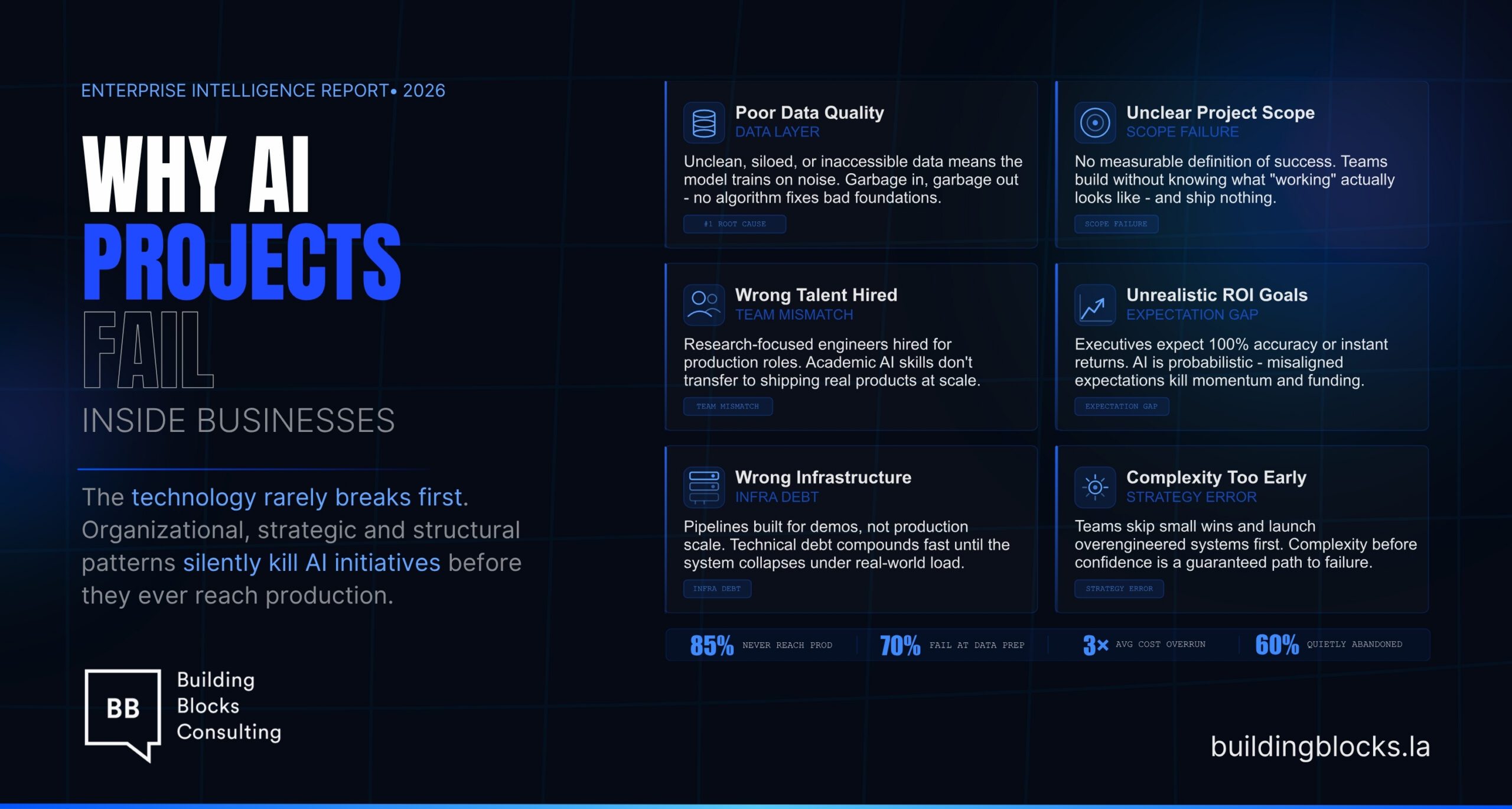
Agentic workflows are powerful but they are not plug-and-play.
They require:
- Well-defined goals
- Clean and accessible data
- Thoughtful system design
- Clear boundaries for decision-making
Without these, agentic systems can become unpredictable or unreliable.
This is where many implementations fail. Not because the technology is immature, but because the system around it isn’t ready.
A Shift in How We Build Systems
At BuildingBlocks, we approach agentic workflows not as a feature upgrade, but as a system redesign.
You’re no longer designing flows. You’re designing systems that can make decisions.
That means:
- Defining outcomes instead of steps
- Designing feedback loops
- Balancing autonomy with control
It’s less about coding logic, and more about structuring intelligence.
The Bottom Line
Traditional automation was built for stability. Agentic workflows are built for complexity.
As businesses move toward more dynamic, data-rich environments, the ability to adapt becomes more valuable than the ability to follow rules.
Agentic workflows don’t just automate tasks. They handle decisions. And that’s why they’re not just an upgrade. They’re a replacement.



By Chris Clifford
Chris Clifford was born and raised in San Diego, CA and studied at Loyola Marymount University with a major in Entrepreneurship, International Business and Business Law. Chris founded his first venture-backed technology startup over a decade ago and has gone on to co-found, advise and angel invest in a number of venture-backed software businesses. Chris is the CSO of Building Blocks where he works with clients across various sectors to develop and refine digital and technology strategy.